Those Warriors didn’t simply win the NBA Finals, they did so in a sweep – and with only one All-Star on the roster.
Motivating and inspiring that team to a championship in 1975 was Alvin Attles’ finest professional hour – until Friday.
That’s when Attles received a phone call that, frankly, was overdue. The Naismith Memorial Basketball Hall of Fame informed him that he had been elected, as part of the Class of 2019, to join the ranks of the game’s legends.
Upon getting the news that he had been chosen, Attles responded with typical good-natured humility.
“The first thing he said about his selection,” according to his son, Alvin Attles III, “is that everybody makes a mistake.”
That surely was the reaction around much of the sports world when the Warriors shocked the Washington Bullets back in ’75.
@youngvino1616
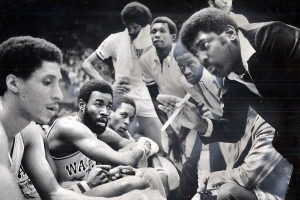
Though the Warriors, with Rick Barry as their only All-Star, finished 48-34 that season, they embraced the underdog role and won four games by a combined margin of 16 points.
That the Warriors won every game by single digits is a reflection of their mental toughness and basketball intellect, two attributes also associated with Attles during his 11-season playing career, providing team owner Franklin Mieuli with sound reasons make Attles a player-coach over his final two seasons before becoming a full-time head coach in 1971.
Attles won a title with a roster with players – rookie Keith (later Jamaal) Wilkes was the No. 2 scorer at 14.2 points per game – that embodied his characteristics surrounding Barry, who averaged more than 15 points per game.
Attles, 82, usually is a fixture at Warriors games, sitting in his personal seat atop the lower bowl at Oracle Arena. In his 59th year with the Warriors in several capacities, he attended a few games earlier this season but has not been on site in recent months while coping with an undisclosed medical condition.
MORE ON AL ATTLES
Alvin Austin Attles Jr. (born November 7, 1936) is an American retired professional basketball player and coach best known for his longtime association with the Golden State Warriors.
He is a graduate of Weequahic High School in Newark, New Jersey and North Carolina A&T State University. He has a bachelor’s degree in Physical Education and History along with a master’s degree in Curriculum and Instruction. He intended to return to Newark and coach at his local junior high school when he was drafted by the Warriors. He initially declined before accepting and going to training camp.
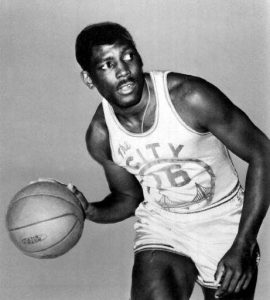
Coaching career
Attles later became one of the first African-American coaches in the NBA when he was named player-coach of the Warriors midway through the 1969–70 season, succeeding George Lee. Attles guided the Warriors to the 1975 NBA championship over the heavily favored Washington Bullets, making him the second African American coach to win an NBA title (the first was Bill Russell). Attles’ team tried to repeat the following season, but they lost to the Phoenix Suns in the Conference Finals in seven games. The team would make the playoffs only once more for the remainder of his tenure as coach. Attles was replaced by Johnny Bach for the last 21 games of the 1979–80 NBA season (a season in which the Warriors finished tied for dead last), though he returned for the next season (Bach would become Attles’ permanent successor after 1983). Attles coached the Warriors until 1983, compiling a 557-518 regular season record (588-548 including playoffs) with six playoff appearances in 14 seasons. During the 1983–84 season, Attles worked as the Warriors’ general manager. He is the longest-serving coach in Warriors history.
Honors
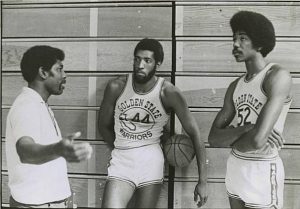
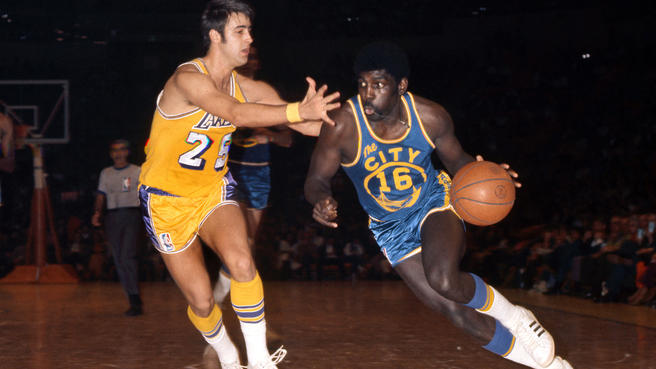
Attles’s number 16 is retired by the Warriors and he attends every Warriors home game. He also serves as a team ambassador. On February 7, 2015, Attles’ #22 was retired by North Carolina A&T, the first ever retired by the team. He was inducted into the Bay Area Sports Hall of Fame in 1993.
Attles has been on the Warriors’ payroll in one capacity or another for 58 years, the longest uninterrupted streak of any person for one team. Attles and his wife Wilhelmina reside in Oakland and have two adult children.
Head coaching record
| Legend | |||||||||
|---|---|---|---|---|---|---|---|---|---|
| Regular season | G | Games coached | W | Games won | L | Games lost | W–L % | Win–loss % | |
| Playoffs | PG | Playoff games | PW | Playoff wins | PL | Playoff losses | PW–L % | Playoff win–loss % | |
| Team | Year | G | W | L | W–L% | Finish | PG | PW | PL | PW–L% | Result |
|---|---|---|---|---|---|---|---|---|---|---|---|
| San Francisco | 1969–70 | 30 | 8 | 22 | .267 | 6th in Western | — | — | — | — | — |
| San Francisco | 1970–71 | 82 | 41 | 41 | .500 | 2nd in Pacific | 5 | 1 | 4 | .200 | Lost in Conf. Semifinals |
| Golden State | 1971–72 | 82 | 51 | 31 | .622 | 2nd in Pacific | 5 | 1 | 4 | .200 | Lost in Conf. Semifinals |
| Golden State | 1972–73 | 82 | 47 | 35 | .573 | 2nd in Pacific | 11 | 5 | 6 | .455 | Lost in Conf. Finals |
| Golden State | 1973–74 | 82 | 44 | 38 | .537 | 2nd in Pacific | — | — | — | — | — |
| Golden State | 1974–75 | 82 | 48 | 34 | .585 | 1st in Pacific | 17 | 12 | 5 | .706 | Won NBA Championship |
| Golden State | 1975–76 | 82 | 59 | 23 | .720 | 1st in Pacific | 13 | 7 | 6 | .538 | Lost in Conf. Finals |
| Golden State | 1976–77 | 82 | 46 | 36 | .561 | 3rd in Pacific | 10 | 5 | 5 | .500 | Lost in Conf. Semifinals |
| Golden State | 1977–78 | 82 | 43 | 39 | .524 | 5th in Pacific | — | — | — | — | — |
| Golden State | 1978–79 | 82 | 38 | 44 | .463 | 6th in Pacific | — | — | — | — | — |
| Golden State | 1979–80 | 61 | 18 | 43 | .295 | 6th in Pacific | — | — | — | — | — |
| Golden State | 1980–81 | 82 | 39 | 43 | .476 | 4th in Pacific | — | — | — | — | — |
| Golden State | 1981–82 | 82 | 45 | 37 | .549 | 4th in Pacific | — | — | — | — | — |
| Golden State | 1982–83 | 82 | 30 | 52 | .366 | 5th in Pacific | — | — | — | — | — |
| Career | 1,075 | 557 | 518 | .518 | 61 | 31 | 30 | .508 |