

The front and back covers of Golf Digest’s ‘Tiger: 25 years a pro’ special collector’s issue.
The Tiger Quiz: Here’s what happens when you put Woods’ photographic golf memory to the test
This month, Golf Digest is commemorating the 25th anniversary of Tiger Woods turning pro with a special 116-page collector’s issue celebrating his career. This story is one of several that appear in the magazine.
The front and back covers of Golf Digest’s ‘Tiger: 25 years a pro’ special collector’s issue.

Tiger Woods celebrates his 2002 U.S. Open win on the 18th green at Bethpage Black.


Tiger Woods, with caddie Steve Williams, walks off the 18th hole at Firestone the winner over Padraig Harrington at the 2009 WGC-Bridgestone Invitational.
Tiger Woods’ TGR Foundation Hits Notable Milestone As It Celebrates Its 25th Anniversary

PACIFIC PALISADES, Calif. — As far as golf goes, Riviera Country Club has not been friendly to Tiger Woods. At least, not as friendly as other golf courses—he does have a runner-up and seven other top-20 finishes at this kikuyu-covered gem, but he’s played 13 tournaments here and left without the trophy 13 times. It’s the most starts he’s made in a single PGA Tour event without a victory.
Woods’ relationship with Riv, however, extends much deeper than a scorecard. It’s where he made his first tour start, as a rail-thin 16-year-old in 1992. It’s a traffic-dependent hour away from where Tiger honed his game, at the Navy Golf Course in Cypress. And since 2017 it has hosted his event, the Genesis Invitational, which has coincided with major growth for his TGR Foundation.
Founded in 1996, the year Woods turned pro, the foundation’s initial mission was to give disadvantaged youth better access to the game of golf. Woods famously transformed the direction of his foundation shortly after Sept. 11, 2001, when during a 17-hour drive from Missouri to Florida (flights were grounded) he had an epiphany and instructed his father to change the focus to providing educational access to underprivileged kids.
Fast forward 20 years, and Woods’ foundation has now reached more than 2 million children through its in-person and digital programs.
“To have so many first-gens go off to college—then they come back and they’re the leaders of their community,” Woods, who is not playing this week at Riviera as he continues to recover from a back procedure, said before last year’s Genesis. “No one expected anyone in their community to go to college. And these kids go to Harvard and Princeton, Yale, Brown. You start meeting these kids who never ever thought they would go to college. It’s pretty unbelievable.”
This is the second year that the Genesis has had elevated status on tour, a change more significant than simply having “Invitational” replace “Open” in the tournament title. The field has been reduced from 144 to 120; the winner receives a three-year exemption, rather than the two for a “normal” PGA Tour event; and the purse increased to $9.3 million, highlighted by a $1.674 winner’s check. Symbolically, Woods’ tournament now stands level with Jack Nicklaus’ Memorial and the Arnold Palmer Invitational.
That, combined with perhaps the finest course on tour in Riviera, has attracted remarkably strong fields each of the past two years. Eight of the world’s top 10 players are teeing it up this week, and all the extra attention a field like this one demands only serves to bring more eyeballs to the TGR foundation and its mission.
“TGR foundation has experienced tremendous growth since Tiger became host of the Genesis in 2017,” TGR foundation President & CEO Gordon McNeill said. “As the benefiting charity, our programs have expanded to reach more students in the L.A. community and around the world.
“As we celebrate our 25th anniversary, we are excited to build on the 2 million students reached through our programs, in person and digitally.”
The foundation is particularly excited about Pathways Forward, the initiative it launched in January to enhance its current education programs and expand resources to reach more students on their pathway to college and career success.
Woods has always taken as much pride in his philanthropic endeavors as his athletic ones, and perhaps this week is a preview of what’s to come. Woods knows his days as a world-class golfer will not last forever, and there will be plenty of Genesis Invitationals that he does not play in. This is one of them, but his presence at Riviera is felt through the TGR Foundation, which will continue to impact children long after Woods’ playing days are finished.

BIOGRAPHY
Tiger (Eldrick) Woods, born December 30, 1975, is a professional golfer and entrepreneur.
Since turning professional in 1996, Tiger has built an unprecedented competitive career. His achievements on the course–106 worldwide wins and 15 majors–have mirrored his success off the course as well.
Woods serves as Founder and CEO of TGR, a multibrand enterprise comprised of his various companies and philanthropic endeavors, including TGR Design, the golf course design company; The TGR Foundation, a charitable foundation; TGR Live, an events production company; and The Woods Jupiter, an upscale sports restaurant.
He has 82 PGA TOUR wins, tied with Sam Snead, holding the record for most wins in history. His majors victories include the five Masters Tournaments, four PGA Championships, three U.S. Open Championships, and three British Open Championships. With his second Masters victory in 2001, Tiger became the first golfer ever to hold all four professional major championships at the same time.
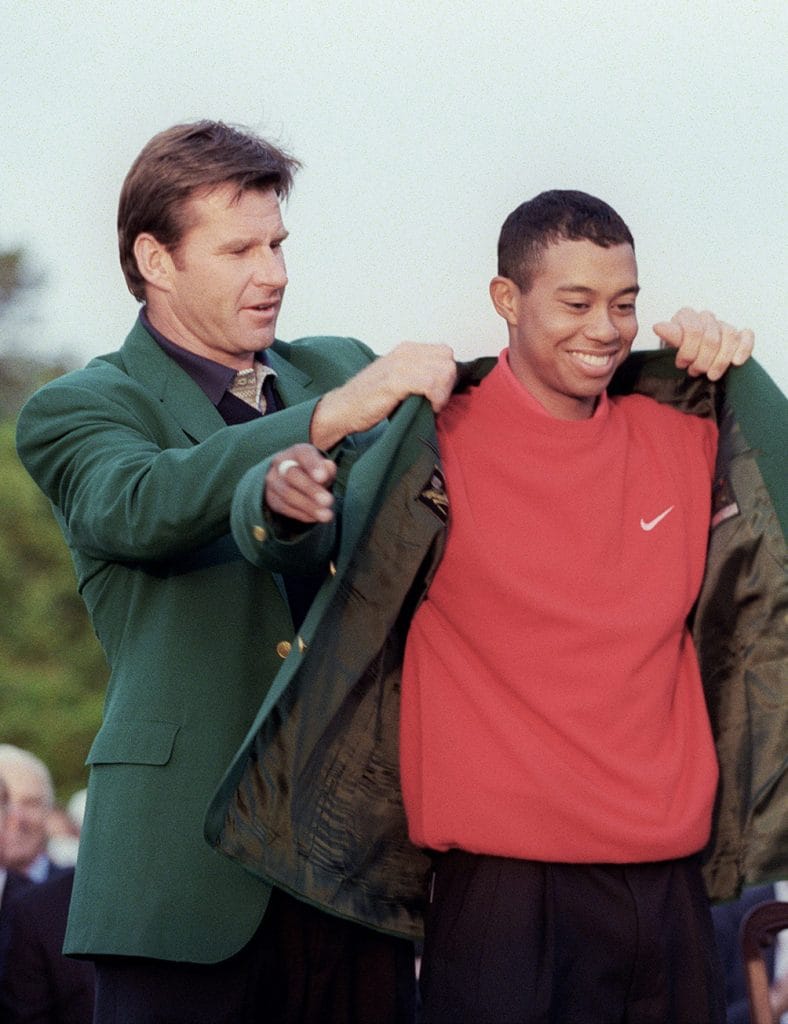
In winning the 2000 British Open at St. Andrews, Woods became the youngest to complete the career Grand Slam of professional major championships and only the fifth ever to do so, following Ben Hogan, Gene Sarazen, Gary Player, and Jack Nicklaus. Tiger was also the youngest Masters champion ever, at the age of 21 years, three months and 14 days, and was the first major championship winner of African or Asian heritage. The 2000 U.S. Open and 2001 Masters victories came by record margins, 15 strokes and 12 strokes, respectively.
He is the career victories leader among active players on the PGA TOUR, and is the career money list leader.
Despite being unable to play the majority of 2016, Woods, the entrepreneur and philanthropist, made significant news. In February, the TGR Learning Lab in Anaheim celebrated its 10th anniversary, with satellite facilities now located in Washington, DC, Philadelphia and Stuart, Florida. Eight months later in October, the Tiger Woods Foundation commemorated its 20th anniversary with a gala event at the New York Public Library featuring Woods and Nike’s Phil Knight.
The Woods Jupiter celebrated its first anniversary—the restaurant opened in August, 2015—and TGR Design’s Bluejack National course located outside Houston, Texas was selected Best New Private Course by both Golf Digest and Golf Magazine/Sports Illustrated.
He is the career victories leader among active players on the PGA TOUR, and is the career money list leader.
Tiger is the son of Earl Woods, a retired lieutenant colonel in the U.S. Army, and his wife, Kultida, a native of Thailand. He was nicknamed Tiger after a Vietnamese soldier and friend of his father, Vuong Dang Phong, to whom his father had also given that nickname.
He grew up in Cypress, California. He took an interest in golf at age 6 months, watching as his father hit golf balls into a net and imitating his swing. He appeared on The Mike Douglas Show at age 2, putting with Bob Hope. He shot 48 for nine holes at age 3 and was featured in Golf Digest at age 5.
Tiger played in his first professional tournament in 1992, at age 16, the Los Angeles Open, and made the 36-hole cut and tied for 34th place in the 1994 Johnnie Walker Asian Classic in Thailand, He entered Stanford University in 1994 and in two years he won 10 collegiate events, concluding with the NCAA title.
Woods compiled one of the most impressive amateur records in golf history, winning six USGA national championships before turning professional on August 27, 1996. He concluded his amateur career by winning an unprecedented third consecutive U.S. Amateur title, finishing with a record 18 consecutive match-play victories.

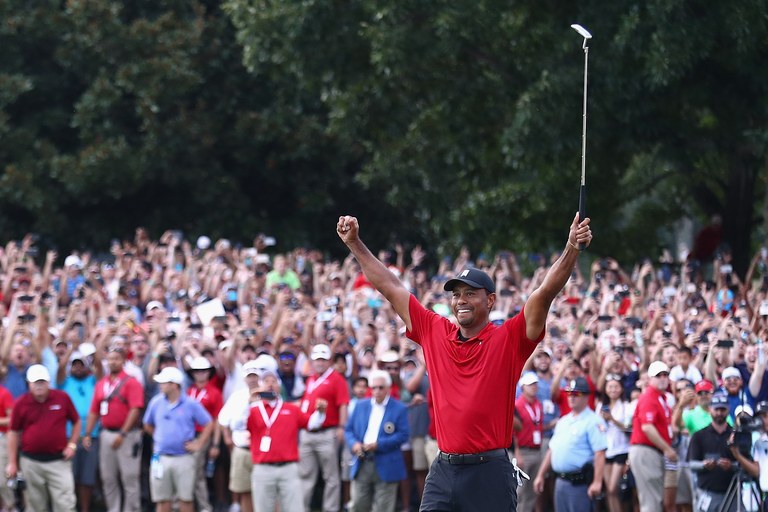
ATLANTA, GA – SEPTEMBER 23: Tiger Woods of the United States poses with the trophy after winning the TOUR Championship at East Lake Golf Club
The week after winning his third U.S. Amateur title, Woods played his first tournament as a professional in the Greater Milwaukee Open. It was one of only seven events left in 1996 for him to finish among the top 125 money winners and earn a player’s card for the PGA TOUR. He won twice and placed among the top 30 money winners.
Woods won four PGA TOUR events in 1997, plus one overseas, and was the leading money winner. He achieved No. 1 on the Official World Golf Ranking for the most rapid progression ever to that position. On June 15, 1997, in his 42nd week as a professional, Woods became the youngest-ever No. 1 golfer at age 21 years, 24 weeks.
Woods won eight times on the PGA TOUR in 1999 (11 worldwide), including the PGA Championship. He won four consecutive PGA TOUR events to end the year and started 2000 with two more victories for a total of six in succession.
In 2000, Woods won 11 events, including three professional majors in the same year, and also became the first player since 1936-37 to win the PGA Championship in consecutive years. Woods won five times, including the Masters, in 2001 and eight times worldwide. He won five times again on TOUR in 2002, and seven times worldwide, and was the TOUR’s leading money winner for the fourth consecutive year.

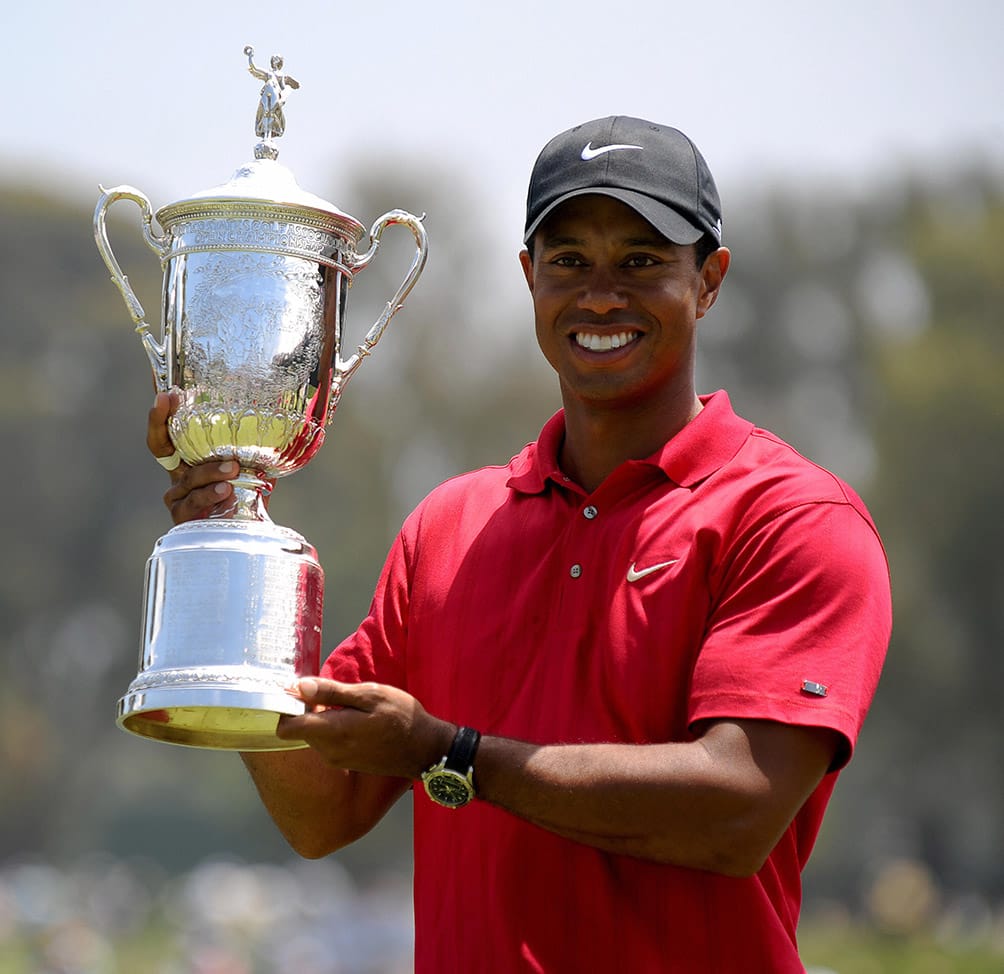
Woods won five times, including the Masters, in 2001 and eight times worldwide.
He won a total of 20 times from 2003-06, lead the TOUR’s money list twice and captured four majors. Woods joined Nicklaus as the only player to win the Grand Slam twice. His emotional win the following year at the British Open at Royal Liverpool came two months after his father’s death. He won the 2006 PGA Championship by five strokes at Medinah CC, the same venue where he won the event in 1999.
He began 2007 with his seventh consecutive PGA TOUR victory and ended the year with a total of seven official wins, including a second-consecutive PGA Championship. In 2008, he won four of six PGA TOUR events, including his 14th major at the U.S. Open—his last event of the year before season-ending knee surgery—plus the Dubai Desert Classic, and finished second on the TOUR money list in just six starts. At his major win at Torrey Pines, Woods sank a 12-foot birdie putt on the 72nd hole to force an eventual 19-hole playoff (tied at even-par 71 after 18 holes) the following day. He later revealed that he had played the tournament with a torn anterior cruciate ligament in his left knee and a double stress fracture in the same leg.
In 2009, he returned to the winner’s circle after 286 days and ended the year leading the PGA TOUR in victories (6) and money ($10,508,163). He also won his first tournament in Australia. He captured three tournaments in 2012 and five in 2013.
Sports Illustrated selected Woods as the 1996 and 2000 Sportsman of the Year, the first to win the award more than once. L’Equipe (France) selected him as the 2000 World Champion of Champions. The Associated Press chose Woods as the Male Athlete of the Year for 1997, 1999 and 2000. He and Michael Jordan are the only athletes to win the award three times. He was chosen ESPY Male Athlete of the Year in 1997 (tied with Ken Griffey, Jr.), 1999, 2000 and 2001. The founding members of the World Sports Academy, in voting for the Laureus Sports Awards, also selected him as the 1999 and 2000 World Sportsman of the Year. In 2008 Businessweek made Woods No. 1 in The Power 100 for the most influential people in sports. In 2009 he was selected AP Athlete of the Decade. Woods received 56 of 142 votes cast by AP editors throughout the country. He was also inducted into the Stanford Athletics Hall of Fame.
Woods was selected as the 1997, 1999, 2000-2003, 2005-2007, 2009, 2013 Player of the Year by the PGA TOUR (Jack Nicklaus Award) and the PGA of America and by the Golf Writers Association of America in 1997, 1999, 2000-2003, 2005-2007, 2009. His adjusted scoring average averages in 2000 and 2007 of 67.79 strokes were the lowest ever and earned him the Byron Nelson Award on the PGA TOUR and the Vardon Trophy from the PGA of America. He also had an actual scoring average in 2000 of 68.17, breaking Nelson’s record of 68.33 in 1945.