A Persistent Teacher through “Words and Actions”

When I was growing up, he never told me that I couldn’t go to the course with him. He paid for me to receive regular golf lessons and gave me a pocket full of money for grilled-cheese sandwiches and Tahitian Treat drinks in the golf grill. Although he didn’t allow me to play him on the course most of the time, he constantly encouraged me—and he let me compete with him on and around the green. To this day, he is easily the best putter I have ever seen. There is no mistake why I constantly tell my players that I am now the best putter in the world. I learned from the best.
My dad was, indeed, the impetus for my career. He pumped me full of positives, encouraged me to have a ton of fun and to follow my dreams, and reiterated that discipline was the key to success. He constantly reminded me of the importance of integrity and respect. He always referenced that on the course, the only color that mattered was the red numbers. Scores under par always won. Once we tee it up, we all have the same opportunity to succeed.
I have asked myself a lot over the years about what my career path might have been if my dad hadn’t introduced me to the game. There is absolutely no way I would have crafted a career in golf. It also makes me smile to know that I have tried to expose the game to those less fortunate. God loves a cheerful giver. My dad is perhaps the most generous person I have ever met.
I grabbed the proverbial golf torch at an early age and sought to make my dad proud. He was truly my golf role model and my golf hero. I was blessed. He tells me all the time that he is proud of what I have been able to accomplish in the game. To me this simply means: job well done.
MEET MR. PURYEAR
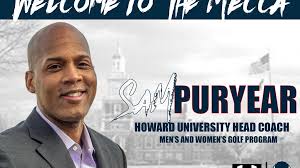
Sam G. Puryear Jr. Named Howard’s Head Golf Coach
WASHINGTON, D.C., April 9, 2020 – Howard University Director of Athletics Kery Davis announced the hiring of Samuel G. Puryear Jr., as the new head coach for the men and women’s golf program today.
“We are excited to welcome Coach Sam Puryear to the Howard University family. His wealth of experience as a collegiate player and coach coupled with his teaching style make him the ideal person for this role,” Davis said. “I look forward to working with him to build an exceptional program for our student athletes.”
Last year, the program made national headlines when it received a generous financial boost from six-time NBA All-Star and Eat. Learn. Play. Foundation co-founder, Stephen Curry, who committed to support the establishment of the university’s first NCAA Division I golf program for six years.
Howard University aims to debut the first men’s and women’s golf teams in the 2020-21 academic year, with resources strategically allocated for talent scouting and training to have a competitive Division I team in place for its inaugural season.
The university previously had a Division II golf team and various intercollegiate and intramural club teams.
“Partnering with NBA Champion Stephen Curry to support Howard University’s first NCAA Division I golf program brings critical resources to the table to support our vision to enhance our athletics program and use sport to expand the cultural experience of our students,” President Dr. Wayne A. I. Frederick said. “The selection of Coach Puryear is the next step in this historic journey to take golf at Howard to the highest level. His experience training student athletes to perform on the greens, in the classroom and on the PGA Tour will serve him well as he creates a foundation of excellence to pursue championship-level play in the Bison community.”
Coach Puryear, a native of Winston-Salem, N.C., graduated from Tennessee State University with honors. During his time as a collegiate golfer and team captain, he played under the leadership of Coach Dr. Catana Starks, the first woman to coach a men’s Division I golf team. Puryear’s 12-year coaching career includes Stanford University, Michigan State University and Queens University of Charlotte.
“I would like to thank Stephen Curry, Dr. Wayne Frederick and Mr. Kery Davis for creating and providing this unique opportunity. I am excited to be involved and on the ground floor with a culturally, historically significant university that has positioned itself with positively shaping and molding some of our countries most talented and brightest student-athletes,” said Puryear. “Mr. Curry’s vision will impact this program and resonate through the world of golf for many years to come.”
Puryear became the first African-American head coach at a Power Five school. To date, his coaching career has produced one national championship, one Big Ten Championship, two Coach of the Year honors, two Conference Carolina titles and two South Atlantic Conference championships.
More than 10 of Puryear’s former players have played in PGA Tour events, which includes one player participating in the Masters.
Puryear is dedicated to maximizing potential in young people as an advocate for education and professional growth. He found a niche in developing golfers, mentoring new coaches, and directing junior golf clinics, camps, adult golf instruction and private corporate outings. Puryear has been a leader within the golf industry by touching lives and instilling dreams on the collegiate level and within local communities. He shared this inspiring story in his new book, “Diamonds in the Rough.”
Puryear has been recognized by several media outlets as a prominent spokesperson discussing the future of minorities in golf. His work with student-athletes has also been featured on ESPN, Big 10 Network and “Inside the PGA TOUR.” Additionally, he served as a consultant for the movie From the Rough, starring Academy Award nominees Taraji P. Henson, Tom Felton of “Harry Potter,” and Michael Clarke Duncan from The Green Mile.”
Puryear has amassed a bevy of accomplishments, but his biggest joys are his three amazing children and his granddaughter.
Chatting with America’s Caddie: Howard coach Sam Puryear on HBCU golf, equality and Steph Curry
Sam Puryear wants HBCU golf to be on equal footing. And the Howard University golf coach knows what it will take to get there. After winning a national championship at Stanford, then a Big Ten title with Michigan State, Puryear, with an assist from NBA champion Steph Curry, literally started from scratch at Howard two years ago.
So he sat down with America’s Caddie, Michael Collins, to talk about how opportunity, how he got the Howard job, the goal to compete and win and so much more.
Collins: What’s the most important thing you want people to know about HBCU college golf?
Puryear: I think one of the most important things you can tell people is, No. 1, we’re out here to compete. We’re not out here asking for an advantage. We’re out here asking for equality. We’re out here ready to compete, and we want to compete at the highest level.
I want young people that want to be uber successful. That want to work hard. That want to play the best competition. That want to improve their golf IQ. That want to have that opportunity where, if they do have that golf dream, it can come true. From where I sit today, everything is inside of me. I’m putting it out on the table. I am giving everything to help these young people and their dreams come true.
HBCU golf is, in my estimation, not looking for a handout. We’re looking for an opportunity.
Collins: That’s something you and I talked about before. Not asking for an advantage, but asking for equal footing.
Puryear: If I’m a corporation reading this now, I would say, “OK, what are the things we can provide that would put you on an equal footing?” That’s how I look at it.
Collins: It seems easy, but people assume because you have a college golf program that every kid gets fitted and you have eight Trackman systems. [Puryear laughs.] You laugh, but how do you fix it?
Puryear: My philosophy on that, and I’ve had it since I was a kid, if you’re a coach, you got to have a short memory. All great athletes have short memories. Michael Jordan shoots the ball. He misses 15 times. But guess what? Those last three [that he makes], win the game. He didn’t think about the other ones he missed. Because they’re not important. I heard [Jack] Nicklaus with my own ears say he never missed a short putt.
It’s all of mindset. As a golf coach, in my perspective, I’m coming to this job, this opportunity, with no preconceived notions that life is going to be easy, life is going to be a great, life is going to be fair. Because I still know I have to raise money. I have to call 45 people to get two to consider my salt. I have to send out 100 inquires in order to get 10. I know that means I’m going to have to work harder. I’m going have to work longer. But guess what? I’m the coach. To me, HBCU programs should see what the big schools are doing. They mimic the flavor of the coach. I’ve been coaching a long time. My goal? I’m not coming here with any other expectation other than to build something on solid ground and to win. I know I’m going to have to outwork everybody else. If I think they’re getting up at 8:30 [in the morning] I’ve got to beat them by two hours cause I don’t have the same budget as them. If I think they’re lazy and going to stop at 5 or 6, I’m going to work till 9. Because I have to be willing to bleed, to sacrifice, in order to get better. You just have to do the extra. You have to call that extra guy, you have to email that extra lady, in order to get that Trackman.
Collins: Where did this career path start for you?
Puryear: My father introduced me to the game. My dad had been a small-college All-American back in 1965.
When I was born, my dad was going to the golf course every week. My mom would tell this story as I got older: My dad became a principal and my mom was a teacher. But what I didn’t realize is, until I got much older, educators were essentially 10-month employees. So my dad would use a lot of those summers playing golf to make the mortgage. My mom said, “Yeah, but the good thing is your dad doesn’t lose.”
Collins: Your dad was a hustler!?! Those summer months, when no paycheck was coming from school, that’s how he paid the mortgage?
Puryear: My dad would play. He’d play that golf — that’s why he stopped playing, guys stopped betting him. You know how it works on the golf course when guys realize they can’t beat you. They stop betting you.
Collins: I guess growing up seeing your dad play, you started young. Ever have aspirations of going pro?
Puryear: Initially, I did. I loved it. True story: My dad would never tell me no if I asked him to go to the golf course. I would say, “Hey can I go?” He would say, “Absolutely.” He was out there playing, but he didn’t want me around all that gambling. He would give me money and say, “OK, you got some money for some grilled cheese sandwiches, some treats. If you want a lesson from the pro, I’ll take care of that, too. Other than that I’ll be back here in a few hours.”
As I got older I’d go down on that range and beat balls. I’m talking about till the cows come home. I wanted to be great. I would sneak out and watch my dad a little bit just so I can learn how [to play] when you’re playing for a couple of coins.
Collins: What happened?
Puryear: I went off to college and I realized, “Wait, there’s a missing component here.” The missing component was not having a ton of [Black] tour players. I noticed that there was a piece of the bridge missing to get people to that point. Where are the teachers, where are the coaches getting these kids prepared to go play college, prepared to go pro?
Collins: So you knew pretty early you weren’t going pro?
Puryear: My mom reminded me of this when I became the head golf coach at Michigan State. She called me and said, “Do you remember what you told me at 12 years old? You told me you were going to change the game, make it look more like you.” Even as a kid I saw things [for Black people] were off. The numbers were flawed. As a kid, I vowed I was going to even the playing field some day. At that point, playing pro golf never became that important to me.
Collins: You graduate from Tennessee State; how do you get into coaching from there?
Puryear: I get a call one day from Eastlake [Academy in Atlanta] and they want to bring in a director of golf to build up what they had started about a year before. I go take the Eastlake opportunity.
In my humble opinion, going to Eastlake was me trying all of my methods out on kids that had never even held a golf club.
From making them lift weights, eat properly, the integrity piece (of golf). To me, they had nothing to do with anything but golf. I made sure they got the educational piece, that they were good people (first), the whole nine yards. So by the time the opportunity opened up to go to Stanford [as an assistant coach], I took the model I had built at Eastlake to California.
Collins: Couldn’t have been that easy?
Puryear: It’s funny, the first thing I did when I got there when I talked to Conrad Ray, who was the head coach and a great guy, I said, “Conrad, I have an idea: I want to do a development program for the students on this team that I have tried and tested.” The only thing he said was, “Hey Sam, you know how to do it? Are you comfortable?” I said, “It’s like the back of my hand.” He said, “Let’s do it.”
Collins: And?
Puryear: I put that development program in place at the beginning of the following year. We start out winning these tournaments and we win the national championship. People seem to forget sometimes, they think, “I have a great golf swing, that means I can be a great player.” Absolutely not. In order to be a great player you have to have a cadre of things that are built in and innate for some development that are going to help you get to that next point.
Collins: Had to be a few schools that knew what you had done?
Puryear: Well, once we won the national championship the telephone rings and I get a few offers. I took the Michigan State offer because I wanted to get back as close to North Carolina as I could. I loved it in California. The people were fantastic and the weather was great. The university was incredible, but I mean I’m a southern guy, you know? I was trying to get back as close to the East Coast as I could.
Collins: How did you know you had something special at Michigan State?
Puryear: It’s interesting. Again, I implemented the same plan. Went out to the players the same way and got the same response. What I really, really enjoyed about Michigan State, I was able to talk to coaches in other sports. You’re sharing culture methodologies and philosophy. It wasn’t so much, “Hey let’s talk golf.” No, I wasn’t talking golf at all. If I talked to [men’s basketball coach Tom] Izzo, he didn’t want to talk basketball, all he wanted to do with me was talk golf.
Collins: Funny how that works in our sport.
Puryear: Yeah. And because I love basketball, I wanted to talk to him about basketball. So it made for really nice banter, you know? For me, it was really growth — continuing to grow as a coach.
Collins: Win a national championship with Stanford, win the Big Ten championship at Michigan State … then what?
Puryear: Many years later I had gotten back to North Carolina. Started my own little golf company and was director of golf at a small school in Charlotte — Queens College. And after six years at Queens, I had won four conference championships. So the proof was in the pudding and I was comfortable [stepping away]. If I step out now I can start trying to find those players that are serious about making it to the professional level. I felt like at that point I had a blueprint. So that’s what I was doing for the last couple years.
Collins: Then Howard University called?
Puryear: Initially someone reached out and said they were representing Howard and wanted to talk to me about it. The irony is, before [Howard] called, I’d probably got, and I’m not exaggerating, 35 calls from people who said, “Man, I just heard about this opportunity! You’re the only person in America they could potentially hire to help them build the program, because you’ve seen the top of the mountain.”
When I sat back and thought about it, knew that Steph Curry was supporting it, I said, “You know, this man is a champion.” I had played golf with him before, so I knew he was uber competitive. With his support and drive as a champion, plus my to drive to win and experience and love to work with young people, there’s no way if they offer me the opportunity I can say no.
At that point, the interest, fire and burn to get back to the coaching, I was like, “Yeah, this would be the one spot to do it.”
Collins: That’s crazy so many people called you first. I’m sure you were probably like, “Come on y’all, calm down. What are you talking about?”
Puryear: That’s right. Because in the beginning I was, “No, you’re putting the cart before the horse. They’re probably not going to build anything special.” That’s the truth, that was my initial thought. So I never considered it. Until the story evolved.
Collins: And Steph was involved!
Puryear: Exactly. At that point you’re dealing with a champion. A champion of champions.
Collins: You have both men’s and women’s golf teams at Howard. I want to talk about the women. How do we get more young African-American women and girls to just start playing and learning the game?
Puryear: The thing you have to do in finding the African-American young ladies, and I know people are going to laugh when they hear this, but it’s so basic that it’s true, you’re going to have to work 10 times longer and harder than everybody else. Junior tournaments, you’re going to have to burn the phone up. Identify who’s playing well in that community. Reach out to the junior group. All of these groups where these young ladies are playing. You know, all of a sudden you can’t just go AJGA. You got to go to some of the smaller tours, junior tours, because the acclimation for the natural and normal African-American young lady is not the same. Because the numbers aren’t as large. But I’m going to tell you what’s happening with the young Black girls. There are some really, really good young Black girls. Problem is, they’re so good that, of course, the Tennessees, Alabamas and Texases … they want them.
I want to be in a position where I can go to the same girl and say, “Hey, yeah, you’re considering a great school. But we’re better. Consider us at Howard.”
Collins: We’re starting to see in tennis the residual of the Williams sisters. We know what Se Ri Pak did for women’s golf in Korea.
Puryear: You better believe it. It goes back to having a mentor or mentors.
Collins: A mentorship can be worth more than a thousand rounds of golf.
Puryear: No question about it.
Collins: Five years from now, the dream scenario, where are you and where is the Howard golf program?
Puryear: Dream scenario for me is always where I am. That’s how I look at life. But Howard’s golf team, at that point, will be built on solid ground. The foundation will have been poured, nurtured and sustained. Mature to a point where you have incredible young student-athletes doing really well in the classroom — and they’re steady on the golf course. That would look like fantastic places to practice and play in the area. Great tournaments to compete in.
Students will have a chance to say, “Hey, every year we compete on the West Coast and the East Coast. We play some of the best teams in our region. We’ll also see some of the best teams in the United States. But at the same time we’ll also keep it culturally relevant and play some of the Black schools when we get a chance. To me in five years, if a young person can walk away and say that, then I can lay down and say, “Sam, job well done.”