


Williams, seeded 17th, trailed 4-2 in the first set but hit back to win 6-4 6-3 against the Czech eighth seed.
The American, 36, is seeking her first Grand Slam trophy since giving birth to daughter Olympia last September.
If she wins it would be her 24th major title – equalling Australian Margaret Court’s all-time record.
“The crowd was really rooting for me and I felt so bad because everyone out here was cheering and I wasn’t winning so I thought I had to try harder,” said Williams.
“I really feel like right now I’m playing free. I was having a baby this time last year so I have nothing to prove.”
Williams faces Latvia’s 19th seed Anastasija Sevastova, who knocked out defending champion Sloane Stephens earlier on Tuesday, in the last four on Thursday.
Williams is only playing her eighth tournament since becoming a mum, but had only dropped one set – in her last-16 match against Latvia’s Kaia Kanepi – on her way to the last eight.
However, having lost to Angelique Kerber in the Wimbledon final, there were question marks how she would fare against another high-calibre player.

The six-time US champion won eight games in a row – four at the end of the first and four at the start of the second – to help her secure victory in one hour 26 minutes.
It was her first win over a top-10 ranked player since beating Britain’s Johanna Konta at the 2017 Australian Open.
Williams suffered a chastening defeat by Pliskova, who had a brief spell as world number one last year, when they last met each other in the 2016 US Open semi-finals.
And it looked like she could face more trouble when 26-year-old Pliskova threatened to go a double break up in the first set.
The tall Czech was unable to convert either for a 4-2 lead with her service game next – and that was the momentum-changing moment in what had promised to be an engrossing match.
Williams upped her number of winners as Pliskova’s unforced error count grew, a pattern which continued in the early part of the second set.
Little danger seemed apparent for Williams when Pliskova clawed one break back for 4-1, only for the tension to grow when the world number eight moved 40-0 ahead on the American’s serve in the seventh game.
Williams responded with some huge serving to see off four break points, averting danger for a 5-2 lead and allowing her to wrap up victory in her next service game.

Serena Williams, on a Court That Has Defined Her, Writes Yet Another Chapter
Serena Williams has played in many a showplace during her 23 years as a tennis pro, but there can be no other court on the planet that stirs up a motherlode of memories like Arthur Ashe Stadium.
It is the cacophonous spot where she became the first Williams sister to secure a major singles title, winning the United States Open in 1999. It is where she would prevail five more times, in 2002, 2008, 2012, 2013 and 2014.
The court has changed color through the years — from green to blue — and added a roof along the way. But this is still the same place where Williams melted down against Kim Clijsters in the 2009 semifinals, threatening a line judge, and where she tightened up and failed to complete the true Grand Slam in 2015 by losing to the unseeded Italian Roberta Vinci in the semifinals.
What has happened in Ashe, the shorthand the players use, has defined her and redefined her as a tennis champion, but unlike so many great players of her generation, she is still coming back for more.
“I think Serena remembers the scars here,” said Chanda Rubin, the former top-10 player from the United States who is now an analyst. “I am sure that loss in 2015 sticks with her, but I think the positives are that she’s finding a way to work through the tough moments. You can still see some of the nerves. She wants this badly, and it’s going to be a challenge to maintain a balance for her and a positive state of mind where she can play the kind of tennis she played at the end of this match and earlier in this tournament. But I think she’s getting better and better.”
At age 36, Williams has also edged closer and closer to tying Margaret Court’s record of 24 Grand Slam singles titles. This is Williams’s third major tournament since returning to the circuit in March after giving birth to her daughter, and she fell just one win short of the record at Wimbledon in July, losing to Angelique Kerber in straight sets in a final where Williams struggled to manage the moment emotionally.

But Kerber was already a two-time major champion and former No. 1.
No one remaining in this U.S. Open women’s tournament has a similar résumé. Williams’s opponent in the semifinals on Thursday will be Anastasija Sevastova, a 28-year-old Latvian who had previously never advanced this far at a Grand Slam.
Sevastova deployed her guile and counterpunching skills to ambush Sloane Stephens, the defending champion, 6-2, 6-3, earlier on Tuesday. The sunbaked, humid conditions in Ashe Stadium left the normally self-contained Stephens uttering oaths as well as spraying groundstrokes.
In the other half of the draw, where the quarterfinals will be played on Wednesday, the two highest ranked players remaining and No. 14 Madison Keys and No. 19 Naomi Osaka, who have huge baseline power and formidable first serves but have yet to prove they have the consistency and mentality required to win a major.
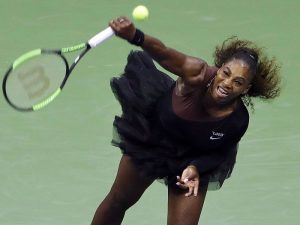
Her duel with Pliskova had scar tissue of its own. Pliskova was the last player to beat Williams in Ashe Stadium, upsetting her in the 2016 semifinals after defeating Williams’s sister Venus in the previous round.
Pliskova and Williams had not played since that match, and Pliskova took a 3-1 lead early on Tuesday night, breaking Williams in the third game. Williams struggled with her consistency and kept casting edgy glances at her support team in the stands.
But as Williams has made abundantly clear in her many years at the top, she can find her range in a hurry. After fighting off three break points in the fifth game with serves Pliskova could not handle, the match changed complexion for good.
“I know she can be off, and she can do mistakes,” Pliskova said. “She can also quickly be back in the match with a couple games or couple shots. She can hit unbelievable shots.”
Down by 2-4, Williams proceeded to win eight straight games, jumping out to a 4-0 lead in the second set before Pliskova was able to stop the streak.

Pliskova said she saw little difference between Williams’s level pre-motherhood and on Tuesday night.
“She’s playing with the same power; she can still serve well,” Pliskova said. “I don’t think there’s any change with her game. She’s just going for her shots. I just think I played much better two years ago.”
It was an emotional evening for Pliskova, and she later cut short the Czech-language portion of her post-match news conference after breaking down in tears. She is still waiting for her major breakthrough after losing to Kerber in the 2016 U.S. Open final.
Meanwhile, Williams rolls on. And though the 37-year-old Roger Federer could not handle the heat on Monday night as he was defeated by John Millman, Williams, who will turn 37 this month, showed no ill effects in this muggy evening session.
It was her first victory over a top-10 player since her return to the circuit.
“Shocking,” Williams said. “My first top-10 win. I really felt like I was playing well in Cincinnati, even though I lost. I was just on the verge. If I could have had just one more match before I played a top-10 player, I think I would have done better. I’m getting those matches now. Just was so light on the matches. So now I feel like I’m at a level where I can play and try to compete against these amazing women in the top 10.”
@serenawilliams
There are, however, no other members of the current top 10 left to beat in this particular U.S. Open. But Williams, ranked 26th but seeded No. 17, has learned the hard way, in Arthur Ashe Stadium and elsewhere, that there are no guarantees.
“I’m definitely not ahead of myself,” she said. “I still know no matter whether I’m in the semifinals or the final, I have a really long way to go to win that. Again, that proved to be true at Wimbledon. I’m just taking it one at a time, literally.”
Serena Jameka Williams (born September 26, 1981) is an American professional tennis player. The Women’s Tennis Association (WTA) ranked her world No. 1 in singles on eight separate occasions between 2002 and 2017. She reached the No. 1 ranking for the first time on July 8, 2002. On her sixth occasion, she held the ranking for 186 consecutive weeks, tying the record set by Steffi Graf for the most consecutive weeks as No. 1 by a female tennis player. In total, she has been No. 1 for 319 weeks, which ranks third in the “Open Era” among female players behind Steffi Graf and Martina Navratilova.
Williams holds the most Grand Slam titles in singles, doubles, and mixed doubles combined among active players. Her 39 major titles puts her joint-third on the all-time list and second in the Open Era: 23 in singles, 14 in women’s doubles, and two in mixed doubles. She is the most recent female player to have held all four Grand Slam singles titles simultaneously (2002–03 and 2014–15) and the third player to achieve this record twice after Rod Laver and Steffi Graf. She is also the most recent player to have won a Grand Slam title on each surface (hard, clay and grass) in one calendar year. She is also, together with her sister Venus, the most recent player to have held all four Grand Slam women’s doubles titles simultaneously (2009–10).
Her total of 23 Grand Slam singles titles marks the record for the most Grand Slam wins by a tennis player in the Open Era, and is second on the all-time list behind Margaret Court (24). She is also the only tennis player to have won ten Grand Slam singles titles in two separate decades. She has won an all-time record of 13 Grand Slam singles titles on hard court. Williams holds the Open Era record for most titles won at the Australian Open (7) and shares the Open Era record for most titles won at the US Open with Chris Evert (6). She also holds the all-time record for the most women’s singles matches won at majors with 325 matches.
Williams has won 14 Grand Slam doubles titles, all with her sister Venus, and the pair are unbeaten in Grand Slam doubles finals. As a team, she and Venus have the third most women’s doubles Grand Slam titles, behind the 18 titles of Natasha Zvereva (14 with Gigi Fernández) and the record 20 titles won by Martina Navratilova and Pam Shriver. Williams is also a five-time winner of the WTA Tour Championships in the singles division. She has also won four Olympic gold medals, one in women’s singles and three in women’s doubles—an all-time record shared with her sister, Venus. The arrival of the Williams sisters has been credited with ushering in a new era of power and athleticism on the women’s professional tennis tour. Earning almost $29 million in prize money and endorsements, Williams was the highest paid female athlete in 2016. She repeated this feat in 2017 when she was the only woman on Forbes‘ list of the 100 highest paid athletes with $27 million in prize money and endorsements. She has won the ‘Laureus Sportswoman of the Year’ award four times (2003, 2010, 2016, 2018), and in December 2015, she was named Sportsperson of the Year by Sports Illustrated magazine.




