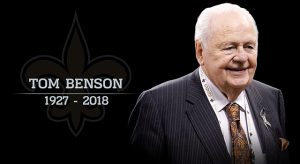
As a sports team owner, Benson had a Super Bowl victory to his credit, via the Saints winning Super Bowl XLIV.
The Benson family established an endowment fund at Central Catholic High School, in San Antonio, Texas dedicated to the memory of their son Robert Carter Benson, who graduated from the school in 1966. Tom Benson also donated the Benson Memorial Library at Central Catholic. Robert Carter Benson died of cancer in 1985, at the age of 37.
Benson and his family long have been ardent supporters of University of the Incarnate Word in San Antonio.The Gayle and Tom Benson Stadium officially opened on campus September 1, 2008, when the Bensons joined with more than 2,000 Cardinals fans and athletes to declare the facility ready for action.The stadium is wide enough and long enough that the Cardinals soccer teams, men’s and women’s, have begun playing their games here.

September 23, 2010, Benson donated $8 million to Loyola University New Orleans in what will be called the Benson Jesuit Center.
In January 2012, Benson and his wife were awarded the Pro Ecclesia et Pontifice for their generosity to Catholic Church, the highest papal honor that Catholic laypeople can receive.
In November 2012 Tom Benson and his wife, Gayle, donated $7.5 million towards the construction of Tulane University‘s Yulman Stadium. The stadium, which opened in 2014, brought the Green Wave back to campus for the first time since the demolition of Tulane Stadium in 1980. The playing surface is known as Benson Field.
In November 2014, Fawcett Stadium at the Pro Football Hall of Fame in Canton, Ohio was renamed “Tom Benson Hall of Fame Stadium” in recognition of a $11 million donation by Tom Benson.
In 2015 the Benson family gave $20 million for cancer care and research.
Benson was born two years before the 1929 stock market crash and the Great Depression, and he and his family had little while he was growing up. By the time he died Thursday at age 90, though, Benson was one of his hometown’s towering figures, a self-made billionaire, the owner of the NFL’s Saints and the NBA’s Pelicans, an owner of Kentucky Derby-caliber thoroughbreds and, in the eyes of many of his neighbors, a hero for helping New Orleans recover after the devastation of Hurricane Katrina.
If his final years were marred by an ugly and very public family fight over who would inherit his sports empire — and whether he was mentally fit to make that decision — then the decades before were filled with wild success as the owner of auto dealerships and banks, with hard-nosed business practices, with years of football failure followed by parasol-twirling celebrations of Saints victories. Benson supported family members and nuns, angered locals when he engaged in a public dalliance with San Antonio after Katrina struck in 2005 and then was lauded after the NFL stepped in to help convince him to stay, endured dismal seasons of the “Aints” and then reveled in the Super Bowl championship run of 2009.

“I’m 85 years old,” Benson said at the time, in an interview with The New York Times. “I’ve been in business since I was a teenager, practically; I was in grade school and I even had a paper route. I always had a job so I could have money to spend on girls.
“When we had to get out of here to go to San Antonio, we met with the mayor, and the next day we moved to the Alamodome, with offices set up in the basement. I could tell you some stories. Listen, this is all part of life. You’ve got to enjoy every day and make the best of it and go forward. That’s what we’re doing.”
Benson had plenty of early — often painful — experiences in moving forward. Just after his 18th birthday, he enlisted in the Navy, and then, while on leave after boot camp, married his high school sweetheart. He began his service on a ship shortly after Japan surrendered in World War II. When his hitch was up, Benson returned to New Orleans and enrolled at Loyola University. He dropped out and made a fortuitous decision, becoming a bookkeeper for a local Chevrolet dealership. The owner became Benson’s mentor, and eventually offered him the chance to run — and hold an ownership stake in — a dealership in San Antonio. Benson came to run dozens of dealerships in San Antonio and New Orleans and he used the profits to purchase several small Southern banks.
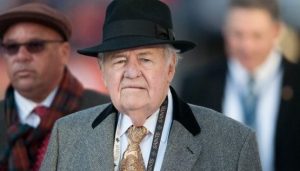
But the Saints were often a source of escape. As an owner, Benson was immediately popular because he hired Jim Mora as coach and Jim Finks as general manager — and in 1987, the Saints made it to the playoffs for the first time in their 21-year franchise history. Neither Benson’s popularity nor the team’s fortunes remained that high for long. After making the playoffs four times in a six-year span — but losing in the wild-card round each time — Mora’s results began to slip. And Benson agitated for a new home to replace the Superdome, suggesting he could move the team elsewhere if a stadium was not built. Benson’s popularity hit a nadir when he seemed to be leaning toward moving the team permanently in the wake of Katrina. Instead, the Saints were a significant part of the revival in New Orleans.
The Saints played the entire 2005 season outside of New Orleans after Hurricane Katrina severely damaged the Superdome and left the city to rebuild, but the NFL prodded Benson to reject a flirtation with San Antonio to return to the Big Easy for the 2006 season. Sean Payton and Drew Brees joined the Saints early in 2006 and the entire team came to symbolize the rebirth of the city, with an electric Monday night victory marking the team’s return to the Superdome. Players and coaches became deeply involved in rebuilding efforts and formed an unusually deep bond with the community. And the Benson Boogie — in which the owner danced down the sideline like a participant in one of the city’s traditional second line parades — was back as the team began to win again. The Super Bowl title following the 2009 season cemented the Saints in local lore.
“This team took the hopes and the dreams of a shattered city and placed them squarely on its shoulders,” President Barack Obama said when he honored the team at the White House. “And so these guys became more than leaders in the locker room — they became leaders of an entire region.”

Benson had long supported and employed close friends and family members and gave away enormous amounts of money, including to numerous Catholic charities and an $11 million donation to the Pro Football Hall of Fame in Canton, Ohio, with $10 million put toward renovating the stadium there. The fight over the future of his franchises was especially bruising after he fired his daughter and grandchildren in January of 2015 and announced that he intended to make his third wife, Gayle Benson, the sole heir to the Saints and Pelicans. That set off a multifaceted legal battle in Louisiana and Texas, in which Benson’s competency was repeatedly questioned.
The legal tussling continued for much of the rest of Benson’s life, a remarkable and dramatic journey for the boy who saved his pennies, made his fortune selling automobiles and buying banks, and became a local legend by finally giving the city that spawned him something to cheer about.