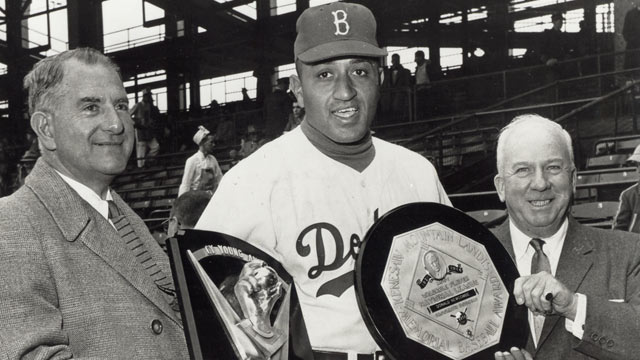
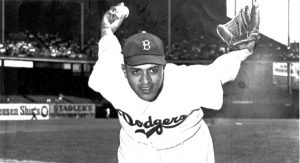
Donald Newcombe, nicknamed Newk, is an American former Major League Baseball right-handed starting pitcher who played for the Brooklyn/Los Angeles Dodgers (1949–51 and 1954–58), Cincinnati Reds(1958–60) and Cleveland Indians (1960).

Donald Newcombe was the only baseball player to have won the Rookie of the Year, Most Valuable Player and Cy Young awards. In 1949, he became the first black pitcher to start a World Series game. In 1951, Newcombe was the first (1st) black pitcher to win twenty (20) games in one season. In 1956, the inaugural year of the Cy Young Award, he became the first (1st) pitcher to win the National League MVP and the Cy Young in the same season.
Newcombe compiled a career batting average of .271 with 15 home runs and was used as a pinch hitter, a rarity for pitchers.
Newcombe, known as a quiet man who kept to himself but was infamous for being a prankster in the clubhouse, began his baseball career in the Negro Leagues, playing for Effa Manley and the Newark Eagles not far from his hometown of Madison, New Jersey.

With catcher Roy Campanella, Newcombe played for the first racially integrated baseball team based in the United States in the 20th century, the 1946 Nashua Dodgers of the New England League. He continued to play for Nashua in 1947 before moving up through the minor leagues. He debuted for Brooklyn on May 20, 1949. Effa Manley, business manager for the Eagles, agreed to let the Dodgers’ Branch Rickey sign Newcombe to a contract. Manley was not compensated for the release of Newcombe.
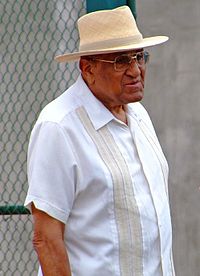
Standing 6-foot-4 and weighing 240 pounds, Newcombe was a threatening image to opposing batters. He was a very big guy, said baseball historian and author Ray Zardetto, who has chronicled Newcombe’s career. This was at a time when there weren’t a lot of big pitchers. He had a very intimidating look about him on the mound. His fastball, however, Stan Musial called it the most frightening pitch he ever had to face.

At 30 years old, Newcombe’s career reached its pinnacle in 1956 when he finished with 27-7 record in addition to 139 strikeouts, a 3.06 ERA, five shutouts and 18 complete games. His strong season earned him both the Cy Young Award (which was then awarded to just one player in all of baseball) and the MVP Award.

Following the Dodgers’ move to Los Angeles, Newcombe got off to an 0–6 start in 1958 before being traded to the Reds for four players in midseason. He posted a record of 24–21 with Cincinnati until his contract was sold to Cleveland in mid-1960. He finished with a 2–3 mark in Cleveland before being released to end his major league career. Newcombe acknowledges that alcoholism played a significant role in the decline of his career.
On May 28, 1962, Newcombe signed with the Chunichi Dragons of Japan’s Nippon Professional Baseball. Doby would join him the same year. Newcombe played one season in Japan, splitting time as an outfielder and a first baseman, only pitching in one game. In 81 games, he hit .262 with 12 home runs and 43 RBI.
In 1956, I was the best player in baseball, Newcombe has said. Four years later I was out of the major leagues and it must have been the lifestyle. When you’re young, you can handle it but the older you get, the more it bothers you.
Newcombe wasn’t just an intimidating presence on the mound, however, as he also knew how to handle a bat. He hit .271 in 878 lifetime at-bats and compared favorably to many of the position players of his time. Newcombe hit over .300 five times in his career and in 1955, he hit .359 with seven home runs.
While he was one of the first great black pitchers in baseball, Newcombe has said that he hopes to be remembered for his efforts off the field in addition to his playing career.
Newcombe rejoined the Dodger organization in the late 1970s and served as the team’s Director of Community Affairs. In March 2009 he was named special adviser to the chairman of the team.

Newcombe has maintained sobriety since 1967. In his personal and professional life, he has helped numerous other people including military personnel via USO in their own battles.

- — Maury Wills, former Dodger great, on Newcombe’s role in helping Wills regain sobriety after Wills’ substance abuse problems in the 1980s.
What I have done after my baseball career and being able to help people with their lives and getting their lives back on track and they become human beings again — means more to me than all the things I did in baseball.
- Don Newcombe’s contributions to the Dodger organization, the Los Angeles community and the game of baseball are incalculable, said Dodgers owner Frank McCourt. His Dodger roots trace all the way back to Brooklyn and we are honored to have him as part of our team. His legacy as one of the greatest pitchers in the game endures today.

Seventy years ago, Jackie Robinson, Roy Campanella and Don Newcombe made history in this country, Newcombe said at the event. We made changes that went on for so long that black men couldn’t play Major League Baseball in the so-called All-American sports pastime. Now all that has changed after 60 years. I’m the only one left from that team who is still here to talk about it, and to remind people that 60 years ago, it was not like this and what we had to go through to get what it is like today.

I would not be here if it were not for Jackie and it were not for Don Newcombe.
- – Barack Obama, April 19, 2010.