
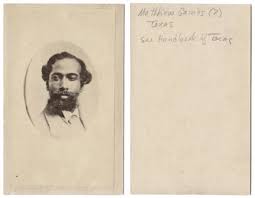
Texas A&M Unveils Statue Of Sen. Matthew Gaines

Gaines was one of Texas’ first African-American state senators and was instrumental in passing the Land-Grant College Act of 1862

The legacy of Matthew Gaines, who was born into the bonds of slavery and went on to serve in the Texas Legislature during Reconstruction, was memorialized Friday in the heart of the university campus he helped establish.
A statue of the former state senator, Baptist minister and advocate for the rights of freed people was unveiled in front of a crowd of more than 1,000 in the Yolanda and Jimmy ‘65 Janacek Plaza at Texas A&M University – the culmination of a nearly three-decade student-led effort to memorialize Gaines. The bronze sculpture depicts Gaines climbing a series of low steps. He carries a stack of books under his left arm, and holds his right hand outstretched as if to help the viewer climb the stairs alongside him.
Those who spoke at Friday’s dedication ceremony said Gaines’ actions were instrumental to Texas A&M’s creation, and for many symbolizes a large step toward recognizing the many Black individuals who contributed to the university’s history.
“Without Matthew Gaines, it’s quite possible there would be no A&M,” said Tim Scott, interim provost and executive vice president. “One of the issues most important to Sen. Gaines was public education. He knew that a mind developed was a mind forever free.”

Born in 1840 on a plantation in Pineville, La., Gaines was enslaved for the first 25 years of his life. He learned how to read — by candlelight — using contraband books. Twice he risked his life to escape enslavement, but both times he was captured. But once emancipated, Gaines made his way to Washington County not far from Bryan-College Station, where he emerged as a community leader and became a Baptist preacher and state legislator.
As part of the 12th Texas Legislature, Gaines was instrumental in ensuring the state took advantage of the federal Morrill Act of 1862, which lead to the creation of U.S. land-grant universities, including the Agricultural and Mechanical College of Texas.
The university, now known as Texas A&M, did not accept Black individuals until 1963.
“In my eyes, this is a perfect example of public service: the unadulterated commitment to make a difference in the lives of others regardless of how it impacts yourself,” said Mason Alexander-Hawk ’24, Gaines’ great, great, great granddaughter and vice president of the Matthew Gaines Society. She was one of the more than 50 descendants of Gaines’ in attendance.
Alexander-Hawk, a doctoral student in the College of Architecture, spoke of the importance of recognizing the legacy of her ancestor, who she described as a champion of African-American rights and an advocate for prison reform, education and voting rights. Gaines, who devoted much of his life to serving others, knew education was foundational to the achievement of true freedom of opportunity for all, said Bill Mahomes ’69, vice president of the Texas A&M University Board of Regents.
“I understand the need to make sure that each and every student who walks this campus can look up and see themselves and their aspirations in the historic icons on the Aggie campus,” Mahomes said, adding, “Who better for us to look up to than Sen. Matthew Gaines?”
In addition to serving as a symbol of inclusion and representation at Texas A&M, the statue is the result of the work of students, faculty and staff to recognize Gaines’ contributions, starting in the 1990s with the formation of the Matthew Gaines Committee. Support fluctuated over time, and the movement struggling to find purchase in the wake of the Bonfire collapse, changes in administrative leadership and budget constraints.
But the momentum changed after last year’s summer of civil unrest and protests in response to the death of George Floyd, said Alexander-Hawk. The group, now known as the Matthew Gaines Society, was instrumental in raising awareness and the $350,000 needed to build the statue.

It was sculpted by Wyoming artists David Alan Clark and Mary Johnson (MJ) Clark, who in November 2020 were named the winners of an open competition for the art installation.
Matthew Gaines Society President Aketch Osamba ’22 said the statue is the result of the perseverance of Aggies who for more than 20 years advocated for an acknowledgement of Gaines’ legacy. The society will continue to emulate Gaines through campus culture, leadership development and public service, she said.
Osamba said the organization’s slogan, “Everybody Gaines,” is more than just a hashtag or catchphrase.
“It serves as a representation that Aggies, regardless of race, gender, ethnicity, religion or background, can make a lasting impact on campus, even if they are unable to see the effects (during) their time here,” Osamba said.


Matthew Gaines
|
Matthew Gaines
|
|
|---|---|
 Matthew Gaines
|
|
| Texas State Senator from District 16 | |
| In office 1870–1873 |
|
| Preceded by | Abraham Morris Gentry |
| Succeeded by | Seth Shepard |
| Personal details | |
| Born | August 4, 1840 Alexandria, Louisiana, US |
| Died | June 11, 1900 (aged 59) Giddings, Texas, US |
| Political party | Republican |
| Occupation | State senator |
Matthew Gaines (August 4, 1840 – June 11, 1900) was a former slave, community leader, minister, and Republican Texas State Senator. He made valuable contributions towards the establishment of free public education in the state of Texas.
Early life
Matthew Gaines was born on August 4, 1840, near Alexandria, Louisiana to a female slave owned by the Martin Despallier family. Gaines taught himself to read from a white boy who smuggled in books. This boy may have been young Blaz Philipe Despallier, who lived on the estate and who would later become the sole heir of Alamo hero Charles Despallier, his uncle. After being sold from the Despallier family, Gaines escaped from his new owner in Louisiana to Arkansas, and eventually made it to New Orleans, where he was captured and returned to his master. In 1859, Gaines was sold to Christopher Columbus Hearne, where he remained until 1863 when he tried to flee to Mexico. He was caught again and was forced to work as a runaway slave in Fredericksburg, Texas until the end of the civil war.
Career
After the 1863 emancipation was finally officially announced in Texas on June 19, 1865, Gaines settled in Burton, Washington County, where he established himself as a leader of the freedmen, both as a Baptist preacher and a politician.
In 1869, Gaines was elected as a Senator of Texas’s 16th district in the Twelfth Texas Legislature. He gained a reputation for being a guardian of the newly won rights of the African-Texans. Throughout his term, he addressed the issues of public education, prison reform, the protection of black voters, and tenant farming reformation. Gaines actively supported the forward movement that established the first public school system for all Texans and assisted in allowing Texas to take advantage of the federal Grant College Act, also known as the Morrill Act.
In 1870, Gaines played a strategic role in passing the Militia Bill, which created a state police force to combat lawlessness and to protect against voter intimidation. Gaines was elected to a six-year term to the Senate, but only served four years. In a politically motivated trial he was convicted of bigamy in 1873. Despite the charge being overturned on appeal, his seat was challenged by Seth Shepard and he was removed from office on the grounds of being a convicted felon. In 1875, he was arrested for making a civil rights speech in Giddings. He told his audience that “in the eyes of God, blacks are as good as whites; they should have pride and hold their heads up even in troubled times.” Gaines continued to be active in politics and made his political views known in conventions, public gatherings, and from his pulpit.
Death and legacy
Gaines died in Giddings, Texas, on June 11, 1900.
In 1998, activists on the campus of Texas A&M University suggested Gaines should have his statue displayed prominently. The project was abandoned in the wake of the Aggie Bonfire tragedy in 1999. However, 19 years later, Texas A&M students and other supporters pushed yet again for the establishment of a statue of Matthew Gaines on the Texas A&M College Station campus. On June 19th of 2020, the donation goal of the “Matthew Gaines Initiative” was surpassed. A statue of Gaines was unveiled and dedicated on November 19, 2021.
In 2016, Lori Bartley, who claimed to be his great-granddaughter, ran unsuccessfully for US Congress against Sheila Jackson Lee.
| General | |
|---|---|
| National libraries | |




