

Jamaica’s Hansle Parchment shocks Grant Holloway at the finish in 110m hurdles
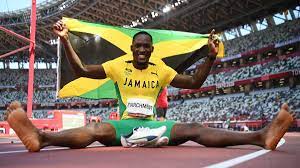
“Injuries after injuries after injuries. I would have been out [at meets] earlier this year, but I had a stress fracture. I had to be doing a lot of swimming to keep my strength up, and I think that worked out pretty well,” he said. “I started out really slowly but I kept on working, kept on believing in myself, and you know I told myself I’m just gonna come out and have some fun and I’m gonna go for the top.”
Holloway came into Tokyo as the favorite, especially after running 12.81 seconds in the semifinals at the U.S. Trials, just 0.01 off the world record.
“First loss of the season always sucks, but to have it at the Olympic games, it sucks a little bit more,” he said. “The nerves got the best of me, I got a little bit excited toward the end of the race, my form kind of broke down but with that being said I was able to get the silver.
“I’m happy with the silver but not satisfied.”
Already the 2019 World Champion and indoor 60-meter hurdles world record holder, Holloway had an incredible career at the University of Florida, winning the NCAA 60m indoor and 110m outdoor hurdles in each of his three years, also contributing points in long jump and as a member of the 4x100m and 4x400m relays. He turned pro after his junior season.
Now 26 years old, this was Allen’s second Games, having won the 2016 U.S. Trials; he finished fifth in Rio. A former receiver at Oregon, he opted to turn pro in track and field after his Olympic experience.
When Rio Games gold medalist Omar McLeod was left off Jamaica’s team, the path for Holloway seemingly got that much easier. McLeod hit the first hurdle in the finals at his country’s Olympic Trials and finished last, but he said he was not at his physical best due to the unusual scheduling; the semifinals had been the night before, the final run in the morning, and he had a “severe cramp.”
The Jamaica Athletic Administrative Association could have selected McLeod, who has Olympic and World Championship golds and the second-fastest time in the world this year, for its team but despite his appeals it kept him off. The decision seemed to work out fine, with Parchment shocking the world on Thursday.
Cuba win boxing gold again as distraught Briton refuses to wear silver
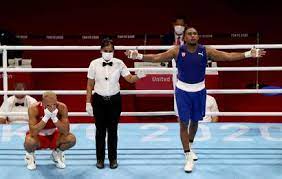

Lopez, who won middleweight gold at the Rio 2016 Olympics, fell to his knees and banged on the floor when he was named the victor, while Whittaker quickly left the ring with his hands over his face.
After receiving his gold medal, Lopez put his fingers to his lips, a gesture he said was towards “those who were against me or thought that I would not be able to make it or lacked motivation”.
His delight was in stark contrast to the 24-year-old Whittaker, who cut a devastated figure at the medal ceremony, trudging to the podium with his hands in his pockets and placing his medal in his tracksuit pocket rather than around his neck.

“At the time I should have taken it on the chin and put the beautiful silver medal around my neck and just smiled,” he said later.
“I did not want silver, I lost the gold, so to me it’s failure, so I am not going to celebrate silver at the moment.”
It had all been so different at the start. Whittaker jigged his way into the ring at Kokugikan Arena, better known as the home of sumo, Japan’s national sport.
But the more experienced Lopez had the Briton dancing to his tune from the first round, stalking Whittaker around the ring.
Lopez beckoned his opponent onto him, feeling that Whittaker was being too defensive, and a member of the British squad in the mostly empty arena shouted at his team-mate to “show no respect”.
Lopez, a former world champion in middleweight, led through two rounds of the scheduled three on the judges’ scorecards and the only surprise was that he was not awarded the bout on unanimous points.
Cuba, a powerhouse of Olympic boxing, have now won two of the three gold medals in the sport so far in Tokyo. The other went to Japan.
– More disappointment –
In the women’s competition Wednesday, there was also disappointment for India’s Lovlina Borgohain in the welterweight semi-finals.
She was well beaten by Turkey’s flamboyant Busenaz Surmeneli, who will face China’s Gu Hong in the final for gold on Saturday.
The 23-year-old Borgohain will still take home bronze, equalling the achievement of India’s trailblazing “Magnificent” Mary Kom, a London 2012 bronze medallist and national treasure back home.
XXXXXXXXXXXXXXXXXXXXXXXXXXXXXXXXXXXXXXXXXXXXXXXXXXXXXXXXXXXXXXXXXXXXXXXX
American wrestler Tamyra Mensah-Stock goes viral for patriotic interview

America’s Tamyra Mensah-Stock won gold at Tokyo in wrestling:
“I love representing the US. I freakin love living there. I love it and I’m so happy I get to represent U.S.A!”
— Daily Caller (@DailyCaller) August 3, 2021
The patriotism from Mensah-Stock probably would not be noteworthy in years past, but we have seen less of it from Americans at the Tokyo Olympics.
Mensah-Stock overcame a great deal of adversity to win a gold medal. She failed to qualify for a spot on the 2016 Olympic team. The 28-year-old also lost her father when she was in high school. Her winning a gold is one of many feel-good stories from Tokyo.
XXXXXXXXXXXXXXXXXXXXXXXXXXXXXXXXXXXXXXXXXXXXXXXXXXXXXXXXXXXXXXXOlympics-Athletics-Canada’s Warner breaks Games record on way to decathlon gold

Damian Warner
.jpg) Warner at the 2017 World Championships in Athletics
|
|
| Personal information | |
|---|---|
| Full name | Damian David George Warner |
| Nationality | Canadian |
| Born | November 4, 1989 London, Ontario, Canada |
| Height | 184 cm (6 ft 0 in)[1] |
| Weight | 83 kg (183 lb)[1] |
| Sport | |
| Country | Canada |
| Sport | Track and field |
| Event(s) | Decathlon |
| Achievements and titles | |
| Personal best(s) | Decathlon: 9018 NR (Tokyo 2021) |
|
Medal record
|
|
|---|---|
| Updated on October 3, 2019. |


Damian David George Warner (born November 4, 1989) is a Canadian track and field athlete specializing in decathlon. He is the 2020 Olympic champion and a three-time World medallist (silver in 2015, bronze in 2013 and 2019). Warner also won the bronze medal at the 2016 Summer Olympics and was the 2014 Commonwealth champion and the two-time and reigning Pan American champion from the 2015 and 2019 Games. Warner holds the title to the Pan Am Games record and the Canadian record for the decathlon, and the fourth-highest decathlon score in history. Notable for his sprinting, Warner holds decathlon bests in the 100 m and 110 m hurdles, running a 10.12 and 13.27 respectively, as well as in the long jump (8.28 m).


Career
Warner was born on November 4, 1989 in London, Ontario to Kevin Warner, a Black Barbadian, and Brenda Philpott, a White Canadian. He attended Montcalm Secondary School where he first showed his athleticism in Grade 10 on the football field and basketball courts under the guidance of English teacher and PE coach, Dennis Nielsen. Warner’s natural talent saw him move effortlessly into the athletics scene and by the age of 20, he had won silver in the decathlon at the 2010 Canadian championships with a final score of 7449. He continued to improve over the next two years, winning the decathlon in the next two national championships. His winning performance of 8107 in the 2012 championships was below the Olympic A qualifying standard of 8200, but in combination with his perceived future potential, he was selected to represent Canada at the 2012 Summer Olympics. Warner placed fifth at the 2012 Summer Olympics in London, with a point total of 8442, a jump of 335 points over his previous best score.
2013: World Championship bronze
In his first outing of 2013 Warner won at the high-profile Hypo Meeting with a score of 8307 points, including bests of 2.09 m in the high jump and 62.84 m in the javelin throw.[11] Following this Warner went into the 2013 World Championships in Athletics; after the first day he was in fifth place, but on the second day he tied a personal best in the pole vault and threw a personal best in the javelin to fight his way into the bronze medal position. After achieving his medal he said “This is such a great feeling, all the hard work my coaches and I put into this the last couple of years. In 2011 I finished 18th, saw the three medallists running around the track with their country’s flags draped over their shoulders, I told my coaches that I want that to be me, pretty special feeling to achieve that.” Warner’s final score of 8,512 was a new personal best and was the first time a Canadian reached the podium in the decathlon at the World Championships since Mike Smith in 1995. He ended his 2013 season with a win at the Decastar meeting with a tally of 8161 points.
2014: Commonwealth Games champion
The 2014 Commonwealth Games took place in Glasgow, Scotland. There Warner participated in the decathlon winning the event with a score of 8,282. This was Warner’s first decathlon of the year as he was sidelined much of the year with an ankle injury. Despite this he ran to a 10.29 in the 100 m, a games record for the decathlon, while also setting a PB in the 400 at 47.68. He finished the second day with a games record in the 110 m hurdles in a time of 13.50.
2015: Pan Am champion and World Championship silver
Warner followed up the next season competing first the prestigious Hypo-Meeting in Götzis, but there he fouled in all three of his shot put attempts resulting in a first disastrous event. The next major event for him was the 2015 Pan American Games taking place on home soil in Toronto. Warner came into the event as the favourite but defied expectations and hinted at his potential by lower the national record and setting the Pan Am Games record at 8,626. This beat Smith’s record which had stood since 1996. Warner and Smith equally provided plaudits for each other, with the new record holder saying of Smith and the fan’s that “That guy is amazing. There’s a reason that record stood for 19 years, and it took a lot to get that, and I’m so thankful for it. Michael Smith is just an amazing athlete and someone I look up to a lot. I’m glad I could be mentioned in the same name as him. I tried to [shake every hand], because when I came to the track today everybody and myself knew that I had to run a fast time in the 1,500 and the whole time, I didn’t know how I was on pace, and I just tried to . . . feed off the crowd. Whenever I went down the backstretch and the homestretch I could just hear the crowd going crazy, and I wouldn’t have been able to run that time without them and I just wanted to show my thanks in any way possible.”
Foregoing the standard rest period between decathlons, Warner went to the 2015 World Championships in Athletics just one month after winning gold in Toronto. He set a new national record (8695 points) and won a silver medal, while Ashton Eaton set a new world record in the same event.[19] Despite finishing with a new national record, he was disappointed not to break the 8,700-point barrier falling just five points short after finishing 15 seconds slower than his personal best in the 1,500 m: “I know what shape I’m in and I know I’m capable of running fast times, but I wasn’t able to do it yesterday. I didn’t quite feel as sharp as I did at the Pan Am Games. I didn’t have that little extra boost. But I don’t regret anything.”

2016: Olympic bronze
At the 2016 Olympics decathlon event in Rio de Janeiro, Warner was initially in second place behind Ashton Eaton, but following a surge by France’s Kevin Mayer and mediocre performances in the shot put and high jump he dropped to third place by the end of the first day of the events. On the second day, he initially resumed second place overall following a first-place finish in the 100-metre hurdles, but afterwards dropped behind Mayer again. Following the pole vault, he threatened to fall behind Kai Kazmirek, but ultimately saved his third-place position in the javelin throw. He finished in third place behind Eaton and Mayer, earning the bronze medal and becoming the second Canadian to medal in the decathlon, following Dave Steen at the 1988 Olympics in Seoul.
2017: World Championships
Warner competed at the 2017 IAAF World Championships hoping to capitalize on Eaton’s retirement. Unfortunately he was forced to be quarantined after coming down with the norovirus that affected many athletes in London that year. Warner struggled on the first day of competition and had to settle for fifth overall.
2018: Commonwealth Games
Warner was named to the Canadian team for the 2018 Commonwealth Games, where he was widely considered the frontrunner to defend his 2014 title. Warner performed strongly on the first day of the decathlon event, and midway through the second day, with seven events completed, was leading. However, disaster struck during the pole vault, when Warner failed to clear any height, immediately dropping from first place to sixth. With no chance of winning a medal, Warner then opted to withdraw from the remainder of the contest. Speaking afterward, Warner remarked “My body was good. There was no excuses. I just didn’t execute well. That’s the bitter truth. That’s why it so hard to deal with.”
Following his disappointment in Australia, Warner won his fourth (and third consecutive) Hypo-Meeting, setting a new Canadian record in the process. Warner commented that the result “means a lot.”
2019: World bronze, Pan Am gold
In May 2019, Warner won his fifth Hypo-Meeting, becoming one of only three athletes to win the event five times. In the process, he broke his own record for the decathlon best in the 100m sprint with a time of 10.12 seconds, and set a new personal best in the shot put.
Warner was one of the more prominent Canadian athletes who opted to attend the 2019 Pan American Games in Lima, aiming to defend his 2015 title. Despite dealing with lingering ankle pain, he successfully repeated as the Pan Am decathlon champion, finishing 273 points ahead of silver medalist Lindon Victor of Grenada. Fellow Canadian decathlete Pierce LePage joined him on the podium as bronze medalist.
Warner concluded the season at decathlon event the 2019 World Championships in Doha. Midway though the event, defending champion Kevin Mayer of France withdrew as a result of injury, briefly making Warner the perceived favourite for the gold medal. However, Warner performed below his normal standard in some events, and was in second place heading into the final segment of the competition, the 1500m race. He finished ninth in that segment, below his personal best times, and dropped to third place overall behind a surging Niklas Kaul of Germany and Estonia‘s Maicel Uibo. This was his third World championship medal. Warner deemed the result “a little bit disappointing”, also citing challenges in the weeks leading up to the event, but said he looked forward to preparing for the following year’s Olympics. However, with the COVID-19 pandemic forcing the cancellation of the 2020 international athletic season and the delaying of the Tokyo Olympics, it would prove to be Warner’s final competition for almost two years.
2021: Olympic gold
The pandemic brought additional challenges for Warner, as the training facilities at the University of Western Ontario were closed as a result, and Warner was unable to travel to the United States to train. Instead, Warner and his coaches transformed the unheated interior of London, Ontario‘s 66-year-old Farquharson Arena into a decathlete training facility. However, he also later credited the time away from competition as affording the opportunity to heal persistent ankle injuries.
Warner returned to competition at the 2021 Hypo-Meeting, where he became the first man to win six event titles. He set his third decathlon best, this time in the long jump, at 8.28m, and a new personal and national record in overall points, with 8,995 points. This was only five points short of making him the fourth decathlete in history to score over 9000 points.
The decathlon event at the 2020 Summer Olympics was widely considered at the outset to be a contest for gold between Warner and French rival Kevin Mayer. On day one, Warner opened the event by repeating his world decathlon best time of 10.12 in the 100 m sprint, setting an Olympic Games record in the process. In the long jump he recorded a distance of 8.24 metres, another Olympic record and just 0.04 shy of the world decathlon best he had set earlier at the Hypo-Meeting. Warner’s distance would have earned him a bronze medal had he performed it in the standalone long jump competition in Tokyo. He then set a season’s best in the shot put, covering 14.80 metres in his third throw. In the high jump he cleared 2.02 m, but failed on all three attempts at 2.05, conceding ground to Mayer, who successfully cleared 2.08 m. Warner closed out the day in the 400 m, recording a season’s best time of 47.48 and finished third in the segment behind Australian Ashley Moloney and compatriot Pierce LePage. Halfway through, Warner was in first place with 4722 points, 81 points ahead of Moloney in second and 382 points ahead of Mayer in fifth.
Day two of the Olympic decathlon began with Warner running the 110 m hurdles in 13.46, one tenth of a second slower than his season’s best, but an Olympic record, his third of the competition. He then recorded a 48.67 m opening discus throw, which would end up being the third-best in the field, ahead of Mayer. In the pole vault, traditionally his weakest event, Warner equaled his previous personal best of 4.90 m, before failing on three attempts at clearing 5 m for the first time. Mayer cleared on 5.20 m in the same segment where he was expected to make up significant ground, and as a result Warner maintained a lead of 361 points on his main rival at the end of eight of the ten events. Resuming competition in the afternoon, Warner’s best javelin throw covered 63.44 m, a significant improvement on his performance at the Hypo-Meeting earlier in the year and close to his personal best. Mayer threw a new personal best distance of 73.09, gaining 147 points on Warner, but this still left Warner ahead by 214 points going into the closing 1500 m race. Warner came fifth in that segment, taking the gold medal and in the process becoming the fourth decathlete to score over 9000 points with a 9018 score. This was the Olympic record. He was the second Canadian man to win a medal at the Tokyo Olympics, after Andre De Grasse.
Personal life
Warner and partner Jennifer Cotten, a former elite hurdler, became the parents of a son, Theo, in March of 2021.
Personal bests (outdoor)
| Event | Performance | Location | Date | Points |
|---|---|---|---|---|
| Decathlon | 9,018 | Tokyo | August 4–5, 2021 | |
| 100 metres | 10.12[a] | Götzis | May 25, 2019[35] | 1066 points |
| Tokyo | August 4, 2021 | |||
| Long jump | 8.28[a] | Götzis | May 29, 2021 | 1133 points |
| Shot put | 15.34 | Götzis | May 25, 2019[36] | 811 points |
| High jump | 2.09 | Götzis | May 25, 2013 | 887 points |
| 400 metres | 46.54 | Athens, Georgia | April 30, 2016 | 981 points |
| 110 metres hurdles | 13.27 | Edmonton | July 4, 2015[37] | |
| 13.36[a] | Toronto | July 23, 2015[38] | 1059 points | |
| Discus throw | 50.26 | Santa Barbara | March 19, 2016 | 876 points |
| Pole vault | 4.90 | Bolton, Ontario | July 16, 2016 | 880 points |
| Javelin throw | 64.67 | Moscow | August 11, 2013 | 808 points |
| 1500 metres | 4:24.73 | Toronto | July 23, 2015 | 780 points |
Achievements
- National & Olympic record: 9,018 points, 2020 Summer Olympics, Tokyo, Japan
- 1st, 2011 & 2012 National Championships, Calgary, Alberta, Canada.
- 3rd, Decathlon, IAAF 2013 World Championships, Moscow, Russia
- 1st, Decathlon, 2014 Commonwealth Games, Glasgow, Scotland
- 1st, Decathlon, 2015 Pan American Games, Toronto, Ontario, Canada
- 2nd, Decathlon, IAAF 2015 World Championships, Beijing, China
- 3rd, Decathlon, 2016 Summer Olympics, Rio de Janeiro, Brazil
- 1st, Decathlon, 2020 Summer Olympics, Tokyo, Japan
XXXXXXXXXXXXXXXXXXXXXXXXXXXXXXXXXXXXXXXXXXXXXXXXXXXXXXXXXXXXXXXX
Bahamian Steven Gardiner wins the men’s 400m gold medal

Gardiner added the Olympic gold medal to the world title in the one-lap sprint event. Colombia’s Anthony Zambrano won silver with former champion Kirani James of Grenada taking bronze.
Steven Gardiner
 Gardiner at the 2019 World Championships
|
|
| Personal information | |
|---|---|
| Nationality | Bahamian |
| Born | 12 September 1995 Abaco, Bahamas |
| Height | 193 cm (6 ft 4 in)[1] |
| Weight | 94 kg (207 lb)[1] |
| Sport | |
| Country | Bahamas |
| Sport | Track and field |
| Event(s) | Sprints |
| Coached by | Gary Evans |
| Achievements and titles | |
| Personal best(s) | |
|
Medal record
|
|---|
Steven Gardiner (born 12 September 1995) is a Bahamian track and field sprinter competing in the 400 metres and 200 metres. He is the current Olympic and world champion in the 400 m, and also won the silver medal at the 2017 World Championships in that event.[2] His winning time of 43.48 s from the 2019 World Championships is the Bahamian record and makes him the sixth-fastest man in the history of the event.[3] Gardiner also owns the Bahamian records in the 300 m and 200 m, with times of 31.83 s and 19.75 s respectively.
Early life
Gardiner was born in Murphy Town, Central Abaco in the Bahamas.[4] During his teenage years Gardiner was a competitive volleyball player, but also ran track and field. Gardiner wanted to transition to track and field in the shorter sprints, but his high school coach said he was too tall, so he became a 400 m runner.[5]
Career
Gardiner competed in the sport in his teenage years and ran in the 400 m at the national championships in 2013. He entered three events at the 2014 CARIFTA Games: he only managed fourth in the individual 200 m but claimed a silver in the 4 × 100 m relay and a bronze in the 4 × 400 m relay.[6] He marked himself as one of Bahamas top young athletes with a win at the Bahamian junior championships in June that year.[7] An appearance at the 2014 World Junior Championships in Athletics resulted in a semi-final run in the 200 m and a sixth-place finish in the 4 × 400 m.[8]
His first senior medal came at the 2015 IAAF World Relays, held on home turf, where he gave American competitor Jeremy Wariner a close run in the 4 × 400 m relay, helping the Bahamas to the silver medal alongside Ramon Miller, Michael Mathieu and Chris Brown.[9] He began to focus on the 400 m in the 2015 season and this proved a successful transition. He rapidly improved to become the youngest Bahamian ever, at 19 years old, to run the distance under 45 seconds, and moved up to fourth on the Bahamian all-time lists with a best of 44.64 seconds. He set the time at the Bislett Games, which brought him victory on his debut on the IAAF Diamond League circuit, finishing ahead of Matthew Hudson-Smith and Pavel Maslák.[10][11]
In 2019 he won the 400 m at the 2019 World Athletics Championships, finishing ahead of American favorite Fred Kerley in a national record of 43.48 s, which also made him the sixth fastest man in history after the race.[2]
Statistics
All information from World Athletics profile unless otherwise noted.[12]
Personal bests
| Event | Time | Venue | Date | Notes |
|---|---|---|---|---|
| 200 m | 19.75 | Coral Gables, Florida, U.S. | 7 April 2018 | (+0.3 m/s wind) NR |
| 300 m | 31.83 | Alachua, Florida, U.S. | 5 July 2020 | NR |
| 400 m | 43.48 | Doha, Qatar | 4 October 2019 | NR |
| 4×400 m relay | 2:58.49 | Rio de Janeiro, Brazil | 20 August 2016 |
International competitions
| Year | Competition | Venue | Position | Event | Notes |
|---|---|---|---|---|---|
Representing the  |
|||||
| 2014 | CARIFTA Games (U20) | Fort-de-France, Martinique | 4th | 200 m | 20.87 (+1.3 m/s wind) |
| 2nd | 4×100 m relay | 40.35 | |||
| 3rd | 4×400 m relay | 3:11.32 | |||
| World Junior Championships | Eugene, United States | 12th (sf) | 200 m | 20.89 (+1.8 m/s wind) | |
| 6th | 4×400 m relay | 3:08.08 | |||
| 2015 | World Relays | Nassau, Bahamas | 2nd | 4×400 m relay | 2:58.91 |
| World Championships | Beijing, China | 16th (sf) | 400 m | 44.98 | |
| DQ | 4×400 m relay | Lane violation[13] | |||
| 2016 | Olympic Games | Rio de Janeiro, Brazil | 11th (sf) | 400 m | 44.72 |
| 3rd | 4×400 m relay | 2:58.49 | |||
| 2017 | World Relays | Nassau, Bahamas | 9th (sf) | 4×400 m relay | 3:05.37 |
| 1st | 4×400 m relay mixed | 3:14.42 | |||
| World Championships | London, United Kingdom | 2nd | 400 m | 44.41 | |
| 2019 | World Championships | Doha, Qatar | 1st | 400 m | 43.48 NR |
| 2021 | Olympic Games | Tokyo, Japan | 1st | 400 m | 43.85 |
400 m circuit wins




