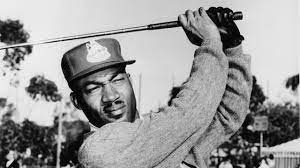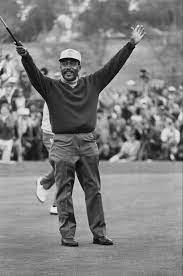
Charlie Sifford became the first African-American to join the PGA Tour in 1961.

Born: June 2, 1922

Died: Feb. 3, 2015

His story: Charlie Sifford was born in Charlotte, North Carolina, and started working as a golf caddie when he was 13. Four years later he moved to Philadelphia and played against black golfers. He made his professional debut in 1948. He earned six United Golf Association National Negro Open championships, including five straight from 1952-56. He also tried to qualify for PGA Tour events during that stretch, his first attempt at the 1952 Phoenix Open after getting an invite from Joe Louis. He won the 1957 Long Beach Open, a PGA co-sponsored event. He tied for 32nd in the 1959 U.S. Open. Sifford faced threats at tournaments because he was black. He joined the PGA Tour in 1961 after the end of the “Caucasian-only” membership clause. He won two money events during his career, the Greater Hartford Open in 1967 and the Los Angeles Open in 1969. His best finish in a major was 21st place at the 1972 U.S. Open. He won two senior tour championships, including the 1975 Senior PGA Championship. He became the first black golfer inducted into the World Golf Hall of Fame in 2004.

Fast fact: Sifford, at age 92, received the Presidential Medal of Freedom from President Barack Obama in 2014.

Quotable: “Golf was not a game for ghettos. Neither did it leave any time for carrying picket signs, joining demonstrations or running for office. Charlie birdied, not talked, his way through society prejudice. He broke barriers by breaking par. His weapon was a nine-iron, not a microphone,” Los Angeles Times columnist Jim Murray wrote before Sifford won the 1969 Los Angeles Open.

An illustration from "Charlie Takes His Shot, How Charlie Sifford Broke the Color Line in Golf".
  • Facebook
  • Twitter
  • Google+
  • LinkedIn

Charlie Sifford: golf’s first Black professional who paved the way for Tiger Woods

(CNN)When Charlie Sifford tried to play with the White golfers, he was told no.

When he politely asked again after participating in events solely for Black players, he was on the receiving end of racist abuse or even death threats.
But Sifford did not give up.
With the backing of California attorney general Stanley Mosk and with fellow trailblazer Jackie Robinson by his side, Sifford became the first Black player to play on the PGA Tour in 1959.
And if you visit the Tiger Woods exhibition at the National Museum of African-American History and Culture in Washington, D.C., you’ll see a photo of Sifford.

Tiger Woods with Sifford during a practice round of the World Golf Championship Bridgestone Invitational in 2009.
  • Facebook
  • Twitter
  • Google+
  • LinkedIn

In breaking through the ‘Caucasian only’ clause in golf, Sifford helped open the door for other Black golfers, including the most famous Black golfer of all time, Woods.
And it’s something Woods recognized, saying in 2015 following Sifford’s death that he himself might not have been a professional golfer if it hadn’t been for Sifford.
“He’s like the Grandpa I never had,” Woods said after a practice round in advance of the 2015 Farmers Insurance Open at Torrey Pines, the day after Sifford’s death. “It’s been a long night, and I’m sure it will be a long few days. He fought, and what he did, the courage for him to stick with it and be out here and play.
“I probably wouldn’t be here (without Sifford). My dad would never have picked up the game. Who knows if the clause would still exist or not? But he broke it down.”
While Sifford was the first Black player to make it through in golf, he had someone close to him to lean on.
Robinson, who broke the color barrier in Major League Baseball as a player in 1947, was a friend of Sifford’s, and from his own experiences, passed on some advice to the golfer before he started his journey to make it onto the Tour.
“Jackie told him that he’s going to have to face up to a lot of things, not respond to a lot of things because once he did that, it would be harder for him and harder for the people coming up behind him,” Charles Sifford, Charlie’s son, remembers.
“So he kept a stiff upper lip, bit his tongue and just dealt with what was presented towards him because he knew if he messed up that it would be even harder for the next guy coming along.”

Sifford studies a shot in the FHP Health Classic at the Ojai Inn Country Club in Ojai, California.
  • Facebook
  • Twitter
  • Google+
  • LinkedIn

Having to move

Born in Charlotte, North Carolina in 1922, Sifford got into golf through the only avenue available to a young, Black kid — caddying.
But he wanted to play the game — at the age of 13, he could shoot a par round of 18 holes — and not carry someone else’s bag.
However, growing up in the age of segregation, opportunities for him to gain experience on courses weren’t easy to come by.
He did eventually begin playing professionally in 1948, but — because of the so-called “Caucasian only” clause which blocked Black players from playing with their White counterparts — Sifford had to settle for playing in Black-only competitions.
By the time Sifford was in his 30s, segregation laws were slowly being abandoned, but golf proved less quick in moving with the times.
“In 1959, you still had the ‘Caucasian only’ clause, and it was easy to see how it could persist because golf was played on these private clubs, and they were able to continue to enforce the segregation rules,” Nancy Churnin — author of “Charlie Takes His Shot: How Charlie Sifford Broke the Color Barrier in Golf” — told CNN Sport.

Sifford practices on the range.
  • Facebook
  • Twitter
  • Google+
  • LinkedIn

“So if you can’t step foot in these private clubs, how are you going to play?”
Sifford’s journey to play on the PGA Tour was not a spur-of-the-moment decision. It was something he worked to achieve for years.
His first attempt to break onto the Professional Golfers’ Association of America (PGA) Tour in 1952 was met with vitriol and racial pressure.
At the Phoenix Open, Sifford and his all-Black foursome — which included the heavyweight boxer Joe Louis — found excrement in the cup of the first hole and had to wait nearly an hour for it to be replaced.
Unable to display his ability with all the best players, Sifford took his talents elsewhere — to great success.
He won the United Golf Association’s National Negro Open six times, securing consecutive victories from 1952 through 1956.
However, his dream was to showcase his abilities on the biggest stage in golf with the best in the business, and that meant making some sacrifices, as his son, Charles, remembers.
“When I was about 10 years old, I realized that we lived in Philadelphia, and my father really couldn’t play in a lot of tournaments,” he told CNN Sport. “There wasn’t a lot of exposure to golf on the East Coast so we moved to the West Coast when I was 10. And that’s when he told me that in order to succeed or have a chance to succeed, we had to move west.”

Sifford is presented with the North-South Negro Golf Tournament trophy by night club celebrity Nat "King" Cole.
  • Facebook
  • Twitter
  • Google+
  • LinkedIn

Breaking through

Baseball star Robinson was a figure of inspiration and an example of what Sifford hoped to achieve in golf. But Sifford also realized he was going to need some legal help.
After his move out to the West Coast of the US, Sifford became friends with California attorney general Stanley Mosk.
Mosk was Jewish and had also experienced discrimination firsthand. He played golf at the Hillcrest Country Club in Los Angeles, which allowed members from the Jewish community when other clubs didn’t allow them access.
Award-winning actor Billy Crystal, in his eulogy for Muhammad Ali at the great boxer’s funeral in 2016, recalled an incident which highlighted golf’s closed-door policy.
Ali invited his good friend Crystal to go for a run on a golf course, not realizing that the club didn’t allow Jewish members.
“(Ali) was incensed: ‘I’m a Black Muslim and they let me run there. Little brother, I’m never gonna run there again,'” Crystal remembers Ali saying.

Billy Crystal and Muhammad Ali at Audemars Piguet's Time To Give Celebrity Watch Auction For Charity, held at Christie's Auction House in New York City in 2000.
  • Facebook
  • Twitter
  • Google+
  • LinkedIn

Sifford’s skill impressed Mosk immediately. And the fact that someone with such ability was unable to perform on the biggest stage angered him.
So Mosk set about helping Sifford in his quest to play on the PGA Tour.
As the attorney general of California, Mosk was able to bring about some political sway to Sifford’s battle. Later, Mosk served as Associate Justice of the California Supreme Court for 37 years — the longest tenure in that court’s history.
After years of letters and conversations, Sifford finally earned a PGA Tour player card in 1960 at the age of 39, becoming the first Black player to play on the Tour.
A year later, following significant pressure, the PGA Tour dropped its “Caucasian only” membership clause.
However, Sifford was consistently subjected to racist abuse from White golfers and spectators.
His son Charles also remembers hearing stories about death threats sent to his father during those years.
“Several times when he was playing down in the South (region of the US), he had a couple of death threats,” Charles explained. “People would call him at his hotel room and told him that if he showed up at the golf course, they were going to kill him.
“He said: ‘Well, you’re just going to have to do that because I’m showing up at the golf course.’ So he was just that determined not to let anybody stand in his way and doing what he wanted to do. And he had that drive in him. The more you tried to stop him, the more he was going to try to succeed.”

An illustration from "Charlie Takes His Shot, How Charlie Sifford Broke the Color Line in Golf".
  • Facebook
  • Twitter
  • Google+
  • LinkedIn

Change in the wind

Although he was late into his 30s when he made it onto the PGA Tour, Sifford was still able to show he could compete against the best golfers — despite the hostility he encountered, both on and off the golf course.
Churnin recalls reading about hotels that wouldn’t rent him rooms or clubs that still wouldn’t let him eat with other professionals or use the locker room because of his skin color.
However, the 1967 Greater Hartford Open — now the Travelers Championship — in Connecticut proved a watershed. “That was the first time the crowd was on his side,” according to Churnin.
And it appeared to make a difference, as Sifford claimed his maiden PGA Tour victory at the event, becoming the first Black player to earn a PGA Tour win.

Sifford is presented a check for $20,000 plus the trophy after winning the Los Angeles Open.
  • Facebook
  • Twitter
  • Google+
  • LinkedIn

Although he wasn’t aware his dad had won because there wasn’t wall-to-wall TV golf coverage as there is today, Charles remembers a palpable change in Sifford after the momentous victory.
“I saw it in the newspaper, and I was really excited for him because that was a lifelong dream to be able to win on the PGA Tour. And it took a lot of pressure off of him. He appeared to be more relaxed knowing that he did it once, and there was always a possibility he could do it again.”
Sifford would go on to win the 1969 Los Angeles Open (now The Genesis Invitational) as well as the 1975 Senior PGA Championship and become an original member of PGA Tour Champions, where he won the Suntree Classic.
In 2004, he became the first Black golfer to be enshrined in the World Golf Hall of Fame.

Sifford during the Ralph's Senior Classic tournament on October 21, 1994 at the Rancho Park Golf Course in Los Angeles.
  • Facebook
  • Twitter
  • Google+
  • LinkedIn

Paving the way

President Barack Obama also awarded Sifford the 2014 Presidential Medal of Freedom “for altering the course of the sport and the country he loved.”
Although Charles admits that Sifford was “highly disappointed” there hasn’t been a huge influx of Black golfers following him, being the first Black player on the PGA Tour was something he was extremely proud of.
Churnin says it wasn’t for lack of effort or commitment from Sifford that the number of Blacks following in his golfing footsteps wasn’t massive.

Then US President Barack Obama presents the Medal of Freedom to Sifford on November 24, 2014.
  • Facebook
  • Twitter
  • Google+
  • LinkedIn

“We all have different tools at our disposal,” she explained. “Some of us use words; some of us use music; some of us will run for office, some of us will be legal scholars.
“We all come into this world and our job as we come into this world is to try to make the world a better place — a better, a more equal, a more just, a kind, a more loving, a more inclusive place. This is a man who used the tool of the golf club to fight for justice. He knew he was not going to see all the fruits of that fight in his own lifetime.
“But he used his golf club for fairness, equality, to make the world a better place for others. And he got to see the promised land from where he was, because now that he knocked down this door, he had made it a place where others behind him could go and realize their dreams on the golf course.”

Charlie Sifford

Charlie Sifford
Charlie Sifford 1961.JPG
  • Facebook
  • Twitter
  • Google+
  • LinkedIn

Sifford in 1961
Personal information
Full name Charles Luther Sifford
Born June 2, 1922
Charlotte, North Carolina
Died February 3, 2015 (aged 92)
Cleveland, Ohio
Nationality
  • Facebook
  • Twitter
  • Google+
  • LinkedIn
 
United States
Residence Brecksville, Ohio[1]
Career
Turned professional 1948
Former tour(s) PGA Tour
Champions Tour
Professional wins 22
Number of wins by tour
PGA Tour 2
PGA Tour Champions 1
Other 19
Best results in major championships
Masters Tournament DNP
PGA Championship T33: 1965
U.S. Open T21: 1972
The Open Championship DNP
Achievements and awards
World Golf Hall of Fame 2004 (member page)
Old Tom Morris Award 2007
Presidential Medal
of Freedom
2014

  • Facebook
  • Twitter
  • Google+
  • LinkedIn

Charles Luther Sifford (June 2, 1922 – February 3, 2015) was an American professional golfer who was the first African American to play on the PGA Tour. He won the Greater Hartford Open in 1967 and the Los Angeles Open in 1969. He also won the United Golf Association‘s National Negro Open six times, and the PGA Seniors’ Championship in 1975.

For his contributions to golf, Sifford was inducted into the World Golf Hall of Fame in 2004. He was awarded the Old Tom Morris Award in 2007, the Presidential Medal of Freedom in 2014, and an honorary doctorate from the University of St Andrews. Lee Trevino referred to Sifford as the “Jackie Robinson” of golf, and Tiger Woods acknowledged that Sifford paved the way for his career.

Early life and career

Sifford was born in Charlotte, North Carolina, in 1922. He began work as a caddy at the age of thirteen. He moved to Philadelphia when he was 17 years old, where he played against local black golfers.

Sifford began golfing professionally in 1948. He competed in the golf tournaments that black golfers organized for themselves as they were excluded from the Professional Golfers’ Association of America (PGA). Sifford won the United Golf Association‘s National Negro Open six times, including consecutive wins from 1952 through 1956. Sifford later worked as a valet and golf instructor to the singer Billy Eckstine, who also financially supported his career when he was unable to find sponsorship.

Sifford first attempted to qualify for a PGA Tour event at the 1952 Phoenix Open, using an invitation obtained by former World heavyweight boxing champion Joe Louis. Sifford was subjected to threats and racial abuse there and at other tournaments.

In 1957, Sifford won the Long Beach Open, which was not an official PGA Tour event, but was co-sponsored by the PGA and had some well-known white players in the field. Sifford competed in the U. S. Open in 1959 for the first time, and tied for 32nd place. He became a member of the Tour in 1961, thus becoming the first African-American to join the PGA Tour. He went on to win two official money events, the 1967 Greater Hartford Open and the 1969 Los Angeles Open, and finished in the top 60 in overall winnings in his first nine years as a member of the PGA Tour. He also won the 1963 Puerto Rico Open and at the 1971 Sea Pines. He tied for 21st place at the 1972 U.S. Open, his best finish in a major tournament. He competed in the PGA Seniors’ Championship, then the leading tournament for golfers over fifty, winning the event in 1975.

Personal life

Sifford’s wife, Rose, died in 1998. They had two sons, Charles Jr. and Craig.

Sifford, a resident of Brecksville, Ohio, was hospitalized for a stroke one month prior to his death in Cleveland, Ohio.[13] He died on February 3, 2015, following that stroke at the age of 92.

In July 2015, Craig Sifford and his wife, Sandra, were indicted and accused of spending more than a million dollars of Charlie Sifford’s money. A Cuyahoga County grand jury indicted them with three counts of theft, one count of money laundering, and one count of unauthorized use of property. Sandra Sifford is also facing an additional charge of receiving stolen property.

Honors

Lee Trevino said of Sifford, “You have to put him in the Jackie Robinson category”.[10] Tiger Woods named his son Charlie after him and referred to Sifford as “the Grandpa I never had,” and that, without Sifford, “I probably wouldn’t be here. My dad would have never have picked up the game. Who knows if the clause would still exist or not? But he broke it down”.

In 2004, Sifford became the first African American inducted into the World Golf Hall of Fame. He chose Hall of Fame member South African Gary Player to present him for induction. On June 22, 2006, he received an honorary degree from the University of St Andrews as a Doctor of Laws. He also received the 2007 Old Tom Morris Award from the Golf Course Superintendents Association of America (GCSAA), the GCSAA’s highest honor.

In 2009, the Northern Trust Open created an exemption for a player who represents the advancement of diversity in golf; it is named in honor of Sifford and is referred to as the Charlie Sifford Exemption.

In 2011, Mecklenburg County Park and Recreation changed the name of Revolution Park Golf Course to Dr. Charles L. Sifford Golf Course at Revolution Park.

President Barack Obama awarded him the 2014 Presidential Medal of Freedom.

  • Facebook
  • Twitter
  • Google+
  • LinkedIn