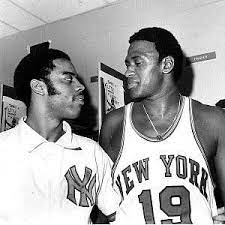
Willis Reed, Clyde Frazier take you inside Knicks’ 1970 NBA title run
Q: The mindset of the team in training camp after losing to the Celtics in the 1969 Eastern Division finals?
Clyde: Championship.
Willis: We thought we had all the pieces. We knew that (the Celtics’ Bill) Russell and Sam Jones were supposed to be retiring. And we knew that there’s no way they could replace Russell and Sam Jones both, and we thought we were gonna be the best team in the East.
Q: The 18-game winning streak?
Clyde: By the third quarter, the starting team was on the bench.
Q: The Bullets first-round, seven-game playoff series?
Willis: We had some great matchups. We had Dave DeBusschere and Gus (Johnson), and myself and Wes (Unseld), and then Jack Marin and Cazzie (Russell) and Bill (Bradley). And we had Earl (Monroe) and Clyde, and Freddie Carter and (Dick) Barnett.
Clyde: It’s always hell with the Bullets. When you win, you lose (laugh). It’s gonna be so physical … every matchup was like an All-Star matchup. They liked to run, and we knew that if we could hang close, we could pull it out in the end because of our teamwork and our defense.
Q: The Bucks and Kareem Abdul-Jabbar were next.
Willis: I thought the advantage we had against him was he was just a young player. I knew that if I didn’t play close to the basket, if I went away from the basket a ways, that he wasn’t gonna go.
Q: Clyde thought that you intimidated Kareem.
Willis: No. He was just a young player.
Clyde: Willis roughed him up, forcing him further out than he wanted to be with the sky hook. We kinda imposed our will on them because we knew they were kind of a young team.

Q: You thought that Willis intimidated Kareem?
Clyde: Oh yeah, yeah. He was appalled by how Willis was throwing him around.
Q: Then the mighty Lakers. The reaction when Jerry West hit that 60-foot buzzer-beater to force overtime in Game 3?
Clyde: Well, DeBusschere did it best, he fell down (laugh). DeBusschere crumpled to the floor, man. When we go back to the huddle (Red) Holzman is always cool and calm: “All right guys, come on, we gotta play five more minutes, we’ll pull it out.” And I’m saying to myself, “Wait man, if God wanted us to win that game, He wouldn’t have let that shot go in.”
Willis: (Prolonged laugh). If I remember correctly, DeBusschere had ran back, was standing under the basket, when the ball went through the basket, he fell flat on his back (laugh).
Q: Do you remember the huddle before OT began?
Willis: Everybody was going through their own emotion and stuff and disorganized, and Barnett said, “Hey, man, what’s wrong with you guys? This game’s not over — it just started.” That was the kind of thing that I liked about that team; you always had somebody else ready to go get it done.
Q: What were your immediate thoughts when Willis went down (torn thigh muscle) driving to the basket in the first quarter of Game 5?
Clyde: There goes the series! When The Captain was lying on the floor in pain, I wasn’t sure if he could return or not.
Willis: It was just one of those things. You’re saying, “How bad could our luck be?”
Q: That incredible second-half Game 5 comeback, when undersized Dave Stallworth somehow helped contain Wilt Chamberlain.
Clyde: At halftime we changed our offense, we went to a more college 1-3-1 opening up the court so that Chamberlain had to come on the perimeter, and Stallworth was a good guy off the dribble, so he was able to create a lot of havoc.
Willis: On any one night, any one player could be the leading scorer. Most of our players had been great offensive college players. We were hard to beat at Madison Square Garden with our fans.
Q: What was it like for you on the bench watching Wilt (45 points, 27 rebounds) lead the Game 6 rout?
Wills: We knew we were gonna fight another day.
Q: But you didn’t know if you were gonna fight another day.
Willis: Listen, I believe if I didn’t play, I believe we would have won at home. But I didn’t want them to play in that big dance without me, though.
Q: You were The Captain.
Willis: A captain is a responsibility. You don’t tell guys what to do, you show guys what to do.
Q: What made Willis The Captain?
Clyde: His leadership qualities; he’s a man’s man. Nobody gives more effort than Willis. With the players, he was the most generous person that you’ll ever meet.
Q: What percent chance did you think you had to play?
Willis: I always believed I was gonna play.
Q: The team left Los Angeles the next morning.
Willis: I left that night after the game so I could start getting treatments the next day.
Q: On your walk from the New Yorker Hotel to the Garden on May 8, was it painful?
Willis: Well, walking didn’t hurt. When you extended the leg where you had to use all of the muscles, that’s when it hurt.
Q: You got there around noon.
Willis: Basically I was getting whirlpool, heat packs, cold packs, all that kind of stuff on the muscle in my leg.
Q: Who was going to defend Wilt?
Clyde: I was living at the New Yorker Hotel on 34th and 8th, so when I went to the game I made a few calls during the day, no one knew anything whether Willis would play or not. Only when we got to the arena did we realize that he was still hurting, he had been there all day getting treatment, and still was questionable for the game.

Q: Did you wear a special game-day outfit?
Clyde: That day I wasn’t concerned with my outfit. … I can’t even remember what I wore for that game because I was so concerned with Willis, ‘Was he gonna play, man?’ Knowing that without him, we didn’t really have a chance to win that game.
Q: Every Knick was concerned?
Clyde: We were all in the training room and Holzman ran us out: “Hey guys, whether Willis plays or not, we have to. Go get ready mentally to play the game.” He was looking apprehensive, he was sitting up in the corner leaning on the wall like maybe 50-50, “I don’t know, I might give it a try.” He wasn’t that sure what he would do. So then when we left, Willis was still in there with the door closed, so we had no idea whether he was coming out or not.
Q: Willis told me there was no way he wasn’t gonna play.
Clyde: Yeah, but he didn’t tell us that.
Q: How close to game time did Dr. James Parkes administer the cortisone shot?
Willis: I probably should have had it a little earlier. The players were warming up when I went out on the floor. We were within 15 minutes of game time, for sure.
Q: What was going through your mind as you were limping through the tunnel?
Willis: I said to myself, “As a kid you dream of being in the championship games.” And I’m saying, “Boy, this is a helluva predicament you’re in. You gotta go out there and play the best big man offensively that ever played the game, and you gotta try to play him on one leg (laugh).”
Q: When the crowd first saw you, how loud was it?
Willis: On a Friday night in Madison Square Garden, the crowd is gonna be ready, they’re gonna be rocking, and they were.
Q: Did you see him immediately?
Clyde: Well first you hear this roar of the crowd. Then you turn around and see what’s going on, and that was Willis limping out of the tunnel. And I’ll never forget, I saw Chamberlain, I saw (Elgin) Baylor, I saw West — they just stopped what they were doing and they were staring at Willis. And that gave me so much confidence when I saw them doing that, I go, “Hey, we got these guys.”

Q: When you started playing, how much pain was there?
Willis: The only way I could prevent there from being pain was I had to kinda drag the leg as opposed to picking it up. When I picked it up, I would have to use all the muscles. If I kinda slid it along, it didn’t hurt as much.
Clyde: He was trying not to limp, but you could tell that he was in pain.
Q: You passed him the ball for that first shot.
Clyde: I didn’t think he would shoot it (laugh). Then after he made the second shot, I went, “There ain’t nothing wrong with this guy!”
Q: You were a man possessed (36 points, 19 assists) after Willis hit those two shots.
Clyde: When we left the locker room, Holzman pulled me to the side: “Hey Clyde, hit the open man, get everybody involved.” But as the game progressed, I was the open man. But the dye was cast after Willis made his first two shots. The Lakers were psyched out, I was psyched up (laugh), so was the rest of the team, the crowd was in a frenzy, and it just rolled from there, man. We believed we could do it.
Q: Willis limping out was an inspiration to you?
Clyde: Oh yeah. If he didn’t do what he did, I would not have had that game. I would had not have the confidence.
Willis: Walt was a helluva player.
Q: Was that the loudest you’ve heard the Garden?
Clyde: Yeah, yeah. It’s been close with (John) Starks, with (Jeremy) Lin, with LJ (Larry Johnson). But I don’t think it’s reached that peak.
Q: Describe that feeling of winning the NBA championship.
Willis: Bill Russell won 11 out of 13 championships. There weren’t a lot of guys winning championships in that stretch (laugh). It’s a personal satisfaction that you and all the other guys have that … only so many people can have that.
Q: What made that team a championship team?
Willis: You had guys who had played places and they had leadership ability, and they were willing to be the man, take big shots. I think it was the quality of the men. And I think the thing that amazes me was that the guy who basically scouted all of us, and picked us to become players on the Knicks was Holzman, with no idea that he would one day be coaching us. I’m sure that there were a little idiosyncrasies about different players on our team that Red picked up scouting when we were in college that really helped him when he coached us. Some guys are fair-weather players. We didn’t have any quitters.
Q: Hit the open man was his philosophy.
Willis: He picked guys that were willing to play together. It didn’t make no difference to him who was the leading scorer. All he wanted to just to do is to win the game. And give the ball to the open guy.
Clyde: We personified team.
Q: What was the celebration like that night?
Clyde: I had so much champagne that night, man, people just buying us a drink, I couldn’t spend any money for months. We just went all over town, we started out down on the East Side, we ended up at Chamberlain’s place up in Harlem, they stayed open til like 4 o’clock.

Q: Your emotions 50 years later.
Willis: As a Knick player, the only team I played for, I’m a Knick forever, I was disappointed that when DeBusschere was GM with Patrick (Ewing), that they had a shot at it and they didn’t get it done. I thought they had enough talent to do it.
I’m a lucky enough guy that won a championship in high school, college and then pro.
Q: That team is still revered 50 years later.
Clyde: I’ll never forget, once I was talking with Bradley, it was in Cincinnati. He told me he was going into a high school, so he thought it would be a good idea to take Oscar Robertson with him. So he said he was so embarrassed, man, that none of the kids knew who Oscar Robertson was. I’m saying today, you could still go in a school here, and some kid would know who Frazier, or Bradley, DeBusschere … some kid would have heard of us. Because of the parents, the parents have perpetuated the legacy of that team, and these guys, like you said, were still revered, man, after 50 years. But in other cities it’s not like that.
Q: Fifty years later, how are you doing?
Willis: I’m down here (Ruston, La.) with the green grass, I’m looking out the window see if I see that coronavirus coming in here, but I can’t see it. It’s like a ghost. But I’m good. I got two ponds in the back of my house, one pond in the front … I’m home.
Q: Sum up what it’s like being Clyde Frazier today.
Clyde: Well I never dreamt of my celebrity. I never dreamt of anything like this. I would have just been happy to play in the NBA, never reaching stardom or anything, the type of career that I had, the legacy that I have around New York, greatest city in the world. It’s made me very humble.
I pray all the time because I see how fortunate I am. Having not played in 30, 40 years, to be able to have a restaurant (Clyde Frazier’s Wine & Dine), kids that are 10 or 11 years old coming in looking for Clyde, wanting my autograph, wanting to take a picture with me.
Q: How proud are you of that team and that day?
Clyde: I still get the goose bumps just talking about it.
Q: Is it hard for you to believe that it’s 50 years later?
Clyde: It’s starting to sound old now, 50 years (laugh). . .
I can remember it like yesterday, though.
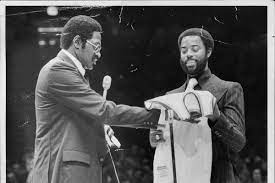
When the New York Knicks Were on Top
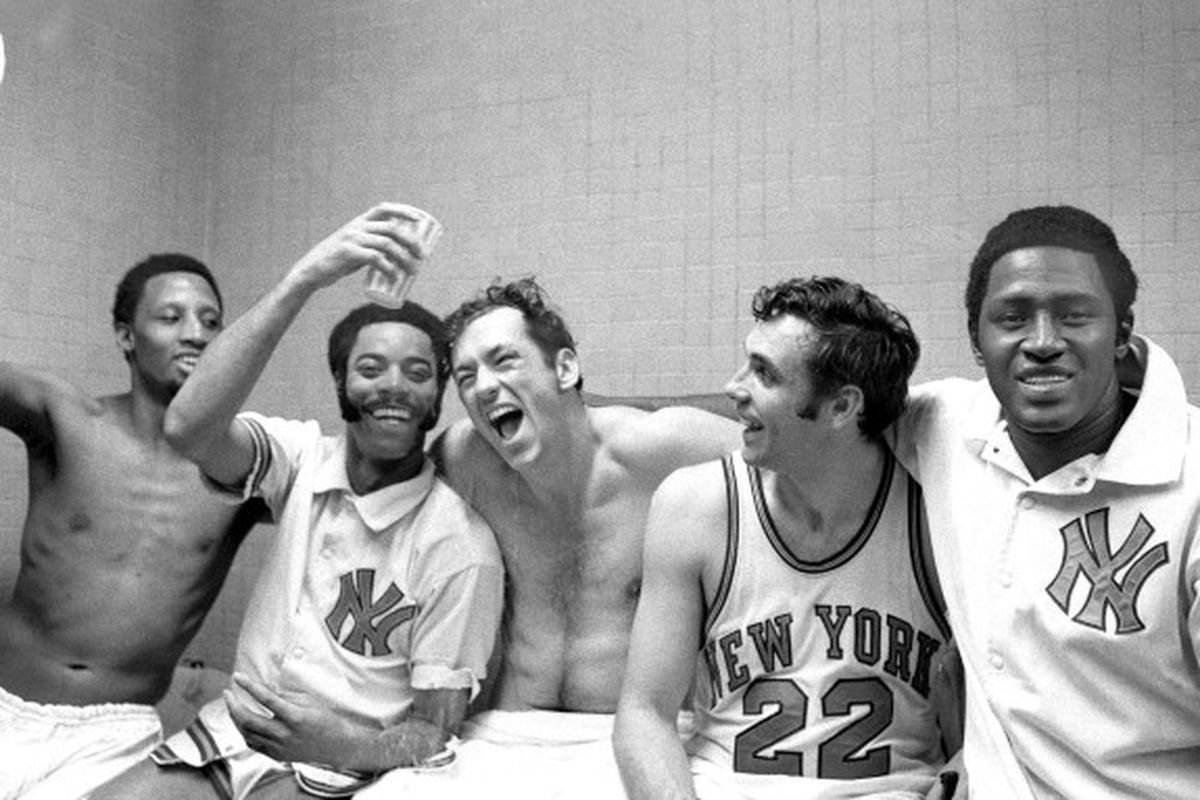
The most valuable NBA franchise today hasn’t won a national championship in two generations. But 50 years ago, the New York Knickerbockers lit up the biggest city in America with their first NBA title, defeating the Los Angeles Lakers in a dramatic 7-game series. May,1970 is fondly remembered in Knicks lore as a magical moment when a talented crew carried their team to the top of the world.
The beginning of the 1970s ushered in a new era in professional basketball. Bill Russel’s retirement from the Boston Celtics in 1969 signaled the end of Boston’s decade-long dynasty under the basket, while 7’2 center Lew Alcindor, the future Kareem Abdul-Jabbar, would start his indomitable reign with the Milwaukee Bucks. In the executive suite, George Mikan, the ABA commissioner who introduced the 3-point line and the flashy red, white and blue basketball, was gone, while former Georgia governor Carl Sanders became part-owner of the newly-minted Atlanta Hawks, formerly the St. Louis Hawks.
The NBA at the time was comprised of just 14 teams and the New York Knicks were running the ball at Madison Square Garden, their home since the league’s inception in 1946. Ned Irish, Knicks founder and President, was still overseeing the club’s operations. For some time, a parade of coaches had come and gone with the team’s fortunes and in 1968, Dick McGuire was replaced in mid-season after the team floundered 15-22. Red Holzman, assistant coach and team scout, took over as Head Coach. As a player, Holzman was point guard for the Rochester Royals when they defeated the Knicks at the 1951 NBA championship.
The impact was immediate. Holzman flipped the remaining games on the calendar to the Knicks’ favor, salvaging what would have been a losing season into a winning one that ended with a 43-39 record and a berth at the playoffs. In the early years, New York were trophy contenders, clinching 3 consecutive conference titles in 1951, 1952 and 1953 under the helm of Joe Lopchick. But they never got past the semifinals for a shot at the crown and after Lopchick departed, the Knicks only made the post-season in 4 of the 13 years leading up to their first title. In one notorious header against the Philadelphia Warriors in 1962, the Knicks failed to stop Wilt Chamberlain who scored 100 points against them, an individual NBA record that still stands today.
By the late 1960s, the Knicks were on a march towards making NBA history. Point guard Walt Frazier was drafted out of Southern Illinois University and power forward Dave DeBusschere was traded in from the Detroit Pistons, both joining veterans Willis Reed and Dick Barnett. Future Chicago Bulls coach, Phil Jackson, and future New Jersey Senator, Bill Bradley, were brought on board as well. Unbeknownst at the time, it was the making of a legacy team that would see 7 of the 8 identified names, including Holzman and Irish, be enshrined in the Basketball Hall of Fame.
The 1969 NBA season exploded with promises for New York as the Knicks delivered their own record-breaking, 18 game-winning streak that ended the day after Thanksgiving. Holzman’s strategy emphasized more than just hard teamwork, but ‘pressure defense’. Playing physical on both ends of the court, Reed was grabbing 14.9 rebounds per game and DeBusschere was catching 10.0. Collectively, the squad led the league in holding off opponents at 105.9 points per game, cementing their reputation as the best defensive club in the NBA. The team wrapped up the regular season with a dominant 60-22 record and a ticket to the playoffs.

First up were the Baltimore Bullets at the Eastern Semifinals. Dispatching the mid-Atlantic squad 4-3, the Knicks put away Earl Monroe, Baltimore’s prolific scorer who led the series with 28.0 points per game. Two years later, Monroe would find himself on the Knicks roster. At the Eastern Finals, it was the towering Kareem Abdul-Jabbar and the Milwaukee Bucks that New York were now facing. Once again, the Knicks’ tight teamwork and defensive focus overcame the powerful presence of a single individual, this time in the form of Abdul-Jabbar who landed 34.2 points per game. New York clinched the series 4-1, earning their first ever trip to the Finals.
Waiting in the wings were the Los Angeles Lakers, fresh from sweeping the Atlanta Hawkes 4-0 at the Western conference. In the first NBA Finals to be televised nationwide, Reed, DeBusschere and Frazier were now squaring off against another group of future Hall of Famers: Jerry West, Wilt Chamberlain and Elgin Baylor. With 19,500 exuberant fans packed into Madison Square Garden, the Knicks took Game 1, but lost Game 2 as Chamberlain made two decisive blocks in the closing minutes to win it for Los Angeles. The series started off with a tie as both teams flew out west for the next battleground.
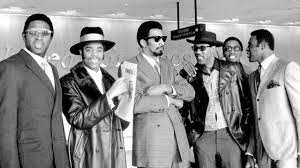
Games 3 & 4 were grueling tests of overtime. Reed and West were fighting for points, while 7’1 Chamberlain, despite mobility issues stemming from knee surgery the previous year, maintained his rebound supremacy. In Game 3, West landed a clutch shot from beyond midcourt, equalizing the score at the buzzer. With no 3-point credit allotted back then except in the ABA, the game went into overtime and the Knicks ended up prevailing. Game 4 saw the Lakers respond with their own overtime victory after Baylor’s free throws tied the score in regulation.
The drama continued to unfold in Games 5 & 6 as both teams traded leads again. Back at the Garden, the Knicks lost Reed to injury after the first 8 minutes in Game 5. As New York fans held their breath, Holzman gambled with aggressive offense-defense hustles, forcing the Lakers into 19 turnovers that resulted in the Knicks conquering a 16-point deficit to win the day. But those tactics failed to carry into Game 6, which saw Reed out of action and Chamberlain net 45 points. Los Angeles tied the series 3-3, unleashing a 7th final and decisive match.
Nobody knew if Reed would return, but the Knicks captain created raucous cheers inside the Big Apple arena when he stepped onto the court. He scored the first two baskets of the game, his only points, and kept effective coverage over Chamberlain despite hobbling on the floor. The Knicks ended up outplaying and outrunning their West Coast rivals, with Frazier leading in points, followed by Barnett and Bradley. In the end, the Knicks were the new NBA champions, having vanquished the Lakers 113-99.
Reed was immortalized with both the NBA and NBA Finals MVP awards and Holzman was named Coach of the Year. For New York, the Knicks also brought the city its third professional championship in 16 months; earlier, the Jets had won Super Bowl III (1968) and the Mets followed with the World Series (1969). The brief, but glorious period for the Knicks was just beginning as the team would reach the Finals again in 1972 and clinch their second and last title in 1973, both against the Los Angeles Lakers. But no other moment in Knicks history matched the Spring of 1970 when a group of legacy players left an indelible mark for their city and fans.
Walt Frazier, “THE GREATEST NEW YORK KNICKS PLAYER OF ALL-TIME”.
.jpg) Frazier in March 2020
|
|
| Personal information | |
|---|---|
| Born | March 29, 1945 Atlanta, Georgia, U.S. |
| Listed height | 6 ft 4 in (1.93 m) |
| Listed weight | 200 lb (91 kg) |
| Career information | |
| High school | David T. Howard (Atlanta, Georgia) |
| College | Southern Illinois (1963–1967) |
| NBA draft | 1967 / Round: 1 / Pick: 5th overall |
| Selected by the New York Knicks | |
| Playing career | 1967–1979 |
| Position | Point guard |
| Number | 10, 11 |
| Career history | |
| 1967–1977 | New York Knicks |
| 1977–1979 | Cleveland Cavaliers |
| Career highlights and awards | |
|
|
| Career statistics | |
| Points | 15,581 (18.9 ppg) |
| Rebounds | 4,830 (5.9 rpg) |
| Assists | 5,040 (6.1 apg) |
Stats  |
|
| Stats |
|
| Basketball Hall of Fame as player | |
| College Basketball Hall of Fame Inducted in 2006 |
|
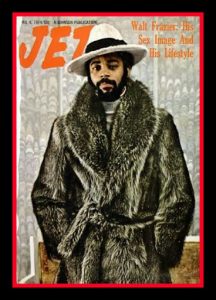
Walter “Clyde” Frazier Jr. (born March 29, 1945) is an American former professional basketball player of the National Basketball Association (NBA). As their floor general and top perimeter defender, he led the New York Knicks to the franchise’s only two championships (1970 and 1973), and was inducted into the Naismith Memorial Basketball Hall of Fame in 1987. Upon his retirement from basketball, Frazier went into broadcasting; he is currently a color commentator for telecasts of Knicks games on the MSG Network.
High school and college
The eldest of nine children, Frazier attended Atlanta’s David Tobias Howard High School. He quarterbacked the football team and played catcher on the baseball team. He learned basketball on a rutted and dirt playground, the only facility available at his all-black school in the racially segregated South of the 1950s. Although he was offered other scholarships for his football skills, Frazier accepted a basketball offer from Southern Illinois University, saying that “there were no black quarterbacks, so I played basketball.”[1]

Frazier became one of the premier collegiate basketball players in the country. He was named a Division II All-American in 1964 and 1965. As a sophomore in 1965, Frazier led SIU to the NCAA Division II Tournament, only to lose in the finals to Jerry Sloan and the Evansville Purple Aces 85–82 in overtime. In 1966, he was academically ineligible for basketball.
SIU moved up from Division II to Division I in 1967, and Frazier and SIU won the National Invitation Tournament, beating Marquette University 71–56 in the final, in the last college basketball game played at the old Madison Square Garden in New York. Frazier was named Most Valuable Player of the 1967 tournament.
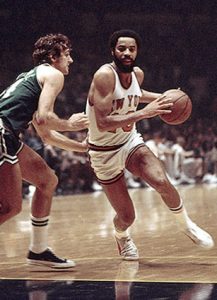
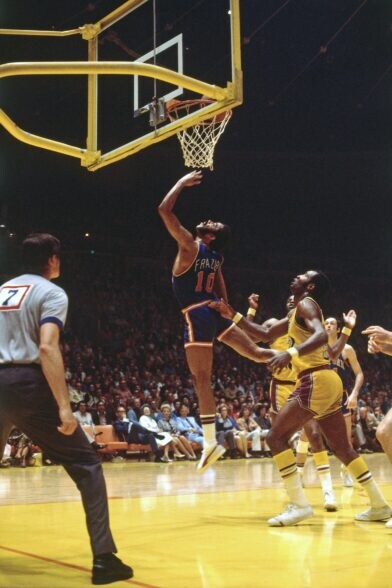
NEW YORK – 1972: Walt Frazier #10 of the New York Knicks drives to the basket against the Boston Celtics during the NBA game at Madison Square Garden in New York, New York in 1972.
Professional career
New York Knicks
1967–1969: Career beginnings
Frazier was drafted fifth overall by the New York Knicks, going on to average 9.0 points per game and be named to the NBA All-Rookie Team during the 1967–68 season. During his rookie season with the Knicks, he picked up the nickname “Clyde” because he wore a fedora similar to that of Warren Beatty, who played Clyde Barrow in the 1967 film Bonnie and Clyde.[2][3]
As a sophomore, Frazier’s 17.5 points, 7.9 assists, and 6.2 rebounds per game averages made him one of the most improved players in the league.
1969–70: Breakthrough year and first NBA championship

On October 30, 1969, Frazier recorded 43 points to go along with 9 rebounds and 5 assists in a 123–110 win over the Houston Rockets. Frazier was chosen as an NBA All-Star during the 1969–70 season, the first of seven selections during his 10-year stint with the Knicks.
The Knicks made it to the 1970 NBA Finals thanks to the great play of both Frazier and star teammate Willis Reed. However, in game five, Reed suffered a painful leg injury. With Reed out, chances of the Knicks winning the championship were slim. However, Reed returned to the series, playing the first two minutes of game seven and scoring its first two points before limping off. With Reed out, Frazier went on to post one of the greatest performances in NBA playoff history, tallying 36 points, seven rebounds, 19 assists, and six steals in leading New York to victory. ESPN is one of the many sports sites to call it the greatest game seven ever.
1970–1977

The Knicks were unable to repeat as champions in 1971, falling to the Baltimore Bullets and their star shooting guard Earl Monroe in the second round of the playoffs despite Frazier’s 20.4 points per game average during the second series.
During the off-season, in May 1971, Frazier scored 26 points and was named MVP of an exhibition game played between NBA and ABA All-Stars in Houston’s Astrodome.
Following the 1970–71 season, the Knicks traded for Monroe, who was always difficult for Frazier to guard. Not many people thought the two players’ styles would mesh, but Monroe and Frazier soon became one of the best backcourts in the league, even earning the nickname the “Rolls Royce” backcourt.
The Knicks returned to the NBA Finals in 1972, but fell to the Los Angeles Lakers, who completed a record-setting season with an NBA championship.
Frazier led the Knicks to a second NBA championship in 1973, topping the Lakers in a five-game series. His defense on Jerry West played a major role in defeating the star-filled team.
In 1976, Frazier was selected for his seventh and final NBA All-Star Game.
Frazier held Knicks franchise records for most games (759), minutes played (28,995), field goals attempted (11,669), field goals made (5,736), free throws attempted (4,017), free throws made (3,145), assists (4,791) and points (14,617). Patrick Ewing eventually broke most of those records, but Frazier’s assists record still stands.
Cleveland Cavaliers
Frazier was traded to the Cleveland Cavaliers after the 1976–77 season for the younger Jim Cleamons. The trade left the NBA world stunned, as many people were furious that New York was willing to let go of arguably the greatest player in franchise history.
Honors
- Won 2 NBA championships (1970, 1973) with the New York Knicks.
- 7× NBA All-Star (1970–1976)
- NBA All-Star Game MVP (1975)
- Frazier’s no. 10 jersey was retired by the New York Knicks on December 15, 1979.
- Inducted into the Naismith Memorial Basketball Hall of Fame in 1987
- Elected to the NBA’s 50th Anniversary All-Time Team in 1996.
- In September 2012, Frazier was honored by the Ride of Fame and a double-decker tour bus in New York City was dedicated to him.
Clyde Frazier’s Wine and Dine Restaurant in New York City
Legends profile: Walt Frazier

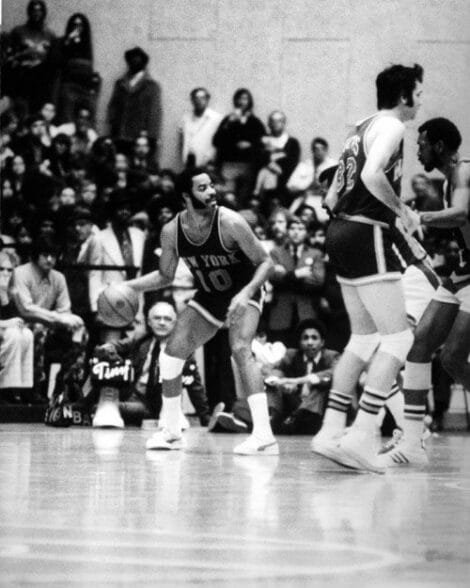
Frazier developed his playing philosophy very early on, according to his high school coach, and carried it with him to the pros: aggressive defense takes priority and hitting an open man is more productive than taking a wild shot.
Although he was offered more scholarships for his football skills, Frazier accepted a basketball offer from relatively obscure Southern Illinois University. “I was looking hopefully to the day when I could play pro ball, and there were no black quarterbacks on the pro scene then,” he explained.
Led by Frazier, Southern Illinois became the first small school to win the National Invitation Tournament. Frazier earned All-America honors as a senior, and the Knicks made him their first-round pick (fifth overall) in the 1967 NBA Draft.
He started slowly, averaging only 9.0 points in 1967-68. “My rookie year, I really played lousy at first,” he recalled in Sport. But midway through that season a new coach, William “Red” Holzman, took charge of the Knicks and emphasized the aggressive defense that was Frazier’s strongest suit. The rookie’s playing time soared, as did his confidence. Frazier and teammate Phil Jackson, who would later gain more fame as the head coach two dynasties: the Chicago Bulls and the Los Angeles Lakers, were named to the NBA All-Rookie Team at season’s end.
Possessing exceptional peripheral vision and quick hands — “faster than a lizard’s tongue,” commented one opponent –Frazier began delighting New York fans with sudden steals and lightning passes. “The great thing about Clyde are his hands, his anticipation,” Holzman told Sport. Added teammate Bill Bradley, “[Frazier] is the only player I’ve ever seen [whom] I would describe as an artist, who takes an artistic approach to the game.”
By adding Frazier, Bradley, and Dave DeBusschere to a starting lineup that already featured center Willis Reed and guard Dick Barnett, the Knicks quickly built an unusually well-balanced club, a championship contender that reached the Eastern Division Finals in 1968-69. Frazier averaged 17.5 points that season and earned the first of seven consecutive selections to the NBA All-Defensive First Team.
https://www.youtube.com/watch?v
Early in the 1969-70 season, the Knicks won 18 consecutive games, setting a new NBA record, and went on to a league-best 60-22 mark in the regular season. The team’s unprecedented emphasis on defense, led by Frazier, showed in two remarkable statistics: the Knicks achieved the best record in the NBA with their leading scorer, Reed, ranking only 15th in the league; and their defense allowed just 105.9 points per game, nearly 6 points better than their closest rival. Frazier averaged 20.9 points and 8.2 assists for the season. He made the first of seven successive All-Star appearances and earned the first of four selections to the All-NBA First Team.
The 1970 NBA Finals matched two superlative clubs, the Knicks and the Los Angeles Lakers, representing the country’s two biggest metropolitan centers. The seven-game series generated more national excitement than the NBA had ever known. Pitted against a Lakers club that featured such legends as Wilt Chamberlain, Jerry West and Elgin Baylor, the Knicks battled their rivals to a deadlock through six games, despite a leg injury to Reed, their top scorer, in Game 5.
In the decisive seventh game at Madison Square Garden, Reed hobbled dramatically onto the court, long enough to score the first two baskets of the game. Then he turned the spotlight over to Frazier, who responded with one of the greatest performances ever in a Finals Game 7: 36 points, 19 assists and five steals — including a celebrated heist from West that devastated the Lakers’ morale.
https://www.youtube.com/watch
While bringing the ball upcourt during the second quarter, the Lakers’ on-floor leader momentarily slowed his dribble as he approached the midcourt line. Frazier pounced across the line, flicked the ball off West’s fingers, and raced for the Knicks’ glass, a half-step ahead of his opponent. As Frazier, in a characteristic motion, laid the ball up into the basket rather than dunking it, West fouled him. Frazier completed the three-point play. On the Lakers’ next possession the Knicks’ Mike Riordan forced West into a shot-clock violation.
“West looked bewildered,” Frazier later wrote of the pivotal sequence in Walt Frazier: One Magic Season and a Basketball Life. “For that one moment, he was out of control, and you never saw that happen with Jerry. We’d wounded their leader. I knew we had them.”
Frazier was right. The Knicks won the game, 113-99, and with it the franchise’s first NBA Championship. “I felt as pumped up as I ever have on a basketball court,” Frazier recalled in HOOP magazine. “I always tried to hit the open man when I played, but that night I was the open man. There’s no doubt that ’69-70 championship team was the highlight of my career. I think of that team every day.”
In a sport known for dizzying offensive numbers, Frazier and the Knicks had managed to make the art of defense seem glamorous. At the height of that era in Knicks history, fans at Madison Square Garden would mount chants of “Dee-fense! Dee-fense,” especially on those occasions when the Knicks trailed in a game’s fourth quarter. Fans believed and opponents feared that a couple of defensive maneuvers by Frazier would turn the score around.
“It’s not only that Clyde steals the ball,” former teammate Bill Bradley told Sport, “but that he makes them think he’s about to steal it, and that he can steal it any time he wants to.”
Part of Frazier’s defensive success lay in keeping his distance. “I don’t believe in contact defense,” Frazier said in 1971. “I like to keep them guessing where I am. I have the advantage because my hands are so quick. It’s like I’m playing possum; I’m there but I don’t look like I’m there. They’re relaxed more than if you’re up there pressuring them all the time. That’s when they get careless.”
Fans, too, admired his cool demeanor. He rarely indulged in angry outbursts and almost never expressed displeasure with officials. Frazier even perspired on the court far less than most players, furthering his aura of unflappability. Frazier moved on the court like Fred Astaire on the dance floor, according to one sportswriter, “his simplest gestures dripping with elegance. Frazier’s smooth, sultry style of play was the physical equivalent of a Southern drawl.”
A certified hero in New York, Frazier became as well known for his stylish attire and after-hours partying as for his ballhandling and peerless defense. This led to many magazine articles, photoshoots as well as commercial advertising opportunities. He parlayed his cool persona into becoming one of the first athletes to be paid to wear a basketball sneaker — a suede version made by Puma.
On the court, he led the Knicks to four more winning seasons. In 1971 New York reached the Eastern Conference Finals but lost to the Baltimore Bullets in seven games. The Knicks returned to the NBA Finals in 1972 but fell to a powerful Lakers team that had gone 69-13 in the regular season.
Early in the 1971-72 season the Knicks acquired guard Earl Monroe, an archnemesis of Frazier’s, from Baltimore. Skeptics said the longtime rivals were a disastrous match, but instead the storied “Rolls-Royce backcourt” gave the Knicks an even more formidable defense. “He’s fire and I’m ice,” Frazier said of Monroe in Newsday. In 1972-73, the pair’s first full season together, New York defeated the Boston Celtics in the Eastern Conference Finals and then regained the championship by downing the Lakers in five games.
His second championship ring marked the peak of Frazier’s career. The Knicks began a steady decline that saw them fall out of championship form and then out of the playoffs entirely by 1976. Frazier, meanwhile, turned in three more All-Star seasons and even captured the All-Star Game MVP Award after a 30-point performance in 1975. In 1976-77, his scoring average dipped to 17.4 points per game, and the Knicks missed the playoffs for the second straight year.
On the eve of the 1977-78 season New York sent Frazier to the Cleveland Cavaliers as compensation for the free-agent signing of Jim Cleamons. With that move one of the most glorious careers in Knicks history came to an end. At the time, Frazier ranked as the Knicks’ all-time leader in scoring (14,617 points), assists (4,791), games played (759) and minutes (28,995). Patrick Ewing would eventually surpass him in all those categories except assists.
Frazier was stunned by the trade but dutifully reported to Cleveland after a decade in the Manhattan limelight. The move did not, however, restore the on-court skills of his prime. Partly hampered by repeated foot injuries, Frazier played in only 66 games over portions of three seasons in Cleveland before the Cavaliers put him on waivers three games into the 1979-80 campaign.
In retirement Frazier set up shop as a player agent, invested in a franchise in the short-lived United States Basketball League and then moved to the U.S. Virgin Islands and obtained a charter-boat captain’s license. But he lost both a home and a boat to Hurricane Hugo, and in 1989 he moved back to New York to work as an analyst on Knicks broadcasts. In that role, the ever-colorful Frazier delighted and confounded New York fans with a constant barrage of rhyming phrases and creative word usage — “Clyde-isms,” as they came to be known.
When his playing days had concluded, Frazier’s accomplishments on the court were still being acknowledged. In 1979, the Knicks retired Frazier’s No. 10 jersey. In 1987, he was elected to the Naismith Memorial Basketball Hall of Fame. And in 1996, he was elected to the NBA 50th Anniversary All-Time Team.
 1972 publicity photo of Reed
|
|
| Personal information | |
|---|---|
| Born | June 25, 1942 Bernice, Louisiana |
| Nationality | American |
| Listed height | 6 ft 10 in (2.08 m) |
| Listed weight | 240 lb (109 kg) |
| Career information | |
| High school | West Side (Lillie, Louisiana) |
| College | Grambling State (1960–1964) |
| NBA draft | 1964 / Round: 2 / Pick: 8th overall |
| Selected by the New York Knicks | |
| Playing career | 1964–1974 |
| Position | Center |
| Number | 19 |
| Coaching career | 1977–1989 |
| Career history | |
| As player: | |
| 1964–1974 | New York Knicks |
| As coach: | |
| 1977–1978 | New York Knicks |
| 1981–1985 | Creighton |
| 1985–1987 | Atlanta Hawks (assistant) |
| 1987–1988 | Sacramento Kings (assistant) |
| 1988–1989 | New Jersey Nets |
| Career highlights and awards | |
|
|
| Career NBA statistics | |
| Points | 12,183 (18.7 ppg) |
| Rebounds | 8,414 (12.9 rpg) |
| Assists | 1,186 (1.8 apg) |
| Stats |
|
| Stats at Basketball-Reference.com | |
| Basketball Hall of Fame as player | |
| College Basketball Hall of Fame Inducted in 2006 |
|
|
Medals
|
||||||||||||||


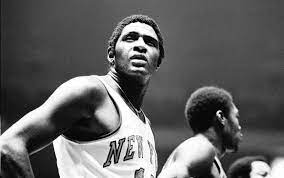
Willis Reed Jr. (born June 25, 1942) is an American retired basketball player, coach and general manager. He spent his entire professional playing career (1964–1974) with the New York Knicks. In 1982, Reed was inducted into the Naismith Memorial Basketball Hall of Fame. In 1996, he was voted one of the “50 Greatest Players in NBA History“.
After retiring as a player, Reed served as assistant and head coach with several teams for nearly a decade, then was promoted to general manager and vice president of basketball operations (1989–1996) for the New Jersey Nets. As senior vice president of basketball operations, he led them to the NBA Finals in 2002 and 2003.
Early life and education
Reed was born on June 25, 1942, in Dubach, Louisiana within Lincoln Parish. He grew up on a farm in nearby Bernice, Louisiana. His parents worked to ensure Reed got an education in the segregated South. Reed showed athletic ability at an early age and played basketball at West Side High School in Lillie, Louisiana.
Reed attended Grambling State University, a historically black college. Playing for the Grambling State Tigers men’s basketball team, Reed amassed 2,280 career points, averaging 26.6 points per game and 21.3 rebounds per game during his senior year. He led the Tigers to one NAIA title and three Southwestern Athletic Conference championships. Reed also became a member of Phi Beta Sigma fraternity.
Career
The New York Knicks selected Reed in the second round, with the eighth overall selection, in the 1964 NBA draft. Reed quickly made a name as a fierce, dominating and physical force on both ends of the floor. In March 1965, he scored 46 points against the Los Angeles Lakers, the second-highest single-game total ever by the Knicks’ rookie. For the 1964–65 season, he ranked seventh in the NBA in scoring (19.5 points per game) and fifth in rebounding (14.7 rebounds per game). He also began his string of All-Star appearances and won the NBA Rookie of the Year Award while also being named to the NBA All-Rookie First Team.
Reed proved to be a clutch playoff performer throughout his career. He gave an early indication of this in the 1966–67 season when he improved his regular season averages to 20.9 points per game, and scoring 27.5 points per game in the postseason.
He played center. Despite his relatively average stature for a basketball player, he made up for his lack of height by playing a physical game, often ending seasons with respectable averages in blocking and rebounding. He stood 6 ft 9 in (2.06 m) but like common practice was listed with shoes at 6’10, when contemporaries such as Wilt Chamberlain stood 7 ft 1 in (2.16 m) and Kareem Abdul-Jabbar was 7 ft 2 in (2.18 m) in their playing careers.
The team continued to struggle for a few years while adding good players through trades and the draft. Dick McGuire was replaced as coach with Red Holzman, midway through the 1967–68 season. The Knicks had gone 15–22 under McGuire; Holzman steered them to a 28–17 finish. In 1968, New York’s record was 43–39, its first winning record since the 1958–59 season.
Reed continued to make annual appearances in the NBA All-Star Game. By this time, he was playing power forward, in order to make room for Walt Bellamy. Reed averaged 11.6 rebounds in 1965–66 and 14.6 in 1966–67, both top 10 marks in the league. By the latter season, he had adjusted to the nuances of his new position, averaging 20.9 points to rank eighth in the NBA.
In 1968–69, New York held opponents to a league-low 105.2 points per game. With Reed clogging the middle and Walt Frazier pressuring the ball, the Knicks would be the best defensive club in the league for five of the next six seasons.
Reed scored 21.1 points per game in 1968–69 and grabbed a franchise-record 1,191 rebounds, an average of 14.5 rebounds per game.
First championship
In the 1969–70 season, the Knicks won a franchise-record 60 games and set a then single-season NBA record with an 18-game win streak. In 1970, Reed became the first player in NBA history to be named the NBA All-Star Game MVP, the NBA regular season MVP, and the NBA Finals MVP in the same season. That same year, he was named to the All-NBA First Team and NBA All-Defensive First Team, as well as being named as ABC‘s Wide World of Sports Athlete of the Year, and the Sporting News NBA MVP.
Reed’s most famous performance took place on May 8, 1970, during game seven of the 1970 NBA Finals against the Los Angeles Lakers in Madison Square Garden. Due to a severe thigh injury, a torn muscle that had previously kept him out of game six, he was considered unlikely to play in game seven. However, Reed surprised the fans by walking onto the court during warmups, prompting widespread applause. Starting the game, he scored the Knicks’ first two field goals on his first two shot attempts, his only points of the game. Following the game in the winner’s locker room, a moved Howard Cosell told Reed on national television, “You exemplify the very best that the human spirit can offer.”
Second championship
The Knicks slipped to a 52–30 record in the 1970–71 season, still good enough for first place in the Atlantic Division; and in mid-season, Reed tied Harry Gallatin‘s all-time club record by grabbing 33 rebounds against the Cincinnati Royals. Once again, Reed started in the All-Star Game. For the season, he averaged 20.9 points and 13.7 rebounds per game, but the Knicks were eliminated by the Baltimore Bullets in the Eastern Conference Finals. In 1971–72, Reed was bothered by tendinitis in his left knee, limiting his mobility. He missed two weeks early in the season and returned, but shortly thereafter the injured knee prohibited him from playing, and he totaled 11 games for the year. Without Reed, the Knicks still managed to make the NBA Finals, but were defeated in five games by the Los Angeles Lakers.
The 1972–73 Knicks finished the season with a 57–25 record and went on to win another NBA title. Reed was less of a contributor than he was two seasons earlier. In 69 regular season games, he averaged only 11.0 points. In the playoffs, the Knicks beat the Bullets and upset the Boston Celtics, and again faced the Lakers in the NBA Finals. After losing the first game, the Knicks captured four straight, claiming their second NBA championship with a 102–93 victory in game five. Reed was named NBA Finals MVP.
Reed’s career was cut short by injuries, and he retired after the 1973–74 season. For his career, Reed averaged 18.7 points and 12.9 rebounds per game, playing 650 games. He played in seven All-Star Games.
Post-playing career
Reed spent several years coaching before moving into general management. He coached the Knicks in 1977–1978, and left the team 14 games into the following season (49–47 record). He was the head coach at Creighton University from 1981 to 1985 and volunteer assistant coach for St. John’s University. Reed also served as an assistant coach for the NBA’s Atlanta Hawks and Sacramento Kings.
Reed debuted as head coach of the New Jersey Nets on March 1, 1988, one week after the Nets’ star forward (and Reed’s cousin) Orlando Woolridge was suspended by the league and was to undergo drug rehabilitation.[7] He compiled a 33–77 record with the Nets. In 1989, he was hired as the Nets’ general manager and vice president of basketball operations (1989–1996). During this time, he drafted Derrick Coleman and Kenny Anderson, acquired Dražen Petrović, and made the Nets a playoff contender throughout the early 1990s. Reed hired Chuck Daly to coach the Nets for the 1992–93 and 1993–94 seasons. In 1996, Reed moved to the position of senior vice president of basketball operations, with the continued goal of building the Nets into a championship contender. The Nets made the NBA Finals in 2002 and 2003.
Reed next took the position of vice president of basketball operations with the New Orleans Hornets in 2004. He retired from that position in 2007.
Legacy
- In 1970, Reed was inducted into the NAIA Basketball Hall of Fame
- In 1982, Reed was enshrined in the Naismith Memorial Basketball Hall of Fame
- In 1997, polling for the “NBA’s 50th Anniversary All-Time Team”, elected Reed one of the “50 Greatest Players in NBA History“
In popular media
Rap songs have mentioned Reed, recognizing his impressive athleticism and skill. Examples include Kurtis Blow‘s 1984 hit “Basketball“ on his Ego Trip album, and the Beastie Boys‘ “Long Burn The Fire” on their 2011 album Hot Sauce Committee Part Two.
Reed’s name has become synonymous with playing through injury, as Cris Collinsworth described an injured Aaron Rodgers as having a “Willis Reed kind of night” on the NBC Sunday Night Football broadcast on September 9, 2018.