Chris Bosh on the Sudden, ‘Surreal’ End of His NBA Career
The Miami Heat star and newly elected Hall of Famer is sharing what he learned with a new generation of young athletes
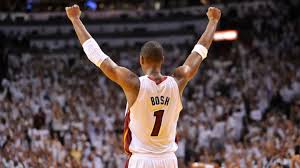
Chris Bosh didn’t know it at the time, but his final NBA game was on Feb. 9, 2016. He was 31 years old and in the prime of his career, an 11-time All-Star player who had helped lead the Miami Heat to two championships and had every expectation of winning a third. But a blood-clot problem that cut short his 2015 season had returned, and doctors warned that playing basketball could kill him.
It was “surreal,” says Mr. Bosh, 37, over the phone from his home in Austin, Tex. “I was in the best shape of my life.” He seethed as he watched season after season from the sidelines, nudged into early retirement by bad luck. “It’s not like I did anything wrong. It just happened,” he says. He bristled when friends told him he simply needed to find something else to do. “I had given my life to basketball,” he says. “You don’t get to that level without making huge sacrifices.” He had no plans for a second act.
In search of something steadying in a disorienting time, Mr. Bosh turned to writing. He found it cathartic to let his sadness and frustration guide his pen, to “get all the crap out” on the page. Scribbling his thoughts also helped him to reach a kind of acceptance, he says, “like going through the weeds with a machete to find the temple.”
Instead of grasping for answers, Bosh found himself asking more thoughtful questions—Who am I now? What else do I enjoy?
Instead of ruing his misfortune, he found himself marveling at his achievements, which include an Olympic gold medal in 2008. This week came the announcement that Mr. Bosh has been elected to the Basketball Hall of Fame; he and 15 other honorees will be inducted at a ceremony in September. Instead of grasping for answers, he found himself asking more thoughtful questions—Who am I now? What else do I enjoy?—and pondering the lessons that have given his life meaning.
The result is his new book, “Letters to a Young Athlete,” three years in the making, which will be published by Penguin Press next month. Part memoir, part life manual, the book is something that Mr. Bosh wishes he could have read back when he was an unseasoned rookie, full of bravado and big dreams. He writes about the value of sweat, the importance of humility and the need to cultivate both the brain and the body. (He spent his off-seasons learning to write computer code, taking guitar lessons and practicing his Spanish, among other things.) Although he draws from his own experiences, Mr. Bosh says that the book is meant for anyone who aspires to greatness in any field: “I want this book to help people. I want people to know it takes hard work to achieve your goals.”

Chris Bosh dunks while playing for the Miami Heat, February 2013.
Growing up in south Dallas, Mr. Bosh was a bookish honors student who whiled away countless hours in his school’s Whiz Kid computer club. But basketball “was more or less my life” starting in the fourth grade, he writes. A 6’7” high-school freshman, he was 6’11” by the time he graduated, and he knew how to hustle, becoming the Texas high school player of the year. He loved the sport but needed it, too, if he hoped to afford college. “Basketball was the only ticket,” he says. “I was lucky to have it.”
Mr. Bosh got a full ride to Georgia Tech, where he planned to study graphic design. But he found it hard to balance his academic interests with the demands of the team, which were so intense that “The first time I saw my schedule, I thought it must be a typo,” he says. Although college athletics is a billion-dollar business, he notes that bans on compensating student athletes meant he often struggled to pay for groceries. He now believes that colleges should not only pay athletes but also better prepare them for the economics of going professional. “I want people to understand that most of the athletes they watch are coming from poverty,” he says. “A million-dollar bonus does not come with wisdom about money.”
In 2003, when he was 19, Mr. Bosh left college for the Toronto Raptors, which chose him as the fourth pick in the NBA draft. In Canada he was a big fish in a cold, little pond, a star player on a middling team. He found the ethnic mix of his Toronto neighborhood refreshingly unlike the default segregation he knew back home. But after seven years on the team, he grew tired of the sense that he was playing in obscurity. “I wanted to be part of the cool kids’ party,” he says. “I thought, ‘Man, what are we doing wrong over here?’”
In 2010, Mr. Bosh and LeBron James joined Dwyane Wade in Miami, launching the most successful era in the team’s history as “the Big Three.” Playing for the Heat demanded a shift in strategy: Instead of racking up points on offense, as he had in Toronto, he used his 7’4” wingspan to anchor the team’s defense, and left most of the shooting to “Bron and D.” His new role offered less “glory,” Mr. Bosh says, but the Heat consistently scored more when he was on the floor. “I’ve always said from day one, CB is our most important player,” said Erik Spoelstra, the Heat’s coach, in 2014. “The average fan doesn’t appreciate what he does for us.”
But instead of earning praise for prizing the success of the team over the needs of his ego, Mr. Bosh found himself raked over the media coals. “Blindsided” by the white-hot glare of public scrutiny, he admits that he read everything written about him, including a 2010 series on the Bleacher Report website called “Everybody Hates Chris.” Addled by the constant criticism, he began second-guessing his every move. “The game stopped being fun,” he writes. “I wanted to win to spite people.”
With time, Mr. Bosh learned to “toughen up” and pay less attention to the haters. He concluded that it was the job of some sports journalists to turn hardworking athletes into stock characters and story lines. He worked to silence the noise by concentrating on what he could control: hitting the gym, watching tape and figuring out the best way to show up for his team. He calmed himself before games by reading books and listening to classical music. “Criticism is a tax on success,” he writes. The best way to cope, he found, was to budget for it.
Mr. Bosh spent years seeking medical clearance to play again. But he has found peace in retirement, devoting time to refining his writing, dabbling in hip-hop production, and spending more time with his wife, Adrienne, and their five children, who range in age from 5 to 12.
After years of jammed fingers, twisted ankles and pushing his body past its limit—the “primary sensation in an athlete’s life” is “exhaustion,” he writes—Mr. Bosh enjoys the novelty of climbing the stairs without pain. “I feel the best I’ve ever felt in my life,” he says. He still watches basketball every day, but no longer plays with anyone besides his family. “That’s all wrapped up in a bow now,” he explains. Looking back, he feels some pangs of nostalgia, but not regret. “I chose to play every game like it was my last,” he writes. “And then, without my realizing it, it was.”
Blood clots snatched basketball from Chris Bosh. His new book is part of the healing.

“It was tough to get over it. Extremely tough,” he told said in a conversation for The Greg Cote Show podcast, released Monday. “It took years. Two years and change to move on. I felt cheated, slighted, like the world was against me, ‘Why me?’ I felt those emotions. I felt ‘em all. Let me not beat around the bush. I thought winning a championship was the hardest thing I ever did in my life. No. Not playing basketball and just yanking the plug out — that was the hardest thing by far.”
Bosh couldn’t, wouldn’t, let go at first. Spent months trying to get back on the court, seeing specialists.
“I felt that team was good enough to compete for a championship [in 2017]. I was so excited. I felt if we can have success without Bron [LeBron James], oooh that’ll do so much for my career. So we didn’t leave a stone unturned [trying to play again]. We tried until I got tired of it. I had to move on.”
The bond and camaraderie in the four years of the Big 3 era is something Bosh holds like a family heirloom.
He recalls the time that bond felt greatest. It was the night before Game 7 of the 2013 Eastern Conference finals vs. Indiana, a game Miami would win.
“I was struggling in the playoffs during the back-to-back years,” he says. “We were in a dogfight with Indiana. Before Game 7, back in Miami, all the fellas came over, and the wives. They all came over to hang out, have a dinner. They all gave me encouragement. ‘Hey, man, we believe in you.’ That was that moment where it was as good as it can get. It wasn’t about basketball. There was no cameras or anything there. It was just friends trying to get the best out of each other. That was the best team ever. A good time was just a moment away. Guys were just hilarious. We loved cracking jokes and talking with each other.”
As with the loss of a loved one, there was grieving on the road to healing when Bosh lost basketball.
Part of that healing is a new book, “Letters to a Young Athlete,” that Bosh has spent the past two years writing and that came out June 1. The first-time author calls the exercise cathartic. The book shares life’s lessons to aspiring young athletes but has an autobiographical feel.
It is about how a kid from Texas whose first job was at a Blockbuster Video grew to become an Olympic gold medalist, a two-time champion with the Big 3-era Heat and a father of five young children ages 3 to 8 with his wife Adrienne, who all now live in Austin.
Bosh is 37 now. His game — big man who can shot three-pointers — would have aged well in the modern NBA. He can talk about that now with a laugh, without regret.
“I’d [still] be playing, for sure,” he said, if not for the fate that stopped him cold. “I could maybe squeak out a couple more years. Just stand over there and shoot it. But I eventually had to get over it. Time helped me get over it. My wife, my kids. You can’t really think about those things when you’re packing lunches for class tomorrow.”
Having his career stopped against his will made Bosh realize for the first time how much of his life had been consumed by his sport.
“I didn’t know how much time was given to basketball. It’s all I ever did. Then, there was no weights, no film, no shootaround. Even [the schedule of] naps — everything was for basketball. It was this whole world.
There was a massive void when that world stopped turning.
“When I had my scare with blood clots I said, ‘Man, what else do I love?’ I wanted to learn to do other things.”
Music was one answer. Bosh now plays guitar and is learning the bass. He and “my Southern Florida brother,” Miami musician Rico Love, have anew single out called, “Different Kind Of Beautiful.”
“Most of my friends are musicians now. Crazy,” Bosh says. “I put enough time into it to where they [hear me] and get the look, ‘Hey, that’s pretty good! I thought it was gonna be trash.’ That’s how it mostly is with athletes trying to do music. I love watching people’s faces, looking at me because the music’s decent. I’m like, ‘chill out, it’s not that crazy!’ ”
Like music, writing was a natural outlet, too, to help fill that void. He has been a voracious reader his whole life. And having young kids of his own, and the experience of fatherhood, made “Letters to a Young Athlete” a natural first book.
“It feels good to have a goal and be working toward something again,” he said of the process of giving birth to a book. “It’s definitely been a great experience being able to try and find my way after basketball. Find that other thing after ball.”
Bosh watched the other day as a Danish soccer player in his prime, Christian Eriksen, fell face first onto the field during a game after suffering a heart attack. There were moments of dread when it seemed he might die on the pitch, on live TV.
Bosh’s mind reeled back five years, to the Heat’s and NBA’s fear blood clots could end his own life right on the court.
“I’m sure that’s what the Heat thought that whole time. I’m sure that’s what Pat [Riley] and Micky [Arison] were thinking.”
When Bosh reflects on it all now, it’s all good. He has his family. His health.
“I had to come to the realization that I had my time,” he says. “I played professionally for 13 years. I can’t complain one bit.”
As for the new book and his own kids? Bosh grins.
“I haven’t made it mandatory reading for ‘em yet,” he says. “Maybe next year.”
Chris Bosh
 Bosh with the Miami Heat in 2011
|
|
| Personal information | |
|---|---|
| Born | March 24, 1984 Dallas, Texas |
| Nationality | American |
| Listed height | 6 ft 11 in (2.11 m) |
| Listed weight | 235 lb (107 kg) |
| Career information | |
| High school | Lincoln (Dallas, Texas) |
| College | Georgia Tech (2002–2003) |
| NBA draft | 2003 / Round: 1 / Pick: 4th overall |
| Selected by the Toronto Raptors | |
| Playing career | 2003–2017 |
| Position | Center / Power forward |
| Number | 4, 1 |
| Career history | |
| 2003–2010 | Toronto Raptors |
| 2010–2017 | Miami Heat |
| Career highlights and awards | |
|
|
| Career statistics | |
| Points | 17,189 (19.2 ppg) |
| Rebounds | 7,592 (8.5 rpg) |
| Assists | 1,795 (2.0 apg) |
Stats  |
|
| Stats |
|
|
Medals
|
||||||||||||||||||||||||||


Christopher Wesson Bosh (born March 24, 1984) is an American former professional basketball player. A Texas Mr. Basketball in high school, Bosh played one season of college basketball for Georgia Tech before declaring for the 2003 NBA draft. He was selected fourth overall by the Toronto Raptors.
While at Toronto, Bosh became a five-time NBA All-Star, was named to the All-NBA Second Team once, played for the U.S. national team (with whom he won a gold medal at the 2008 Summer Olympics), and supplanted former fan favorite Vince Carter as the face and leader of the Raptors franchise. In the 2006–07 season, Bosh led the Raptors to their first playoff appearance in five years and their first-ever division title. He left Toronto in 2010 as the franchise’s all-time leader in points, rebounds, blocks, and minutes played.
In 2010, after seven seasons with the Raptors, Bosh entered into a sign-and-trade deal whereby he was traded to the Miami Heat. In Miami, he joined fellow stars Dwyane Wade and LeBron James; the trio became known as the Big Three. Bosh spent the second half of his career with Miami, appearing in the NBA Finals each year from 2011 to 2014 and winning NBA titles in 2012 and 2013. He made the NBA All-Star team every year during his time in Miami. His career was cut short by a blood clotting condition that the NBA ruled to be a career-ending illness. Bosh played his final NBA game on February 9, 2016. Notwithstanding the NBA’s ruling, Bosh fought to resume his playing career for three years before announcing in February 2019 that he intended to retire. On March 26, the Heat retired his no. 1 jersey. On May 15, 2021, Bosh was elected to the Basketball Hall of Fame.
Seeking to promote sports and education amongst youths in Dallas and Toronto, Bosh set up the Chris Bosh Foundation and regularly speaks to youths about the benefits of reading.
Honors and achievements
- NBA Eastern Conference Player of the Month: January 2007
- 9× NBA Eastern Conference Player of the Week: January 3, 2005; January 30, 2006; March 26, 2007; January 7, 2008; October 28, 2008; February 1, 2010; April 5, 2010; December 23, 2013; October 28, 2014
- NBA Atlantic Division Champion: 2007
- 4× NBA Southeast Division Champion: 2011, 2012, 2013, 2014
- 2× NBA Champion: 2012, 2013
- 11× NBA All-Star: 2006, 2007, 2008, 2009, 2010, 2011, 2012, 2013, 2014, 2015, 2016
- All-NBA Second Team: 2007
- NBA All-Rookie Team: 2004
- 2× NBA Rookie All-Star Game: 2004, 2005
- 3× NBA Shooting Stars champion 2013, 2014, 2015
- Bronze medal winner with Team USA at the 2006 FIBA World Championship
- Gold medal winner with Team USA at the 2008 Summer Olympics
- Third-youngest player in NBA history to record 1,000 rebounds
- Fourth-youngest player in NBA history to record 20 points and 20 rebounds in a game
- Toronto’s first player to achieve 10,000 points
- Toronto’s all-time leader in rebounds
- Toronto’s all-time leader in defensive rebounds
- Toronto’s all-time leader in offensive rebounds
- Toronto’s all-time leader in rebounds per game
- Toronto’s all-time leader in rebounds per game in a season
- Toronto’s all-time leader in blocks
- Toronto’s all-time leader in free throws made
- Toronto’s all-time leader in free throws made in a season
- Toronto’s all-time leader in free throws attempted
- Toronto’s all-time leader in free throws attempted in a season
- Toronto’s all-time leader in double-doubles
- Toronto’s all-time leader in double-doubles in a season
- NBA Sportsmanship Award (divisional winner): 2007–08
- Elected to the Naismith Memorial Basketball Hall of Fame
Off the court

Besides his on-the-court exploits, Bosh was a National Honor Society member and graduated with honors from Lincoln. He is also a member of the National Society of Black Engineers and the Dallas Association of Minority Engineers. Following his success in the NBA, Bosh soon had his own YouTube channel, and has since made various TV appearances. In December 2009, First Ink, a DVD featuring comedic digital shorts and a documentary about Bosh, was released. The DVD was filmed during the summer of 2009. A fan of the X-Men television series as a child, Bosh voiced the Marvel Comics character Heimdall in an episode of Hulk and the Agents of S.M.A.S.H. in 2014. He also made appearances on episodes of Entourage and Parks and Recreation.
In the field of philanthropy, Bosh established the Chris Bosh Foundation in 2004. Remembering the challenges he faced as a youth, Bosh founded the organization to help younger people in academics and athletics. The Foundation, with programs in Toronto and Dallas, has worked closely with organizations such as the Toronto Special Olympics to raise important funding for community projects. Bosh’s mother, Freida, has served as CEO of the Foundation. As an avid reader, Bosh also regularly speaks to groups of children about the benefits of reading, and has received the NBA Community Assist Award for his active contributions for the Raptors community development program in Toronto and Dallas during the course of the NBA campaign. In November 2008, Bosh pledged to donate $75,000 to the Boys and Girls Clubs of Canada. He is also an advocate for increased computer literacy in schools, supporting the non-profit code.org.
In July 2011, Bosh married Adrienne Williams. The couple have five children, three sons and two daughters.
Bosh has dabbled in hip-hop production. In 2017, alongside record producer, songwriter, and singer Rico Love, Bosh co-produced a song titled “Miss My Woe” by Gucci Mane. The song is featured on Gucci’s 11th studio album titled, Mr. Davis.