
Howard’s first banners at Michigan came down. He’s ready to hang another one.

Those old-soul characteristics followed the McDonald’s all-American to Ann Arbor in 1991 as the first member of the Fab Five to commit to Michigan. Former teammate Jalen Rose said everyone filled an unofficial role on that team that featured five of the top freshmen in the country. Rose was the “undisciplined, irresponsible” one, and Howard was the “adult in the room.”
Chicago, however, teaches other lessons, too. Sometimes the maturity gets set aside and it’s time to stand up for yourself and those closest to you. The college basketball world saw a different version of Howard when he had to be restrained and was ejected from a Big Ten quarterfinal win over Maryland. The he-said, he-said between Howard and Terrapins Coach Mark Turgeon didn’t clarify the confrontation, but the moment gave a different glimpse into the second-year Michigan coach from the one doing the cabbage-patch dance as a college kid or the one who danced salsa after clinching the Big Ten regular season title earlier this month.
Howard reminded everyone at his next media session where he’s from, and that when you’re from Chicago, you’re taught to defend yourself.
“You knew the command, you knew the respect more than anything,” LeBron James said of his former Miami Heat teammate last year. “The way he dressed, the way he carried himself, the way he protects his family. You just have that respect level for him.”
Any questions about whether Howard was just a feel-good link to a golden age of Michigan basketball have been answered in two seasons. The Wolverines are a No. 1 seed in the NCAA tournament for the first time since Howard was a sophomore, and they have the No. 1 incoming recruiting class in the country, according to 247Sports.

The Big Ten Coach of the Year and one of four finalists for Naismith Coach of the Year spent the offseason after his Michigan debut self-scouting, evaluating and plotting his own growth. He reflected on lessons from working with coaches such as Larry Brown, Don Nelson, Doc Rivers, Erik Spoelstra and Nate McMillan. Howard, 48, drew on experiences from a 19-year NBA career that included a leadership role on a pair of championship teams in Miami that included James, Dwyane Wade, Ray Allen and Chris Bosh.
The adult in the room is now at the helm of an NCAA championship contender, and there’s no time to play nice with outsiders.
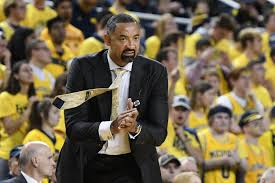
“I’m a grinder,” Howard said last March. “That’s the only way I know how from the day when I first started understanding [things], growing up in inner-city Chicago and not having any money, at times, to buy food. … This is what I do. This is what I’m all about, a guy who is a grinder.”
Howard has always looked the part, Rose said — crisp haircut, well-dressed, creased pants. He grew up fast while being raised by his grandmother, Jannie Mae. The road grew harder when she died on the same day he committed to play at Michigan.
Howard has also always been the guy to command respect from everyone in the room. Former Heat assistant David Fizdale remembers Howard ripping into the team after a particularly poor first half in a playoff game against the Indiana Pacers. Fizdale was ready to light into the group at halftime, but Howard insisted on handling it himself. Coaches could hear him shouting from outside the locker room. Howard was barely playing toward the end of his career, but had the attention of that star-studded Heat roster.
“He has a genuine humility about him, which I think is his defining characteristic,” former teammate Shane Battier said last year. “What you see is what you get. It’s a genuineness about Juwan.”
That immediately struck a tone with players and early proof was the signing of Hunter Dickinson, an AP second-team all-American and Big Ten freshman of the year this season. The DeMatha Catholic star picked Michigan over Duke, Florida State and Notre Dame to become the crown jewel of a 2020 recruiting class that ranked among the best in the country. Dickinson said Howard never made any promises, and the personality traits that shined through during the recruiting process have only shone brighter in the past year.
“He’s really all about family,” Dickinson said before the Big Ten tournament. “Just his honesty about everything. Like how he really, truly is. A family-first person. He really treats us all like family, not just the starters or the key players. Everybody.
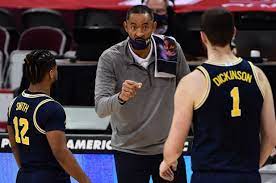
“Learning that he’s a true, genuine guy was something that made me really happy with my decision.”
Members of the Heat organization saw the coaching chops before Howard knew he wanted to go in that direction. When Howard was ready to retire, he talked with Fizdale about what to do next. He could coach, go into the front office or simply move into the business world. Other teams began to inquire about Howard’s availability, and Fizdale went to Spoelstra with a message: “People are in our hen house trying to get our eggs.”
Not long after, Howard accepted a player development position with the Heat and began to learn the finer points of coaching from the ground up. No job was beneath him, Howard said, as he shagged loose balls, set screens and helped chart analytics.
“The qualities that he learned over the course of a long career of leadership, that’s a really hard skill to quantify,” Spoelstra said. “You just know it when you see it.”

Howard’s basketball résumé checked almost every box. He filled every role over the course of a long NBA career before moving to the coaching staff and worked with respected figures in Spoelstra, Fizdale and Hall of Famer Pat Riley. The only thing missing was experience as a head coach, and he put those concerns to rest in his first season as the Wolverines went 19-12 and were ranked as high as No. 4 in the nation.

Basketball is basketball, according to Howard, and that part is easy. The adjustment was handling all the other responsibilities that come with the college game — recruiting, dealing with boosters, NCAA regulations, academics. And that was before every athletic team in the country was forced to deal with the coronavirus pandemic.
Howard clearly has a knack for the recruiting part. He backed up his strong first class with an even better second — a whole new world for a program that has had top-10 classes just twice since 2003 and only two five-star recruits during that span. Former coach John Beilein was more known for developing prospects as opposed to signing elite-level talent.
“I know how to communicate with today’s teenagers,” Howard said last March with a laugh. “That’s not a part where I’m like lacking at all whatsoever. I enjoy listening to some of the hip-hop music that’s out there. I enjoy having drip on my feet, too. I know all the lingo. I’m not that old. I might have gray hair.”
One of Howard’s first successes was convincing sophomore Franz Wagner to keep the commitment he originally made to Beilein. In two years with Howard, the four-star Wagner was named to the Big Ten all-freshman team and this season was voted all-Big Ten second team.
No one knew what the identity of Howard’s teams would be, but they’ve proved to be tough and defensive-minded with a versatile, up-tempo, NBA-style offense.
“You can see so much growth in how he learned from the first year,” Wagner said before the Big Ten tournament. “How he looked at the team and what we could do better. How he was so prepared for everything coming back to campus. I was really impressed by how he handled everything. How composed he was even though it was so frustrating for him as a coach that we couldn’t practice and play our normal schedule.
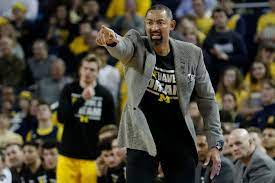
“His character and how he handles things really rubbed off on the team. He really rubbed off his identity on us and how he wants us to play.”
Miami Heat forward Udonis Haslem points to Howard’s journey as the source of his strength as a coach.
“He’s real … he’s figured out how to master every level of life,” Haslem said last year. “So, you know, he can relate to all players in all walks of life. He’s been a kid coming out of the inner city. He’s been somebody that’s been traded. He’s been somebody that’s made max [money]. He’s been somebody that’s come off the bench. He’s been somebody that didn’t play. He’s been somebody that won championships. He’s been somebody who’s been on the sideline and a bench coach.
“Literally, he’s been a star on every road that he’s had in life and in this league. And when you have all those experiences, you can relate to any kid coming from anywhere.”
Rose added, “What gets dismissed is, when you’re a former player, that’s a level of experience that isn’t duplicated.”
The enormous displays run the length of the basketball court inside the pristine William Davidson Player Development Center at the University of Michigan. Eyes are immediately drawn to the six Final Four logos, highlighted by a monstrous version commemorating the 1989 national championship. The rest of the area is a blend of blue padded walls with maize trim, “Block Ms” and signature Jordan Jumpman insignia serve as the backdrop to the staccato sounds of basketballs and sneaker squeaks.
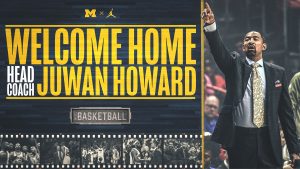
Howard sat in a chair talking about finishing what he couldn’t as a player, facing all those logos, and the absence of two displays is difficult to ignore. Acknowledgment of the two biggest accomplishments of Howard’s time in Ann Arbor — back-to-back appearances in the NCAA tournament championship game — are nowhere to be found. Banners that once hung in the Crisler Center were removed years ago. The university largely disassociated itself from those Fab Five teams because of NCAA violations that occurred while they played there, but the return of Howard makes that impossible to ignore.
Athletic Director Warde Manuel praised Howard for learning the intricacies of the job and being willing to lean on others for help. He reached out to Florida State Coach Leonard Hamilton, Harvard Coach Tommy Amaker (who once held the Michigan job), former Minnesota coach Clem Haskins, Spoelstra and Fizdale for guidance and had the humility to hire longtime Saint Joseph’s coach Phil Martelli as his top assistant.
Beilein was beloved in Ann Arbor, but Howard brought a different type of cache.
“I was like part of the Fab Five, 100-million dollar man is about to be our coach?” said Isaiah Livers, the all-Big Ten second-team selection who is out indefinitely with a stress fracture in his right foot. “I used to play with him on the video game. … Coach Beilein was more, like a guru, a Mr. Miyagi-type coach.”
Detroit Free Press columnist Mitch Albom, who wrote the book “The Fab Five,” said Howard’s return is like sewing close “a gaping hole in the historical narrative of Michigan basketball.”
Still, the two banners are missing inside the Crisler Center. Howard simply intends to add new ones.
“Me being a first-time head coach at a prestigious university like Michigan, yeah it’s pressure,” Howard said near the end of his first season. “I’m my worst critic. … The honeymoon is over. … People expect us to win every game. But I expect us to win every game, too. … Being able to hang up the banner at some point. National champions. That’s our goal.”

Michigan basketball’s Juwan Howard is a finalist for Naismith Coach of the Year award
Michigan basketball‘s Juwan Howard is one of four finalists for the Naismith Men’s Coach of the Year award, the Atlanta Tipoff Club announced Wednesday afternoon.
The other candidates: Alabama’s Nate Oats, who coached at Romulus before entering college ranks; Baylor’s Scott Drew and Gonzaga’s Mark Few.
Howard was recently named the Big Ten Coach of the Year for his role in guiding Michigan to its first Big Ten title since the 2013-14 season and a No. 1 seed in the NCAA tournament. In Howard’s second season as head coach, the Wolverines are 20-4 and went 14-3 in conference play. Michigan won 18 of its first 19 games and has been ranked as high as No. 2 in the country.
Howard has already won one national coach of the year award, from the Sporting News.
The winner of the Naismith Coach of the Year award will be announced on April 4. Fans can vote on naismithfanvote.com from Friday until March 31 and the fan vote will account for 5% of the overall vote.
Howard isn’t the only Wolverine in the running for a Naismith award, as freshman center Hunter Dickinson is one of 10 semifinalists for National Player of the Year. That list will be cut to four finalists on Friday.
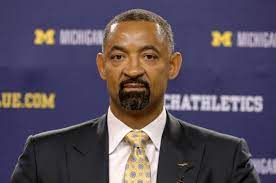
WHO IS JUWAN HOWARD
Juwan Antonio Howard (born February 7, 1973) is an American former professional basketball player and current head coach of the Michigan Wolverines men’s team.[1] He was an assistant coach for the Miami Heat of the National Basketball Association (NBA) from 2013 to 2019. Howard played in the NBA from 1994 until 2013.
A one-time All-Star and one-time All-NBA power forward, he began his NBA career as the fifth overall pick in the 1994 NBA draft, selected by the Washington Bullets. Before he was drafted, he starred as an All-American on the Michigan Wolverines men’s basketball team. At Michigan he was part of the Fab Five recruiting class of 1991 that reached the finals of the NCAA Division I Men’s Basketball Championship in 1992 and 1993. Howard won two NBA championships with Miami, in 2012 and 2013.
Howard was an All-American center and an honors student at Chicago Vocational Career Academy. Michigan was able to sign him early over numerous competing offers and then convince others in his recruiting class to join him. The Fab Five, which included Chris Webber, Jalen Rose, Jimmy King and Ray Jackson, served as regular starters during their freshman and sophomore years for the 1991–92 and 1992–93 Wolverines. Howard was the last member of the Fab Five to remain active as a professional basketball player. Although many of the Wolverines’ accomplishments from 1992 to 1998 were forfeited due to the University of Michigan basketball scandal, which involved booster payments to players to launder money from illegal gambling, Howard’s 1993–94 All-American season continues to be recognized.
Howard played six-and-a-half seasons (1994–2001) for the Bullets franchise (renamed the Wizards in 1997), three full seasons (2004–07) for the Houston Rockets, two plus seasons for the Heat and shorter stints for several other teams. During his rookie year with the Bullets, he became the first player to graduate on time with his class after leaving college early to play in the NBA. After one season as an All-Rookie player and a second as an All-Star and an All-NBA performer, he became the first NBA player to sign a $100 million contract. While he continued to be a productive starter, he was never again selected to play in an All-Star Game. Towards the end of his contract, he was traded at the NBA trade deadline twice to make salary cap room. He was most recently a regular starter during the 2005–06 NBA season. In 2010, he signed with the Heat and entered his 17th NBA season, during which he reached the playoffs for the sixth time and made his first career NBA Finals appearance. He remained with the Heat the following season and won his first NBA championship during the 2012 NBA Finals. He returned to the Heat for part of the following season, and won a second championship. Howard has developed a reputation as a humanitarian for his civic commitment.




