

Congratulations @TomBrady Welcome to the 7 Chip Club pic.twitter.com/FIAyjSW5hI
— Robert Horry (@RKHorry) February 8, 2021
Robert Horry was one of the first real stretch-4s in the game, especially during his Houston Rockets years. He was also a tremendous defensive asset who lurked in the passing lanes and used his athleticism to swat shots as a help-side defender.
Of course, Horry also became known as “Big Shot Bob” for his clutch shot-making through the years. The Los Angeles Lakers almost certainly lose the 2002 Western Conference Finals if not for his game-winning dagger in Game 4. Horry later scored 21 points and hit the game-winner in Game 5 (the series was tied at two games apiece) of the 2005 NBA Finals as a member of the San Antonio Spurs.
Robert Horry has won championships with:
1993-94 Houston Rockets, 1994-95 Houston Rockets, 1999-00 Los Angeles Lakers, 2000-01 Los Angeles Lakers, 2001-02 Los Angeles Lakers, 2004-05 San Antonio Spurs, 2006-07 San Antonio Spurs.
_______________________________________________________________________________
Robert Horry: ‘I don’t think people really appreciate what I did’

“More than half the time, I feel slighted because I don’t think people really appreciate what I did,” Horry said.
“A part of you gets mad because I don’t think people outside the NBA family — and when I say ‘NBA’ I’m saying coaches and players — they don’t really respect what I did and they don’t really understand what I did and what I was able to accomplish,” Horry told FOX Sports. “It’s always, ‘Oh he was a part. Oh, he was a part.’ Yeah, I was a part, but I was a significant part.
“You can’t have Kool-Aid without sugar, and I was the sugar to most of that stuff.”
Horry won so many rings for multiple reasons:
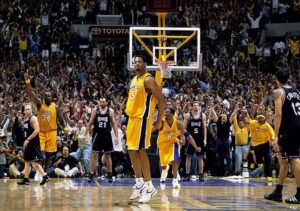
- He was a solid player. He defended effectively and versatilely. He spaced the floor as a 3-point-shooting power forward in an era where those were scarce. He proved to be comfortable in clutch situations.
- Well-run franchises repeatedly targeted him. The types of organizations that are in championship contention covet players like Horry. His skill set allowed him to complement stars. He also had the personality to fit in the locker room with bigger egos.
- Because Horry didn’t stuff the box score, especially not with points, his salary remained relatively modest. That’s part of why he appealed to top teams. It also allowed the team that had him plenty of financial flexibility to maximize the rest of the roster.
- Luck. Horry played with Hakeem Olajuwon in Houston, Shaquille O’Neal and Kobe Bryant in Los Angeles and Tim Duncan, Tony Parker and Manu Ginobili in San Antonio. Few good role players get put into so many great situations.
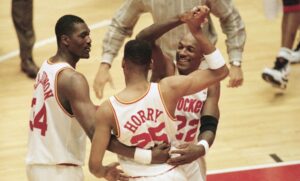
Horry was often in the right place at the right time.
That doesn’t make him a worthy Hall of Famer or even close. He was never even an All-Star, and that wasn’t just because his traditional statistics lagged. In his very best season (with the 2001-02 Lakers), Horry posted just 6.9 win shares. For perspective, that matches D.J. Augustin and Thaddeus Young in the NBA’s last normal season (2018-19).
But Horry was also a contributor who consistently elevated his game in the playoffs. He did win seven titles. That counts, too.
The people who rank Horry ranks among the all-time greats just because of rings are right
WHO IS ROBERT HORRY
Robert Keith Horry (/ˈɒri/; born August 25, 1970) is an American former professional basketball player and current sports commentator. He played 16 seasons in the National Basketball Association (NBA), winning seven championships, the most of any player not to have played on the 1960s Boston Celtics. He is one of only four players to have won NBA championships with three teams; he won two with the Houston Rockets, three with the Los Angeles Lakers and two with the San Antonio Spurs. He earned the nickname “Big Shot Rob”, because of his clutch shooting in important games; he is widely considered to be one of the greatest clutch performers and winners in NBA history. Horry now works as a commentator on Spectrum SportsNet for the Lakers.
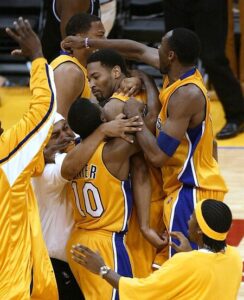
Notable playoff clutch plays
- May 22, 1993, Western Conference Semifinals, Game 7, Houston Rockets at Seattle SuperSonics. With the score tied at 91 late in the fourth quarter and the shot clock winding down, the rookie Horry took a pass from teammate Hakeem Olajuwon and knocked down a midrange jumper to give the Rockets a two-point lead with 32.7 seconds remaining in regulation. However, Horry’s heroics were not enough to secure the victory for the Rockets, who succumbed to the Sonics 100–103 in overtime.
- May 22, 1995, Western Conference Finals, Game 1, Houston Rockets at San Antonio Spurs. Horry hit a jumper with 6.5 seconds left to give Houston a 94–93 win over San Antonio.
- June 11, 1995, NBA Finals, Game 3, Orlando Magic at Houston Rockets. With the Rockets up 101–100 with 20 seconds left and the shot clock winding down, Hakeem Olajuwon kicked it out to Horry, who hit a 3 over Orlando’s Horace Grant to give Houston a 104–100 lead with 14.1 seconds left. It led them to a 106–103 win and a 3–0 series lead. Houston also won Game 4, 113–101, to complete the sweep and win back-to-back NBA titles.
- June 10, 2001, NBA Finals, Game 3, Los Angeles Lakers at Philadelphia 76ers. With the series tied at 1, the Sixers were down 89–88 with under a minute left after a three-point play by Kevin Ollie. Brian Shaw found Horry wide open in the corner; he then hit a three-pointer with 47.1 seconds left to give the Lakers a 92–88 lead. Horry, who had been a 44% free throw shooter in the playoffs to that point, also made 4 free throws in the final minute to seal a 96–91 victory. The Sixers never recovered.
- April 28, 2002, Western Conference First Round, Game 3, Los Angeles Lakers at Portland Trail Blazers. Down 91–89 with 10.2 seconds left, Kobe Bryant drove on Ruben Patterson and kicked it out to Horry, who hit the game-winning 3 with 2.1 seconds left.
- May 26, 2002, Western Conference Finals, Game 4, Sacramento Kings at Los Angeles Lakers. The Kings led 99–97 with 11.8 seconds left. After Kobe Bryant attempted a game-tying shot and missed, Shaquille O’Neal attempted a putback. When that missed, Vlade Divac knocked the ball away to try to run out the clock. However, it went right to Horry, who hit the game-winning three-pointer at the buzzer to give the Lakers a 100–99 victory and tie the series at 2 going back to Sacramento for Game 5. L.A. eventually beat the Kings in 7 and went on to win their third straight NBA championship.
- June 19, 2005, NBA Finals, Game 5, San Antonio Spurs at Detroit Pistons. Horry inbounded to Manu Ginóbili, who was cornered by two Pistons defenders. Ginóbili passed it back to Horry on the left wing, who then hit a three-pointer with 5.9 seconds left to give the Spurs a 96–95 victory and a 3–2 series lead heading into Game 6. Horry scored 21 points in the fourth quarter and OT combined to carry the Spurs.
- April 30, 2007, Western Conference First Round, Game 4, San Antonio Spurs at Denver Nuggets. With the Spurs up 90–89 with 35 seconds left, Tony Parker drove into the paint drawing his defender and Horry’s defender Marcus Camby away. Parker then passed to an open Horry on the right wing, who hit the three-pointer to give the Spurs a 93–89 advantage. The Spurs won 96–89.




