

AHMAD RASHAD, The longtime sportscaster opens up about his relationship with MJ, his thoughts on ‘The Last Dance’ and his successes in sports and journalism.

Whether it was riding in Michael Jordan’s car, chilling in the Chicago Bulls’ locker room or hanging out with the Dream Team, Ahmad Rashad was a regular during the entire showing of The Last Dance.
Rashad has been long recognized as one of Jordan’s most trusted confidants, but there’s much more to Rashad. A four-time NFL Pro Bowler, Rashad fought racism during his playing career, converted to Islam and changed his name and went on to become a pioneer in broadcast journalism, including hosting and producing the popular show NBA Inside Stuff.
“I don’t think there’s anybody that has done it the way I’ve done it,” Rashad told The Undefeated. “When I got into television, my goal was to do television so well that you would forget my football career. And I think I did that, and now, maybe that was a mistake. Maybe I should have messed up a little bit on TV so they could still remember my Hail Mary catch.”
The Undefeated caught up with Rashad in a wide-ranging interview about his relationship with Jordan, his thoughts on The Last Dance and his successes in sports and journalism.
What has it been like watching The Last Dance?
What I’m really enjoying about it is the highlights. There used to be a group of us that would sit together after the game. We’d sit in the hotel room and smoke cigars, and then go over the game. And talk about different plays and what happened. ‘Damn, did you see that?’ And that’s bringing it back.
I was talking to [former NBA player] Quinn Buckner just the other day. And Quinn and I would say, ‘Man, there’s no way he can play any better than that.’ And then the next night, he played way better than that. It just kept going up and up and up. So now when I see it and remind myself, man, that dude played at a level that’s unbelievable. To see somebody hanging in the air that long is almost crazy. The dude did fly.
And I think that one of the greatest things that’s happening with this thing is you’re getting to see a human being. You’re getting to see the human side of Michael. And as a matter fact, he wasn’t an a–hole, he was a winner. People say stuff to me and I’m like, ‘Do you think that Larry Bird was not like that? Do you think that Magic Johnson was not like that?’ Magic laughs, and smiles … but Magic can put his foot on your throat when you’re playing basketball. Larry Bird, the same way. So, it’s not like Michael was the only one.
What is it like to watch The Last Dance with Michael Jordan?
We laugh so hard, man. Well, no, with Michael and the tequila, there’s three of us watching it. Me, him and the tequila. So, we end up telling stories, we end up laughing, we end up correcting s—. We end up remembering the whole thing. It is just a flat-out fun night. …
If you could have a camera on that, you’d have some gold. But that ain’t going to never happen. I’m telling you, we end up really, really laughing and having a great time watching the entire thing and remembering it all. And if you don’t remember it, I remember it. And if I don’t remember it, he remembers it. We’re almost like two old people that can’t remember nothing.
Did you see that movie with Eddie Murphy and Martin Lawrence called Life? Life, that’s us. That’s us sitting there. … That’s us 100%, man. I’m telling you. We are crying laughing. ‘Man, you can’t remember nothing … ’ It’s just absolutely crazy. And just fun, and a chance to look back at a time in life that was just wonderful, and we just enjoy it. I don’t know how you top that. But life goes on, we still got lives now to go and do what we do. But it’s a chance to sit down and stop for a minute, and just have a great look back. And him and I are the only ones that can remember all this stuff.
How did you meet Michael Jordan?
I was in LA for Magic Johnson’s Midsummer Night’s Dream [charity game in 1990]. That’s when I met Michael. And we just hit it off. I had already known Magic, and I had already known most of the other guys because I lived in LA half the time and would play pickup games with them.
We traded numbers, and then we just started talking. It was very seldom about basketball. We started off as just casual friends. And then we became really, really good friends. …
He’s like a brother. Our families are close also. And we live near each other. It feels like family.
What kind of respect does Jordan have for your NFL career?
Tremendous respect. But we’re all athletes, so we’re sort of talking on that level. Like, Michael watched me play. In the gym, the guys always like to crack on me that they watched me play: ‘I caught a ball one time and it was so great that they fell off their tricycle.’ I had heard that gym joke from [Jordan] and [Charles] Barkley. So, it was just certain respect on that matter.
What led to your retirement at age 32 and how do you think you fared in your NFL career?
I felt like I had as good a career as anybody. I had been MVP of the Pro Bowl. … I went to four straight Pro Bowls and ended up No. 10 on the all-time reception list at the time. So I felt very good about my career.
Even as I tell you these stories that sometimes are a little bit tense and a little bit tragic, I always had fun. I had a great time playing football. I had a great time with my teammates. I had a great time just playing for Bud [Grant]. He was the best coach I ever had in my life because he got the best out of me. And being the captain of the Minnesota Vikings was one of the highlights of my whole career.

What are your memories of playing for the Vikings and Bud Grant?
Bud was a tough guy. He was one of them guys that you’d be afraid to speak to. He’s just a tough, Vince Lombardi-type guy, all business, didn’t smile much.
I know that I got a little reputation of being like a wild guy in the league, right? … So, the first day I go to practice, they’re practicing somewhere in St. Paul and I get lost and I show up to practice maybe half-hour, 45 minutes after they had already started. … So, Bud just kind of walked over and he said, ‘So, what, did you get lost?’ And not in a nasty way, in a very nice way. I said, ‘Yeah, I got lost. I was trying to find my way over here. I’m really sorry. I couldn’t find my way.’ He goes, ‘No problem, no problem. Now you know where it is.’
And he goes, ‘Wait, one other thing I wanted to ask you, so your name, how do you pronounce it?’ And I said, ‘Well, the Arabic way of pronouncing it is Ahmed.’ I said, ‘But people call me Ahmad.’ He goes, ‘Oh, I want to know what the correct pronunciation is.’ I said, ‘It’s Ahmed.’ He goes, ‘That’s what I’ll call you from here on out.’
I went through that whole thing in St. Louis where no one would call me … they didn’t respect my name. It was like a whole different flip. But the strange thing about it was, it was Bud Grant saying that. I was swelled up. I was almost emotional because it got to the point where I was almost making excuses when I meet people or making excuses or having to explain it or whatever it was. But this wasn’t like that at all.
Can you talk about your conversion to Islam in 1973 and changing your name from Bobby Moore to Ahmad Rashad?
I grew up in a Pentecostal church, which is very, very religious. You go to church four or five times a week. And then as life goes on, you sort of try to figure out religion and God and all those things. And somehow I realized that there’s more than one path to God. There are paths to get there and you should find one that’s comfortable that you feel strongly about. And when I was in college, I was doing those things of looking, trying to find my spirituality. …
My influence at that time was Kareem [Abdul-Jabbar]. Somehow Kareem and I had met and we would talk about it all the time. And then I just felt like my feelings aligned with Islam and that’s kind of the way it went. And then when I changed my name [to Ahmad Rashad], I changed my name to glory God. It means ‘admirable one led to truth.’ That’s why I took that name, and I was studying religion my first year in St. Louis and a guy’s name was Rashad Khalifa.
You didn’t have a great experience with the St. Louis Cardinals. What things went wrong?
I tried to explain to them what my name change was all about, thinking that I was going to be at least understood of what I was trying to do, and it had nothing to do with football. And I remember that they would say things to me like, ‘What are you reading? … I don’t know who the hell he thinks he is over there reading that book. You got to be reading the playbook.’ …
Don Coryell was the head coach and he refused to call me the name. Just refused. Just said, ‘I’m not going to, I don’t care what it was.’ …
Coryell, to his credit, I saw him at a Pro Bowl [in 1978] in Hawaii when I was playing for the Minnesota Vikings and he pulled me aside and apologized. I had all the respect in the world for him at that point, because I could tell he was flushed when things were going on.
Can you tell the story about the racist incident at a Cardinals practice?
One of the black players missed the ball in a drill. And I was standing right next to the coach, getting in line, and he yelled at the guy and he goes, ‘Hey, I bet you if that was a piece of fried chicken, you’d have caught it.’ And so, I was just a rookie and I said to this guy, ‘Hey, man, you don’t let him talk to you like that. That’s really some racist s—. I guess if it was a piece of watermelon, you’d have caught it, too?’ So, the guy got mad at me. He goes, ‘I’m just trying to make the team and you’re trying to make trouble.’ And the coach said something to me. He goes, ‘I wasn’t even talking to you. So, you just shut the hell up.’ It was just crazy stuff like that, man.
Do you know, at the end of practice, [my teammate] called me over and wanted to fight me? ‘I don’t need you to take up for me for the coach, man. I’m trying to make the team, whatever he wants to say to me, he can go ahead and say to me. All I’m trying to do is make this team.’ And I just thought that was the dumbest thing. Where’s your self-respect? And can it be that big of a deal that you have no self-respect? And now you want to fight me because I was trying to take up for you?
You began working part time as a television sports reporter locally in Minneapolis while with the Vikings. What was your mindset behind that move?
I always wanted to do television in some sort of capacity. So, my last five years in Minnesota, I had a football show. I was on TV three times a week locally, and a CBS affiliate. And then in the offseason, I would do another variety show. They had them in every town. You do stories around town at a flower shop, a meat market, at a school where somebody is doing this, or with some handicapped kids. I would always have a feature on once or twice a week. But not only did I just have the feature, but I produced it also. I sat in, we cut the thing. I wrote the script. I did the whole thing.
So, I was getting myself ready for when I quit playing football.
I had a radio show at that time, too, which was really easy. But doing radio and television, the radio helps you so much, because you sort of fill in. You’re able to learn how to talk in increments of 10 seconds, 20 seconds, a minute, two minutes. You learn all those things that really go well with once you get to television. And so over the years that I was there, I became pretty good at television … to the point where that was going to be my next career.
How do you look back at the “gambling interview” you had with Jordan wearing sunglasses during the 1993 NBA Finals?
He wasn’t talking to anybody. I wasn’t the guy on the side going, ‘Come on, man, come talk to me. Come on, man, let’s do this.’ I never said that, ever. You do whatever you want to do. I wasn’t out here trying to make headlines of having the first interview or anything like that. So, he called me one morning and goes, ‘Hey, man, go get a camera, and let’s do this interview so I can get this out of the way.’ I went, ‘OK.’
But then I started thinking how much I was going to get killed if I did it, because I knew how jealous everybody else was of our relationship.
So, that’s when I incorporated Dick Ebersol, to tell him I was bringing Michael over to do the interview and I want you to write the questions so they don’t kill me and say I didn’t ask him any tough questions. … And so, we get over there, Michael comes in, he had sunglasses on. And I’m thinking he’s going to take them off before we start. I said, ‘Hey, man, when are you going to take them glasses off?’ He’s going, ‘Oh, I’m all right, I’m all right.’ And so, I’m looking at him like, ‘Hey, man, you need to take those glasses off.’ And he’s just like, ‘No, I’m OK, I’m all right.’ OK, let’s go. Whatever, it’s your s—.
The next day, I did get punctured. Everybody who had any sort of byline somewhere starts saying how I shouldn’t have done it, I was too soft on him, I’m too close to him, all that. A bunch of craziness like that.

You had not only a strong connection to Jordan, but the Bulls in general with strong access to their locker room. What was that like?
One time they were playing in Utah, and [journalist] Jim Gray came in the training room. And [Bulls head coach] Phil Jackson walked in and kicked him out. [Jackson] said, ‘Hey, hey, hey, hey, no meeting in here, you’ve got to get out of here.’ And Jim Gray looked over at me and said, ‘What about Ahmad?’ And Phil Jackson, without missing a beat, said, ‘Ahmad’s family, you’re media, get the f— out,’ in front of the whole team.
Jim Gray went back and told David Stern, and David called me. He goes, ‘Oh, God. He complained, he complained. Maybe if you go in there again, sneak in another door. … I don’t want to tell you that you’re not supposed to be in there.’ But it had been like five years, I’ve been going wherever I want to go in there.
One of the funny things we laugh at to this day is Pat Riley [when he was with the Miami Heat] wouldn’t let me come in his locker room because of my relationship with Michael. And then when Michael retired, I remember he goes, ‘Hey, Ahmad, you can come in now.’
What do you hope the younger generation learns from The Last Dance?
I hope they learn about the commitment to winning, how things are possible when you commit yourself to something, when you commit yourself to something and really bear down. Here you see one of the greatest players ever in the history of the game, and he would have never been that if he didn’t have that kind of commitment to winning at all costs. And realizing that all things are possible.
And also, a lot of these kids don’t realize now that when they see me, there weren’t many black people on TV. Now there’s a ton, but you don’t realize that job that I had was, like, there was only one of them. And so, if you want to be in that business, it’s possible.
When Michael’s dad came on [The Last Dance], I was trying to explain it to somebody how his dad was like my dad. He inspired me as a young black man to be a young, strong black man, and to go out there and show them what you can do, and be strong in what you do. And he would emphasize that, and support you in that way. And so, it was much needed during that time. It’s probably still needed now. …
Just like somebody had to inspire you, that you may have saw coming up, that, ‘Yeah, OK, that guy did it, I can do it.’ That was what I was trying to do. I was trying to inspire young African American people, athletes, whatever they are, to realize that life doesn’t end when the ball stops bouncing. There are so many more things that you can do, it’s open to you, you just have to be committed to it. So, when you watch Michael and see how hard it was to do all the things that he did, it wasn’t easy. And I think it was about commitment, and it doesn’t scare me. And if it does scare you, you’re in the wrong place.
What are you most proud of in terms of your journalism career and being one of the black pioneers in the business?
When I see young guys like you say to me that I was an inspiration to you when you were growing up, it makes me feel like my job is done. I feel wonderful, I feel like I’ve done everything my father told me to do. There’s a whole thing among African Americans, when you go, you’ve got to bring somebody with you. When you all go, you show somebody that they can get there too. …
It’s a beautiful thing.
For 16 years or so, we had one of the most-watched shows [Inside Stuff] on the air, and nobody still wanted to give me the credit for being the executive producer or the managing editor. They didn’t know that the show was me. … That show was an extension of my personality, and I made sure of that on a weekly basis.
At the time, I had the best co-host I could possibly have in Willow Bay. I would go off the rails, because I wanted the show to be like a normal show. But if you made a mistake, rather than stop and do it over, just dig yourself out of the mistake, and it’ll either be, we’ll enjoy it, and people sitting at home, they won’t feel alienated because you feel like one of them. But she was so good at, when I would be bouncing off the walls, she’d take the wheel and just drive it right on straight. She was so knowledgeable. She was one of these people that really, really worked hard at the job.
[The NBA] was giving me an opportunity to do something that no African American at that point had ever done before. Normally, they’ve got an African American who’s the host, but that’s as far as it goes. Somebody else is pulling the strings, but I was very proud of the fact that I was running that show.
When I look back over time and I look at my work, I don’t think I got quite the credit that I should have gotten in terms of, I really did a wonderful job at hosting the Inside Stuff … executive producing Inside Stuff and bringing more information to the views on a Sunday basketball game of the week.
What advice would you give an athlete who wants to follow your path?
I think it’s about putting in the time. It’s about knowing what you want. You can’t stumble around. You still have to do it the right way. And I’ve always thought that. I always fancied myself as a writer, and in my mind I felt like that helped me so much in terms of doing my journalistic part of the thing; to be able to write means you’ve got to be able to think.
You’ve got to be able to have concepts. You have to be inquisitive about everything, every single thing. You have to be able to see things, and not just look at the world in a small, little, narrow thing, it has to be wide, and you have to be open for things. And it can’t be just because you’re on TV playing sports, don’t mean that’s going to make you a television something. It doesn’t work that way.
If you just had watched TV over the years, whoever the biggest star is that quit playing their sport, they go right to the top spot of being the color guy in whatever sport they played. Nine times out of 10, they suck. They were a great player, but they certainly can’t talk.
It’s a commitment to figuring out how this thing works, and going at it. And hopefully, you’re getting reinforcement along the way. Everybody needs an ‘atta boy.’ Everybody needs a ‘way to go.’ And when they were trying to make me be like … ‘You’re going to be the color analyst for this.’ No, I’m not doing that job, I want the other one. You can get anybody to do that one, I want that other one.
When people see you now, they see this great journalist who has this relationship with Michael. But what do you think people can learn about you?
I’ve had fun the entire way. I’ve made so many great friends. It’s just been absolutely wonderful, and it continues to be wonderful. You always take the things that really matter. I remember when there wasn’t no [black] writers, there was none of that. I see the progress that it all makes, and I’m still a cheerleader for that. And that’s just a wonderful thing. And I always think that, ‘Man, my dad would be so proud of me, because that’s what they preached.’
Robin Roberts told me one time on the phone three years ago, ‘Because of your relationship with Michael, you may never get the accolades that you deserve because there are so many people that are jealous, or there are so many people that are this, that and the other.’
I guess that’s right. I don’t know if there’s anybody that was on the mark as much as that. I was on TV every day for the longest time — a game show on every single day, the Inside Stuff was on every Saturday, the game was on Sunday. All those things, it was a mark that I don’t know any other African Americans that were doing stuff like that then.
Ahmad Rashad Still Has All the Best Michael Jordan Stories

Rashad (born Robert “Bobby” Moore, he changed his name after converting to Islam) was a former Pro Bowl wide receiver for the Minnesota Vikings and a television broadcaster for NBC, but he’s better described as one of the most well-networked dudes in sports. By the 1993 Finals, he’d become friends with Jordan—and, since he’d be in Phoenix covering game one, Jordan asked him to do the interview. This became Rashad’s calling card: as a sideline reporter and host of NBA Inside Stuff, he made his name by getting the type of access no one else could.
Given his friendship with Jordan (and with then-Bulls coach Phil Jackson), and his job in television, he was lashed to the 1990’s Chicago Bulls like a sidecar. ESPN’s documentary The Last Dance, chronicling Jordan’s final season in Chicago, is revelatory because of its deep reservoir of never-before-seen footage from a time of closed-off locker rooms and before social media. But what we see for a couple of hours on Sunday is only a small fraction of what Ahmad lived in the nineties.
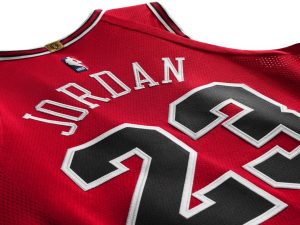
Even though he’s featured as a talking head, and his notorious 1993 interview played a central role in one of last Sunday’s episodes, Rashad’s insight into that team and those years goes beyond what made it into the doc. His friendship with Michael continues today. And since The Last Dance has replaced live games as the country’s lone appointment-viewing sports content, we figured we’d asked Rashad to help us explore the myth of Michael. Here, he talks about playing Jordan one-on-one in the backyard, fielding MJ-related inquiries from a young Kobe Bryant, and seeing the G.O.A.T. tell a room of Dream Teamers and future Hall-of-Famers to prepare for an ass-kicking.
Have you been watching along on Sunday nights?
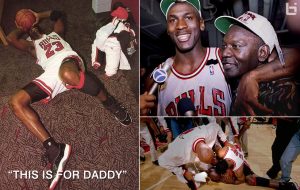
I watch every week. It’s reminiscent of a time more than anything else—a time that I was there, that period where the Bulls just really ran over everybody. Every Sunday [on NBC], we had the game of the week—it wasn’t like now where they’ve got games all week—and most of the time, it was Chicago. My job as a sideline reporter was to get insights and interview the star of the game after the game, who just happened to be Michael, who just happened to be one of my best friends.
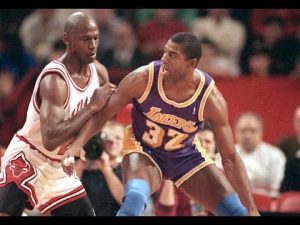
He set the bar so high and lived up to that bar every single time. That’s the fascinating part. No one has ever been that great for that long and dominated the league in that way. There was a time when, if you were at the top of your business, you were the “Michael Jordan of banking,” or the “Michael Jordan of insurance salesmen.” If you were the greatest, you were the Michael Jordan of whatever business you were in.
Nowadays, when LeBron’s going off in a playoff game, you can hop on Twitter and see athletes commenting. You didn’t have that back then. As someone who knew athletes and Jordan’s peers or contemporaries—as much as he had them—I’m curious what the conversation around him was like.

One of the things that he used to always say was that he played so hard every single night because there was a chance that somebody in that audience had never seen him play before—and he was not going to disappoint him. He played hard every single night. He never took nights off. There was no resting him for the Finals, or cutting his time down. He was a guy that was on tour and having a sold-out show no matter where he went. It’s a once in a lifetime thing to go to one of the Bulls’ games. I don’t think anybody was ever disappointed.
As someone who’s been along for the entire ride, what are the things about MJ that we take for granted now?
People don’t really realize how hard it was for him—not only as a player but also as a team—to get past the Celtics, or to get past the Pistons, or to get past the Lakers.
There was an interesting thing that happened that I was privy to—this was during the Dream Team [at the 1992 Olympics]. A bunch of guys were sitting on a pool table, and Michael and Magic got into a conversation about who was the best and playing one-on-one and all that stuff, arguing back and forth. Charles Barkley was in the room and he tried to speak up, and Larry Bird wouldn’t let him talk because he had never won a championship. Patrick Ewing was in the room too and he tried to talk. [Bird] wouldn’t let Patrick talk either.
So the argument came down to Michael telling each one of those guys that it’s a new day: I’m here now and if you don’t quit when I show up at your building next time, I’m kicking ass. So you can quit now or you can take this ass-kicking that I’m giving you when I come around. [laughs]
Finally, at the end of it—I was sitting next to Larry Bird—he just sits back and goes, “Magic, I guess we got to be quiet. We were then and he’s now.”

It was respect all the way around.
You saw that respect in last Sunday night’s episode between Michael and Kobe at the 1998 All-Star game. It was just so cool to see that exchange.
It really was. Kobe would ask me a bunch of things about Michael every time I saw him. He’d call me and ask, “What does Michael do about this? How’s he do that? How about his training? How about this?” He was just one of those kinds of guys. And Michael put him under his wing like a little brother. There was that kind of respect there.
Would you divulge stuff to Kobe?
Yeah. And then I’d tell Michael, “Hey, Kobe asked me this and that the other.” He goes, “Yeah, yeah. Well, no problem.” It was just a normal, friendly thing. There was one time when Michael had retired, and we were out in L.A. going to a Laker game. After the game, we went back to a room and it was just Michael, Phil Jackson, Kobe and myself. And Kobe challenged him to a one-on-one game.
Phil Jackson was talking to Michael about coming out and helping the Lakers at practice or something like that. And then it was like, “You guys can play one-on-one.” Kobe was not backing down. He wanted to play. [laughs] And they got a little back and forth, and then when we were leaving the building, we’re leaving the arena, and Michael goes, “You know, I really respect that kid. Really respect that kid.”
What does it take to earn Michael’s respect?
It was being dedicated to going out and doing the best you can to win every night—not once a week, or two times a month. Bring it every single night. That’s the kind of thing that really impressed him.

Last week’s episodes really explored the media scrutiny Michael faced. I know you faced your own backlash in your NFL career, especially in St. Louis after you’d changed your named to “Ahmad Rashad”—
[laughs] When I got booed all the way out of the tunnel onto the field?
Yeah. So I’m curious if you and Michael ever had any conversations or shared any wisdom about what it’s like to face that public scrutiny?
You realize that you have to use it as inspiration. It’s either that or it kills you—one or the other. It’s either going to break you, or it’s going to give you something to make you soar. It’s about getting better, being better, using things like that to make you go, “I got to go to practice tomorrow. I’m going to do an extra 15, 20 minutes.” Some people get knocked down and they have a hard time getting back up. But when your mind is right and you have a goal and you’re trying to achieve that goal, nothing can deter you from that. All I can do is show you. If you think I can’t do it, I’ll show you I can do it. Just remaining confident. Because if you don’t, it’s going to chip away at you and it’ll take everything away from you.
I felt like, in these last episodes, you could see the weight of the scrutiny on Michael. Someone was talking about how, though he didn’t break any rules with his gambling, he violated people’s expectations.
The gambling rumor was just that. It had nothing to do with playing basketball. And I think as it got out of control, when people started coming up with rumors of him gambling, that was just something that was…over there. It wasn’t real. He likes to gamble. But that’s not against any rule. His gambling would never have made him take his focus off of winning games and playing as hard as he could play.
That happens to everybody who rises up in stature: They build you up and then they start trying to tear you down. At that point, you didn’t really know much about him as a person. You just knew him as a great basketball player. And when it came to a head, that’s when he said, “Look, man, go get a camera. Can you go get a camera? I want to do this interview right now. Let’s get this thing straight right this minute.” And it didn’t deter him. He did the interview and he just moved on. There was no more conversation about it.
Did you tell him to take his sunglasses off?

And at the end of the interview I went, “Wait. Michael, don’t leave.” I turned around and said, “Is there anything else that we need to ask him?” Because I’m thinking about the fallout the next day. And it was like, “Nope, we got everything you need. It’s all good.” And then the next day, I had probably every sports guy in the world being like—I guess there was a lot of jealousy, first of all—”Ah, he was too easy on him. He shouldn’t have done the interview with him. He should have done it with me.” [laughs]
How heavily did all that weigh on him, though? Once it was over, did he really let it go?
Yeah. You know why? Because he wasn’t guilty. He wasn’t bullshitting. He wasn’t lying. What else can you say? It did not deter him from trying to win more championships. That was the most important thing. All those commercials and all that other stuff, that was secondary. First? Winning championships.
There’s a recent GQ interview with Tim Grover, Michael’s trainer, and, in the photo, you’re in the background. What was it like to be around him as he was training?
He would amaze you with how strong he was. He could do the iron rings—you know, with your hands out straight and you’re holding those rings? He could do that shit! [laughs] That’s crazy strong. Never did he ever skimp. You talk about a guy who was dedicated—tremendously dedicated.
But then, as you talk, he says, “All that stuff created my confidence.” If you ever saw him practice, he practiced as hard as he played in a game. So if you thought some of the things that you saw in a game that was just so fantastic, you should see what he was doing in practice. It was like the same guy: “I’m going a hundred miles an hour all the time.” And that is what gave him the confidence. Because he worked so hard at it.
People think, “Well, he just showed up and he’s just naturally talented.” He’s naturally talented. [But] on top of that, he works harder than anybody I’ve ever seen, any athlete I’ve ever met. He had a goal, and he was hell-bent on achieving it.

Golf is just about you. It’s not about the other guy you’re playing, it’s about you. So it was a chance to get away from people, from the game, from all the hype around being Michael Jordan. It was a place to get away, but he was also trying to challenge the game of golf.
He would play before games. I remember one time we went and played golf somewhere [before a game], and I was doing sideline reporting [that night]. I was so tired that I went to sleep on the sideline. I kept thinking, “How the hell can he be up there playing, when he just finished 18 holes?” He was just a different kind of human being.
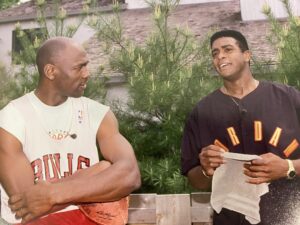
Have you talked to him about the documentary?
Yeah, we talk about it. And more so than anything else, we remember. Last night, we watched it, and, at some point, something came on and I was like, “Hey, do you remember we had dinner the night before that?” It’s more like two friends looking back.
For instance, I remember when they played Phoenix. Charles [Barkley] and Phoenix won this particular night, and I had to interview Charles at the end of the game. He was saying, “I talked to the Lord and the Lord told me that we’re going to win this game.” That was kind of a joke.
So then, after, we went somewhere to have dinner, and Charles walked into the room. It was a private room in a restaurant. And Michael didn’t speak to him. Nothing. They’re friends, but they weren’t friends during this. This was a whole different thing. Charles came in, he was trying to joke around, nobody really said anything so he just went right back out.
And when you talk about somebody like Charles, and Charles says, “He’s the greatest player I’ve ever seen,” you have to take that into account. In championships, there was another star that was supposed to be in Michael’s stratosphere. So at the end of that series, he wanted to put it down that nobody’s in my stratosphere. Whoever it was, it was like, “Nah, let’s see what happens at the end of this.” And he loved it. Absolutely loved the competition.
One time we were in his yard and we were just messing around, so I was trying to play. It was just the two of us. I was like, “Hey, let’s play one on one.” He was like, “Shit, I ain’t playing you one on one.” I’m like, “Come on, man.” He’s like, “I ain’t playing you.” So he took the ball first and shot and made it. It was my turn to take the ball and every time I dribbled it, he took it.
He wouldn’t even let me dribble. He was guarding me so tight. I was like, “Shit, man, it ain’t that serious, is it?” [laughs] “Yep, it is. I’m not going to let you make one basket. Matter of fact, I ain’t going to let you even dribble.” It only lasted about three or four minutes. I was like, “Okay, I quit. Let’s play football.”
Has that competitive fire waned at all with time?
No, he’s still one of the most competitive people you’re ever going to meet. When we play golf, he’s still just as competitive. And that’s just him. That’s Michael. He’s ain’t ever going to ease up. You’re always going to get his best. And that’s cool.
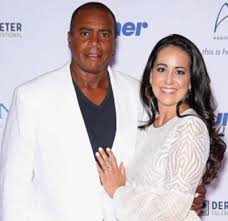
Ahmad Rashād (born Robert Earl Moore; November 19, 1949) is an American sportscaster (mostly with NBC Sports) and former professional football player. He was the fourth overall selection of the 1972 NFL Draft, taken by the St. Louis Cardinals.
Recruited out of high school as a wide receiver by the Oregon Ducks, he moved to the running back position and was named to the 1971 College Football All-America Team at that position. After being drafted by the Cardinals, Rashād went back to wide receiver, and played for the Cardinals for two seasons. After being traded to the Buffalo Bills in 1974, and sitting out the 1975 season with a knee injury, he signed with the Seattle Seahawks before the 1976 season, who traded him shortly thereafter to the Minnesota Vikings (1976–1982), where he earned four Pro Bowl selections from 1978 to 1981.
Following his retirement from football, Rashād transitioned to television, where he worked as a studio analyst, game reporter, and anchor for several sports, notably hosting the National Basketball Association weekly digest shows NBA Inside Stuff (1990–2004) and NBA Access with Ahmad Rashad (2005–2011). He has appeared as a fictionalized version of himself as a television sports personality in several films and television shows, and hosted several non-sports related game shows and reality television shows.
After his football career, Rashād covered NFL, NBA, and MLB televised contests as a studio anchor and game reporter for NBC and ABC, as well as hosting NBA Inside Stuff for 16 seasons. He also has hosted the video-clip show Real TV in 2000, the reality show Celebrity Mole, the game show Caesars Challenge along with co-host Dan Doherty, and NBA Access with Ahmad Rashad on the ABC network.
He starred in an episode of Monsters. Rashād has also guest starred on several TV shows, mainly ones that starred his then-wife Phylicia. In 1988, he filled in for Robb Weller on the weekend edition of Entertainment Tonight (then known as Entertainment This Week). He used to interview long-time friend Michael Jordan frequently while he was at NBC. In early 2013, he became a panelist on the daily talk show Morning Drive on the Golf Channel, but left that summer. Rashād has narrated the yearly highlight films for NBA championship teams since 2012.




