


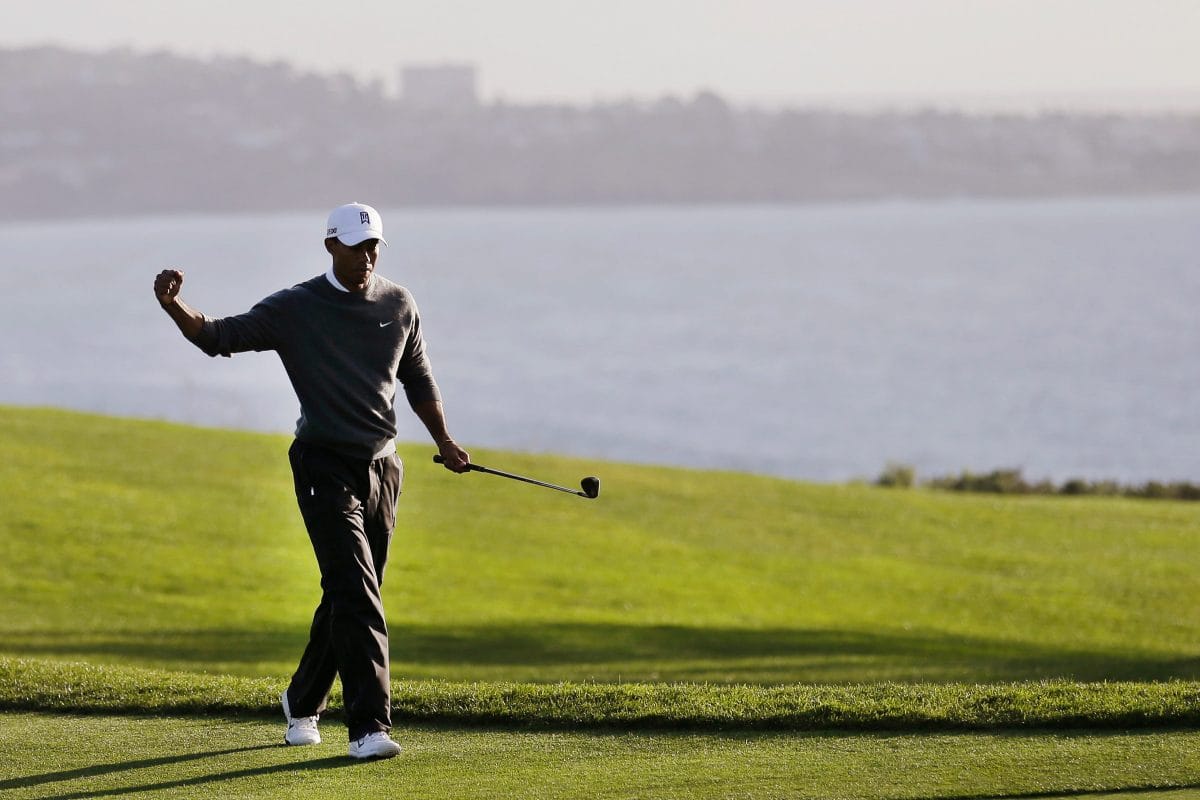
SAN DIEGO, CA – JANUARY 27: Tiger Woods walks down the fairway on the 14th hole during the third round of the Farmers Insurance Open at Torrey Pines South on January 27, 2018 in San Diego, California. @TigerWoods
After a 12-year-absence, southern California native Tiger Woods will tee it up again this week in L.A., at Riviera, for the Genesis Open. He’s tried to claim victory at “the Riv” on 10 occasions without success, but he’s still enamored with the place. With his Tiger Woods Foundation running the event, Tiger is the tournament host, and he looks fondly upon the venue where he first attended a PGA Tour event with his pop, Earl, when Tiger was 9 or 10. In addition, his first-ever appearance in a PGA Tour event was at Riviera at age 16, at the 1992 Los Angeles Open. Despite respectable rounds of 72-75, he missed the cut, but stuck around for Sunday’s finale to be presented with a newly created “low amateur” award.
Tiger Woods: They get a ton of use. At Bluejack, I know they do a lot of cross-country golf, too. You play whatever configuration you want. It’s all about having fun. The kids play it, the elderly play it. It’s fun to mix and match with different little iterations. The short courses are made to be for either practice or to be played for fun, very quickly, very easily, very efficiently. Obviously it’s up to the developer what he wants, but we love doing them.

SAN DIEGO, CA – JANUARY 24: Tiger Woods addresses the media during a press conference after playing in the pro-am round of the Farmers Insurance Open at Torrey Pines Golf Course on January 24, 2018 in San Diego, California.
What is it that you learned from the par-3 courses where you grew up that made you think about how you would do par-3 courses today?
The par-3 courses I grew up on, one was Hartwell, in Long Beach (Calif.) and the other was Bellflower. They were short and they were lit at night. And so you’d get people with, say six clubs and a six-pack and they’d really enjoy themselves.
We had, at the time when I played, an extremely good junior golf program because all kids could play from all different levels, so I started playing when I was 8. It was a nice place to play, competed every Saturday, always had a tournament. They catered to us (juniors), but also to anyone who wanted to play. And it was very quick. That’s the great thing about it. Even back then, when they didn’t have cell phones, everyone enjoyed the pace of play. It was quick and fun. That’s what stuck with me.

Jul 16, 2015; St Andrews, GBR; Tiger Woods on the 2nd green during the first round for the 144th Open Championship at St. Andrews – Old Course.
Do you have a favorite memory from competing in a par-3 tournament or playing with the guys, when you were that age?
I’d have to say when I was eight years old, on the 12th hole at Hartwell, I made my first hole-in-one. I hit a nice little two-and-a-half-wood up there. And I couldn’t see the ball. I was too short to see over the bunker. And so the ball hit on the downside of the bunker and rolled into the back of the hole. The guys were screaming and yelling and I didn’t know what they were screaming and yelling about, so they picked me up and held me, showed me that there was no ball on the green. I immediately ran down to the hole, started celebrating when I saw the ball in the hole and they said, “Hey, you little s—, your clubs are back on the tee.”

That’s why we call it a Short Course. We can make it so that, like, the Playgrounds at Bluejack has 10 holes. Well, you can play 18. You can configure however you want. You can leave it up to the players. Yeah, you have suggested areas which you want to tee off from to go to that green, but if you don’t want to use them, don’t. Like here at the Oasis (at Diamante). You have 12 holes, but three of the holes can be a par 5 and a par 4 and a par 3. So you can mix and match however you want.
Do you have a specific design philosophy that extends to each short course you do?
We try to have it where actually every hole is open to all types of shots. At the Playgrounds in Houston, when we first played with those two kids (at the Grand Opening in May 2016), the one that made the hole-in-one, I putted the whole time. What did I shoot, 3-over, something like that? I just putted the whole way around the golf course. Going back to what I said earlier, about what’s my favorite type of golf, it’s links golf. You can use the ground, you can have a bunch of fun. It’s a reason why I loved how the Playgrounds turned out is that we were able to use the ground literally from tee to green.

LA JOLLA, CA – JANUARY 28: Tiger Woods celebrates on the 18th green after winning the Farmers Insurance Open at Torrey Pines Golf Course on January 28, 2013 in La Jolla, California.
What’s your new Bahamas Short Course project about, and how will it differ from your other designs?
It’s called Jack’s Bay, in Eleuthera. The project developers (Beacon Land) are the same as at Bluejack. They liked the Playgrounds concept and 10 holes, so we’ll keep those themes. The seventh hole is right on the water, a downhill, short par 3, but actually you’re in the water. At high tide, you just tip your foot over to the left side of the green and you’re wet. You can feel spray from the waves hitting.
Can you identify your favorite short course?
I have four greens in my backyard — my own little short course. Charlie (Woods’ son) and I play it all the time and we play it in whatever configuration we want.

Tiger (Eldrick) Woods, born December 30, 1975, is a professional golfer and entrepreneur.
Since turning professional in 1996, Tiger has built an unprecedented competitive career. His achievements on the course–105 worldwide wins and 14 majors–have mirrored his success off the course as well.
Woods serves as Founder and CEO of TGR, a multibrand enterprise comprised of his various companies and philanthropic endeavors, including TGR Design, the golf course design company; The Tiger Woods Foundation, a charitable foundation; TGR Live, an events production company; and The Woods Jupiter, an upscale sports restaurant.
He has 79 PGA TOUR wins, the second-highest total of any player. His majors victories include the four Masters Tournaments, four PGA Championships, three U.S. Open Championships, and three British Open Championships. With his second Masters victory in 2001, Tiger became the first golfer ever to hold all four professional major championships at the same time.
In winning the 2000 British Open at St. Andrews, Woods became the youngest to complete the career Grand Slam of professional major championships and only the fifth ever to do so, following Ben Hogan, Gene Sarazen, Gary Player, and Jack Nicklaus. Tiger was also the youngest Masters champion ever, at the age of 21 years, three months and 14 days, and was the first major championship winner of African or Asian heritage. The 2000 U.S. Open and 2001 Masters victories came by record margins, 15 strokes and 12 strokes, respectively.
He is the career victories leader among active players on the PGA TOUR, and is the career money list leader.
Despite being unable to play the majority of 2016, Woods, the entrepreneur and philanthropist, made significant news. In February, the TGR Learning Lab in Anaheim celebrated its 10th anniversary, with satellite facilities now located in Washington, DC, Philadelphia and Stuart, Florida. Eight months later in October, the Tiger Woods Foundation commemorated its 20th anniversary with a gala event at the New York Public Library featuring Woods and Nike’s Phil Knight.
The Woods Jupiter celebrated its first anniversary—the restaurant opened in August, 2015—and TGR Design’s Bluejack National course located outside Houston, Texas was selected Best New Private Course by both Golf Digest and Golf Magazine/Sports Illustrated.

Tiger is the son of Earl Woods, a retired lieutenant colonel in the U.S. Army, and his wife, Kultida, a native of Thailand. He was nicknamed Tiger after a Vietnamese soldier and friend of his father, Vuong Dang Phong, to whom his father had also given that nickname.
He grew up in Cypress, California. He took an interest in golf at age 6 months, watching as his father hit golf balls into a net and imitating his swing. He appeared on The Mike Douglas Show at age 2, putting with Bob Hope. He shot 48 for nine holes at age 3 and was featured in Golf Digest at age 5.
Tiger played in his first professional tournament in 1992, at age 16, the Los Angeles Open, and made the 36-hole cut and tied for 34th place in the 1994 Johnnie Walker Asian Classic in Thailand, He entered Stanford University in 1994 and in two years he won 10 collegiate events, concluding with the NCAA title.
Woods compiled one of the most impressive amateur records in golf history, winning six USGA national championships before turning professional on August 27, 1996. He concluded his amateur career by winning an unprecedented third consecutive U.S. Amateur title, finishing with a record 18 consecutive match-play victories.
The week after winning his third U.S. Amateur title, Woods played his first tournament as a professional in the Greater Milwaukee Open. It was one of only seven events left in 1996 for him to finish among the top 125 money winners and earn a player’s card for the PGA TOUR. He won twice and placed among the top 30 money winners.
Woods won four PGA TOUR events in 1997, plus one overseas, and was the leading money winner. He achieved No. 1 on the Official World Golf Ranking for the most rapid progression ever to that position. On June 15, 1997, in his 42nd week as a professional, Woods became the youngest-ever No. 1 golfer at age 21 years, 24 weeks.
Woods won eight times on the PGA TOUR in 1999 (11 worldwide), including the PGA Championship. He won four consecutive PGA TOUR events to end the year and started 2000 with two more victories for a total of six in succession.
In 2000, Woods won 11 events, including three professional majors in the same year, and also became the first player since 1936-37 to win the PGA Championship in consecutive years. Woods won five times, including the Masters, in 2001 and eight times worldwide. He won five times again on TOUR in 2002, and seven times worldwide, and was the TOUR’s leading money winner for the fourth consecutive year.


WOODS WON FIVE TIMES, INCLUDING THE MASTERS, IN 2001 AND EIGHT TIMES WORLDWIDE.
He won a total of 20 times from 2003-06, lead the TOUR’s money list twice and captured four majors. Woods joined Nicklaus as the only player to win the Grand Slam twice. His emotional win the following year at the British Open at Royal Liverpool came two months after his father’s death. He won the 2006 PGA Championship by five strokes at Medinah CC, the same venue where he won the event in 1999.
He began 2007 with his seventh consecutive PGA TOUR victory and ended the year with a total of seven official wins, including a second-consecutive PGA Championship. In 2008, he won four of six PGA TOUR events, including his 14th major at the U.S. Open—his last event of the year before season-ending knee surgery—plus the Dubai Desert Classic, and finished second on the TOUR money list in just six starts. At his major win at Torrey Pines, Woods sank a 12-foot birdie putt on the 72nd hole to force an eventual 19-hole playoff (tied at even-par 71 after 18 holes) the following day. He later revealed that he had played the tournament with a torn anterior cruciate ligament in his left knee and a double stress fracture in the same leg.
In 2009, he returned to the winner’s circle after 286 days and ended the year leading the PGA TOUR in victories (6) and money ($10,508,163). He also won his first tournament in Australia. He captured three tournaments in 2012 and five in 2013.
Sports Illustrated selected Woods as the 1996 and 2000 Sportsman of the Year, the first to win the award more than once. L’Equipe (France) selected him as the 2000 World Champion of Champions. The Associated Press chose Woods as the Male Athlete of the Year for 1997, 1999 and 2000. He and Michael Jordan are the only athletes to win the award three times. He was chosen ESPY Male Athlete of the Year in 1997 (tied with Ken Griffey, Jr.), 1999, 2000 and 2001. The founding members of the World Sports Academy, in voting for the Laureus Sports Awards, also selected him as the 1999 and 2000 World Sportsman of the Year. In 2008 Businessweek made Woods No. 1 in The Power 100 for the most influential people in sports. In 2009 he was selected AP Athlete of the Decade. Woods received 56 of 142 votes cast by AP editors throughout the country. He was also inducted into the Stanford Athletics Hall of Fame.
Woods was selected as the 1997, 1999, 2000-2003, 2005-2007, 2009, 2013 Player of the Year by the PGA TOUR (Jack Nicklaus Award) and the PGA of America and by the Golf Writers Association of America in 1997, 1999, 2000-2003, 2005-2007, 2009. His adjusted scoring average averages in 2000 and 2007 of 67.79 strokes were the lowest ever and earned him the Byron Nelson Award on the PGA TOUR and the Vardon Trophy from the PGA of America. He also had an actual scoring average in 2000 of 68.17, breaking Nelson’s record of 68.33 in 1945.




