His wife, Lovell Woods Gamble, said the cause was ameloblastic carcinoma, a rare tumor in the jaw. Gamble, who died in a hospital, lived in Montgomery, Ala.
Gamble played for seven teams over 17 seasons, starting with the Chicago Cubs. The Cubs traded him to the Philadelphia Phillies, who sent him to the Cleveland Indians, where he began to show the power that made him an offensive force. A left-handed batter who regularly faced right-handed pitchers, Gamble hit 54 home runs in three seasons for Cleveland.
He arrived at the Indians’ spring training camp in 1973 sporting the Afro, putting him in tonsorial company with Julius Erving and Darnell Hillman, big-haired stars of the American Basketball Association. It was a stylish look among black men of that era — sometimes associated with the black power movement — but unusual within the conservative world of Major League Baseball.
“People took one look at that hair and thought I was a bad guy,” Gamble told The Sporting News in 1979. “There were some sportswriters who wouldn’t talk to me. They thought I was some kind of militant with my beard and my hair.”

Oscar Gamble, a power hitter for nearly two decades in the major leagues who was instantly recognizable in the 1970s by his impressive Afro, which bulged like giant earmuffs from beneath his cap, died on Wednesday in Birmingham, Ala. He was 68.
His wife, Lovell Woods Gamble, said the cause was ameloblastic carcinoma, a rare tumor in the jaw. Gamble, who died in a hospital, lived in Montgomery, Ala.
Gamble played for seven teams over 17 seasons, starting with the Chicago Cubs. 
He arrived at the Indians’ spring training camp in 1973 sporting the Afro, putting him in tonsorial company with Julius Erving and Darnell Hillman, big-haired stars of the American Basketball Association. It was a stylish look among black men of that era — sometimes associated with the black power movement — but unusual within the conservative world of Major League Baseball.
“People took one look at that hair and thought I was a bad guy,” Gamble told The Sporting News in 1979. “There were some sportswriters who wouldn’t talk to me. They thought I was some kind of militant with my beard and my hair.”
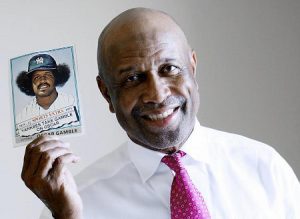
“As he raced across the Municipal Stadium outfield or hustled his way around the bases,” The Hardball Times, a baseball website, wrote in a profile in 2009, “Gamble frequently lost his cap and helmet in the wind; even extra large sizes of headwear could not sustain the friction created by the unstoppable Afro.” “I went into Billy Martin’s office on the first day of camp and said, ‘Excuse me, there’s no uniform in my locker,’ ” Gamble told The New York Times in 2005, referring to the Yankees manager. “Billy looked at me and said: ‘Son, we have rules here. And you need a haircut.’ ” The cards became collectors items, and Gamble would later receive them in the mail from fans. “I sign those cards all the time,” he told The Daily News in 2008.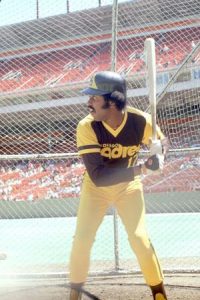


Gamble had a subpar season for the Yankees in 1976 before he was traded early the next year to the Chicago White Sox in a deal that brought the shortstop Bucky Dent to the Bronx. Dent went on to hit a home run that helped defeat the Boston Red Sox in a memorable 1978 playoff game at Fenway Park.
Gamble had his most productive season in 1977, when he hit 31 home runs and had 83 runs batted in and a .297 batting average with the White Sox. With his value at a peak, he then signed a six-year, $2.85 million contract with the San Diego Padres (the equivalent of about $12 million today).
But his power faded to seven home runs in 1978 — disgruntled fans booed and called him “Ol’ 2.8” — and the Padres shipped him to the Texas Rangers after one season.

He stayed with the Yankees through 1984. One highlight came during the 1981 American League division series, when he hit .556 with two home runs, including one during a Game 5 victory over the Milwaukee Brewers. The Yankees went on to face the Los Angeles Dodgers in the World Series, in which Gamble had two hits and one run batted in before New York lost to the Dodgers in six games.
Oscar Charles Gamble was born on Dec. 20, 1949, in Ramer, Ala., about 25 miles southeast of Montgomery. His father, Sam, was a sharecropper, and his mother, the former Mamie Scott, was a homemaker. He began playing semipro baseball for local teams when he was 13.

After high school, he was drafted by the Chicago Cubs in 1968; its renowned scout, Buck O’Neil, the former Negro Leagues player and manager, had had a strong hunch that Oscar would make it to the major leagues.
“This kid is the greatest prospect I’ve signed since Ernie Banks,” O’Neil told The Associated Press in 1969, referring to the Cubs’ Hall of Fame first baseman.

Gamble had a second go-round with the White Sox before retiring in 1985. In the years since, he had worked as a player agent and coach. He was inducted into the Alabama Sports Hall of Fame in 2016.
Even with the Steinbrenner-enforced shorter hair — and a shaved-head look in his later years — Gamble could not escape his famous Afro.
“I liked it, but I guess it did cause me to get a bad reputation,” he said in the Sporting News interview. But, he added: “I’m really full of fun. I never try to hurt anybody.”
MORE ON OSCAR GAMBLE
Oscar Charles Gamble (December 20, 1949 – January 31, 2018) was an American professional baseball player. He played as an outfielder and designated hitter in Major League Baseball for 17 seasons, from 1969 to 1985. He played for seven different teams: the Chicago White Sox and New York Yankees on two separate occasions, as well as theChicago Cubs, Philadelphia Phillies, Cleveland Indians, San Diego Padres, and Texas Rangers.
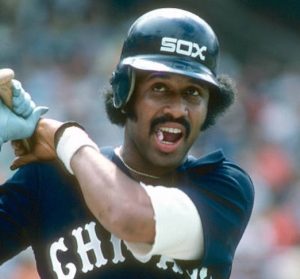
Nicknamed the Big O by Yankees announcer Phil Rizzuto, Gamble was a great baseball player given the amount of time he was allowed to play in the game. Despite the limited playing time, he still hit 200 career home runs in just over 4,500 major league at bats. Oscar’s career peaked in 1977 with the White Sox, when he hit 31 home runs and tallied 83 RBI. After an ill-fated, injury-plagued year in San Diego, he returned to the American League in 1979 to hit a career-best .358 batting average, slamming 19 home runs with the Yankees and Rangers. (He did not have enough plate appearances to qualify for the American League batting title.)
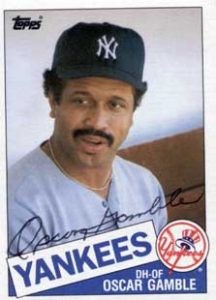
In 1976, Gamble helped the Yankees return to prominence as the “Bronx Bombers” won their first American Leaguepennant in 12 seasons, hitting 17 home runs and 57 RBI. His left-handed power stroke was ideal for the renowned short right field fence at Yankee Stadium. Returning to the Yankees in 1979, he would settle into a limited role with the team, aiding the Yankees once again to an AL East division title in 1980 and a World Series appearance in 1981.
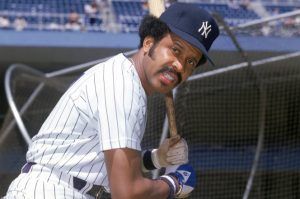
Notably, Gamble also finished with more career walks (610) than strikeouts (546). He was considered a below-average fielder, and consequently played over a third of his games as a designated hitter, but he had a good arm. He played in the 2007 Yankee Old Timers Game with many Yankee players that were honored from the 1977 championship team.
Gamble lived in Little Ferry, New Jersey, while playing with the Yankees.
After retirement from baseball, Gamble returned to Alabama and lived in Montgomery where he was a player agent for several years. He was involved in youth baseball. One son, Sean, was a player in the Philadelphia Phillies organization, and another son played in junior college.
He opened up a discotheque known as ‘Oscar Gamble’s Players Club’ in Montgomery; baseball writer Dan Epstein called it a “hip” place.
Gamble died of ameloblastic carcinoma on January 31, 2018, at the age of 68.