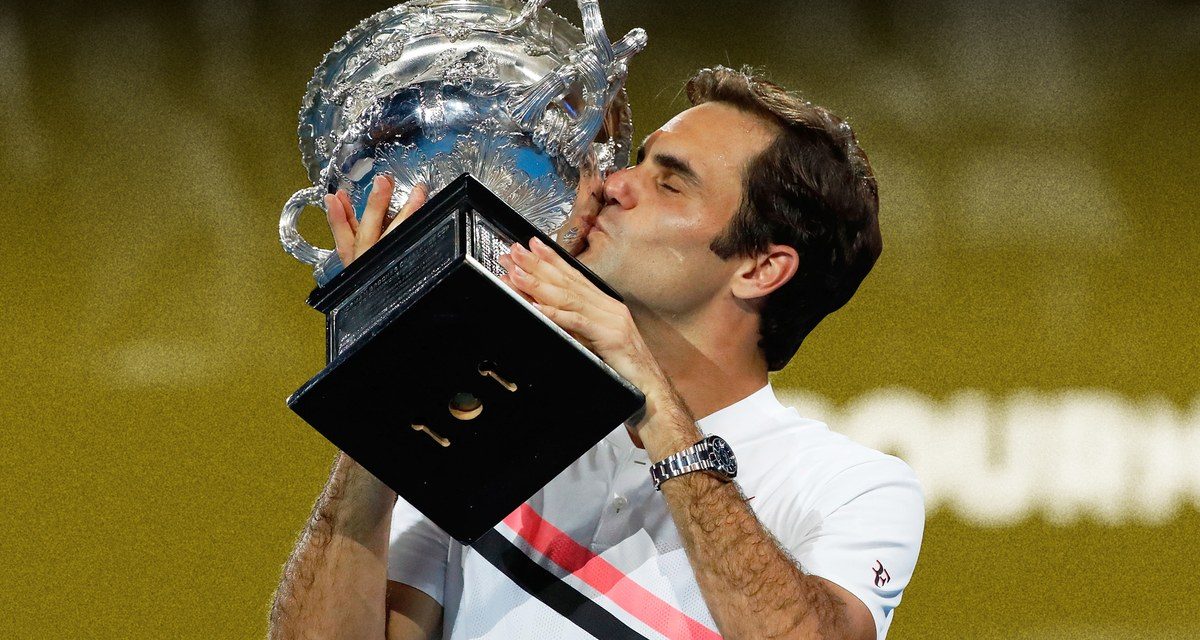


The man who was already considered by most as the greatest male player of all-time is now the first to that milestone, but his list of ridiculous records and insane feats doesn’t come close to ending there.
This is what Federer has achieved over his incredible career.
Roger Federer is the first man to win 20 Grand Slam titles.
Only three others, all women, have reached that mark — Margaret Court (24), Serena Williams (23) and Steffi Graf (22), while his nearest male challenger is Rafael Nadal (16).

Federer has now won 96 singles titles, with a very realistic chance of reaching an incredible 100 by the end of the year.
It’s incredibly close at the top, but Federer is still the world No.2 — just.Nadal remains the world No.1 on 9760 ATP ranking points, with his quarter-final berth being exactly what he needed to retain the top spot. Federer is on 9605.
That order could change very quickly though with Nadal needing to defend the 300 points he earned by making the final of the Mexico Open in Acapulco last year.
Federer, meanwhile, is set to play in Dubai next month where he only reached the second round last year, earning 45 points.The ATP rankings system sees the last 12 months of events adding up to a player’s total. Therefore if Federer wins that event this year he could earn an extra 455 points, while Nadal can only earn an extra 200 (winning each event is worth 500 points).

Federer would easily surpass Andre Agassi as tennis’ oldest over number one. The American was 33 years and 131 days old when he last held top spot in 2003.
To honor and celebrate Roger’s 20th Grand Slam title, Wilson has created an exclusive Collector’s Edition Platinum Racquet Package, complete with a special Pro Staff RF 97 Autograph racquet painted in a metallic, glittering platinum-colored paint.
The color platinum is widely used to the mark the achievement of 20th milestones.
Along with the limited edition platinum racquet, each package includes a Roger Federer signed Australian Open Wilson tennis ball and a premium box to display this commemorative racquet and ball. The Package also includes a series of mini-posters documenting Roger’s 20 Grand Slams titles, a photo of Roger Federer holding the commemorative racquet and the certificate of authenticity. Proceeds go to the Roger Federer Foundation.
Only 20 of these racquets have been made!

| Singles | |
|---|---|
| Career record | 1139–250 (82%) |
| Career titles | 96 (2nd in the Open Era) |
| Highest ranking | No. 1 (2 February 2004) |
| Current ranking | No. 2 (11 September 2017) |
| Grand Slam Singles results | |
| Australian Open | W (2004, 2006, 2007, 2010,2017, 2018) |
| French Open | W (2009) |
| Wimbledon | W (2003, 2004, 2005, 2006,2007, 2009, 2012, 2017) |
| US Open | W (2004, 2005, 2006, 2007,2008) |
| Other tournaments | |
| Tour Finals | W (2003, 2004, 2006, 2007,2010, 2011) |
| Olympic Games | F (2012) |
| Doubles | |
| Career record | 129–89 (59.17%) |
| Career titles | 8 |
| Highest ranking | No. 24 (9 June 2003) |
| Current ranking | N/A |
| Grand Slam Doubles results | |
| Australian Open | 3R (2003) |
| French Open | 1R (2000) |
| Wimbledon | QF (2000) |
| US Open | 3R (2002) |
| Other doubles tournaments | |
| Olympic Games | W (2008) |
| Team competitions | |
| Davis Cup | W (2014) |
| Hopman Cup | W (2001, 2018) |
|
Olympic medal record[hide]
|
|


Roger Federer is a Swiss professional tennis player who is currently ranked world No. 2 in men’s singles tennis by the Association of Tennis Professionals (ATP). Federer has won 20 Grand Slam singles titles and has held the world No. 1 spot in the ATP rankings for 302 weeks, including 237 consecutive weeks. After turning professional in 1998, he was continuously ranked in the top ten from October 2002 to November 2016. He re-entered the top ten following his victory at the 2017 Australian Open.
In majors, Federer has won eight Wimbledon titles, six Australian Open titles, five US Open titles and one French Open title. He is among the eight men to have captured a career Grand Slam, and has reached 30 men’s singles Grand Slam finals, including ten in a row from the 2005 Wimbledon Championships to the 2007 US Open. Federer has also won six ATP World Tour Finals, 27 ATP World Tour Masters 1000, and 19 ATP World Tour 500 tournaments. Given these achievements, many players and analysts consider Federer to be the greatest tennis player of all time.
1. Rafael Nadal (9760 points)
2. Roger Federer (9605)
3. Marin Cilic (5760)
4. Grigor Dimitrov (4630)
5. Alexander Zverev (4610)
6. Dominic Thiem (4060)
7. David Goffin (3460)
8. Jack Sock (2880)
9. Juan Martin del Potro (2815)
10. Pablo Carreno Busta (2705)
11. Kevin Anderson (2620)
12. Sam Querrey (2490)
13. Novak Djokovic (2470)
14. Nick Kyrgios (2395)
15. Stan Wawrinka (2385)
16. Tomas Berdych (2320)