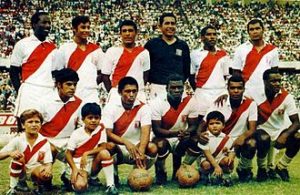
PICTURED TO THE LEFT: Peru’s football team at the 1936 Olympic Games in Germany!!!!!
Standing between them and a place at Russia 2018 are New Zealand, with the two sides set to contest the first leg of their intercontinental play-off on Saturday. In looking ahead to the tie, FIFA.com picks out four key aspects that allowed the Peruvians to revive what looked set to be another failed qualification campaign.
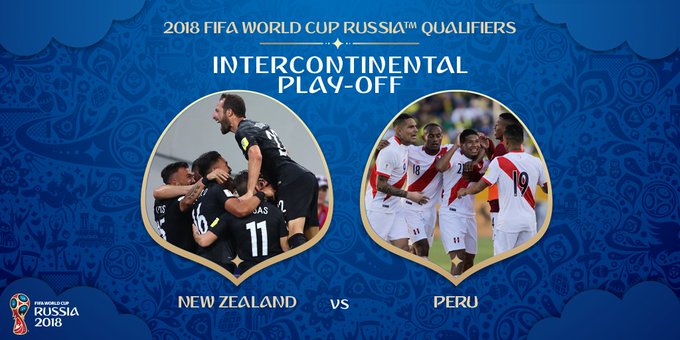
After a dramatic night in South America, the first confirmed intercontinental play-off seesNew Zealand facePeru!#WCQ


1. All hail coach Gareca
Argentinian coach Ricardo Gareca is regarded by all his players as the man responsible for Peru’s resurgence. “He’s not so much a coach as a friend,” Yosimar Yotun told FIFA.comahead of the final two matches in the South American qualifiers. “He’s coached in Peru before and he knows how good our players are. It didn’t take him long to get us believing again, both on an individual and a team level. He restored our confidence.”
- Stat: Peru lay 64th in the FIFA/Coca-Cola World Ranking when Gareca took charge of his first training session in April 2015. They now lie 10th, an all-time high.
2. Finding the right blend
When the qualifiers began in October 2015, Gareca put his faith in a 4-4-2 formation and the spine of the team that finished third at the Copa America that year. Forced by poor results to switch tactics and personnel, he eventually came up with a 4-2-3-1 system, employing it for the first time at the 2016 Copa America Centenario. From that September onwards, he would stick to it for virtually the rest of the qualifying campaign.
- Stat: Peru won a mere four points out of 18 between October 2015 and March 2016, a success rate of only 22.22 per cent. From September 2016 onwards, they upped that figure to 61.11%, collecting 22 points from a possible 36.
3. Doing it on the pitch
Pedro Gallese is the team’s undisputed first-choice goalkeeper. Only injury ever kept him out of the side and he played a decisive role as the qualifying competition reached its conclusion. Aldo Corzo, Christian Samos, Alberto Rodriguez and Miguel Trauco now form a settled rearguard, having first played together on Matchday 9 in October 2016 and with only suspension preventing them from appearing more than five times together in the last nine qualifiers. The midfield partnership formed by Renato Tapia and Yotun has, since Matchday 8, been vital in allowing wide men Andre Carrillo and Edison Flores and attacking midfielder Christian Cueva to get forward at every opportunity. Paolo Guerrero was very influential up front, but when injury struck him down the experienced Jefferson Farfanproved a more than able replacement.
- Stat: With five, four and three goals respectively, Edison Flores, Cueva and Farfan scored exactly half of Peru’s 24 goals in the qualifiers. Yotun and Cueva provided the most assists, with four and three respectively.
4. United in a cause
As Gareca’s squad has evolved, a number of players have happily taken on their role as replacements, among them Raul Ruidiaz, Yordi Reyna and Paolo Hurtado, while the likes of Luis Advincula and Farfan have responded admirably to losing their places in the starting line-up. Youngsters such as Andy Polo, Pedro Aquino, Miguel Araujo and Nilson Loyola have also broken into the squad along the way. In the process, Gareca has fashioned a well-balanced side that has risen to every challenge it has faced so far.
- Stat: Front man Ruidiaz was Gareca’s most-used substitute in the South American qualifiers, coming on in nine matches. He also started two games, in place of Guerrero on both occasions, and scored a crucial injury-time equaliser in the 2-2 draw with Venezuela on Matchday 5. Meanwhile, Hurtado came off the bench five times and Polo and Aquino four each.
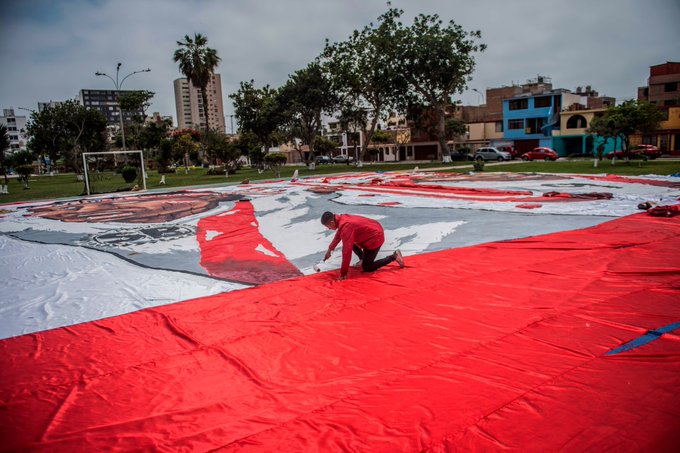
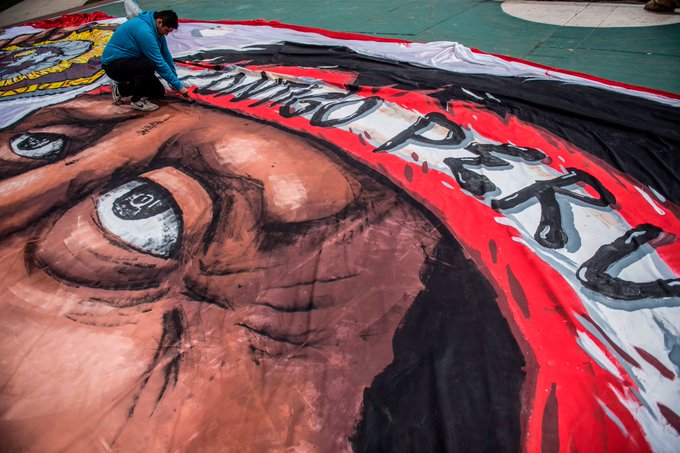

The Peru national football team has represented Peru in international football since 1927. Organised by thePeruvian Football Federation (FPF),[A] it is one of the 10 members of FIFA‘s South American Football Confederation (CONMEBOL). The Peruvian team’s performance has been inconsistent; it enjoyed its most successful periods in the 1930s and the 1970s. The team plays most of its home matches at the Estadio Nacional in Lima, the country’s capital.
To the left: Peru at the 1970 World Cup in Mexico, wearing their traditional kit. The distinctive diagonal red “sash“, emblazoned across Peru’s white shirts continuously since 1936, has won praise as a simple yet effective design.Peru has won the Copa América twice and qualified for FIFA World Cup finals four times; it also participated in the 1936 Olympic football competition. It has longstanding rivalries with Chile and Ecuador. The team is well known for its white shirts adorned with a diagonal red stripe, which combine Peru’s national colours. This basic design has been used continuously since 1936, and gives rise to the team’s common Spanish nickname, la Blanquirroja (“the white-and-red”).
The Peruvian national team took part in the inaugural FIFA World Cup in 1930 and enjoyed victories in the 1938 Bolivarian Games and the 1939 Copa América, with goalkeeper Juan Valdivieso and forwards Teodoro Fernández and Alejandro Villanueva playing important roles. Peruvian football’s successful period in the 1970s brought it worldwide recognition; the team then included the forward partnership of Hugo Sotil and Teófilo Cubillas, often regarded as Peru’s greatest player, and defender Héctor Chumpitaz. This team qualified for three World Cups and won the Copa América in 1975. Peru last reached the World Cup finals in 1982.
Under the current management of Ricardo Gareca, Peru came in third at the 2015 Copa América, reached the quarterfinals of the Copa América Centenario, and is currently in the qualification phase for the 2018 World Cup finals in Russia. They will face New Zealand in the inter-confederation play-offs that are scheduled to be played on 11 and 15 November 2017.