


Jake LaMotta, the brutish former boxing champion whose life of violence in and out of the ring was portrayed in the movie “Raging Bull,” died on Tuesday, according to one of his daughters.
LaMotta, who admitted intentionally losing a fight at the behest of mobsters, was in his 90s, listing his birthday as July 10, 1922, while other sources had the year as 1921. His daughter Christi LaMotta announced the death on her personal Facebook page but did not disclose the cause of death.

Due to his style of fighting, LaMotta often got as much as he was giving in an era of great middleweights; with a thick skull and jaw muscles, LaMotta was able to absorb incredible amounts of punishment over the course of his career, and is thought to have one of the greatest chins in boxing history. LaMotta’s six-fight rivalry with Sugar Ray Robinson was one of the most notable in the sport, but LaMotta won only one of the bouts. Although each fight was close, LaMotta dropped Robinson to the canvas multiple times. LaMotta, who lived a turbulent life in and out of the ring, was portrayed by Robert De Niro in the 1980 film Raging Bull.
LaMotta was managed by his brother Joey LaMotta.
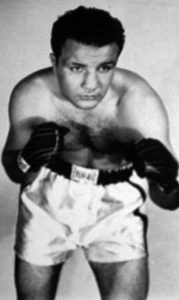
LaMotta turned professional at age 19 in 1941. During World War II, he was rejected for military service because of a mastoid operation on one of his ears.
As a middleweight in his first fifteen bouts, LaMotta went 14–0–1 (3 KOs) before losing a highly controversial split decision to Jimmy Reeves in Reeves’ hometown of Cleveland, Ohio. Chaos erupted after the decision was announced. Fights broke out around the ring and the crowd continued to boo for 20 minutes. The arena’s organist tried to calm down the crowd by playing the “Star Spangled Banner“.
One month later, LaMotta and Reeves fought again in the same arena. Reeves won a much less controversial decision. A third match between the two took place on March 19, 1943 in Detroit, Michigan. The first five rounds were close, though Reeves was struggling in the fourth. In the sixth round, LaMotta floored Reeves, who was only down for a second. Once the fight resumed, LaMotta landed a left on Reeves’ chin, sending him down face-first. Reeves was blinking his eyes and shaking his head as the referee counted him out.
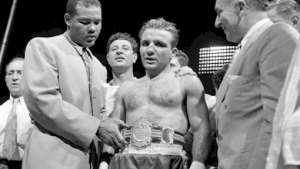
A 10 round rematch took place February 5, 1943, at Olympia Stadium in Detroit, Michigan. The eighth round was historic. LaMotta landed a right to Robinson’s head and a left to his body, sending him through the ropes. Robinson was saved by the bell at the count of nine. LaMotta, who was already leading on the scorecards before knocking Robinson out of the ring, pummeled and outpointed him for the rest of the fight. Robinson had trouble keeping LaMotta at bay. LaMotta won via unanimous decision, giving Robinson the first defeat of his career.

The victory was short-lived, as the two met on February 26, 1943, another 10 round fight, once again at Olympia Stadium in Robinson’s former home of Detroit. Robinson was knocked down for a nine-count in Round 7. Robinson later stated, “He really hurt me with a left in the seventh round. I was a little dazed and decided to stay on the deck.” Robinson won the close fight by unanimous decision, utilizing a dazzling left jab and jarring uppercuts. LaMotta stated the fight was gifted to Robinson because he would be inducted into the army the next day.
A fourth fight, the duo’s final 10 rounder, took place nearly two years after the third, on February 23, 1945, at Madison Square Garden, New York. Robinson won again by a unanimous decision.
LaMotta and Robinson had their fifth bout at Comiskey Park, Chicago, Illinois on September 26, 1945. Robinson won by a very controversial split decision contested over 12 rounds. The decision was severely booed by the 14,755 people in attendance. LaMotta later said in his autobiography that the decision was widely criticized by several newspapers and boxing publishers. Robinson said afterward, “This was the toughest fight I’ve ever had with LaMotta.”
REST IN PEACE CHAMP!!!!!!!!!!!!!!!!!!!




