
The Kroenke camp are big fans of Henry and Arsenal’s all-time leading goalscorer is particularly close to the influential Josh, who was appointed to the club’s board as a non-executive director in 2013. Henry is currently working as assistant to Belgium national team manager Roberto Martinez and has helped reinvigorate the likes of Romelu Lukaku and Eden Hazard.
The 39-year-old will pass his Uefa Pro Licence in time for the start of next season and has made it clear that his dream job would be to manage Arsenal.
Other than having played at the highest level for Arsenal, Barcelona and France, Henry worked under managers such as Wenger, Pep Guardiola and Aime Jacquet.
His France World Cup winning team-mate Zinedine Zidane is now manager of Real Madrid, while Guardiola took over at Barcelona in 2008 having never managed a senior team.
Kroenke Jr sees no reason why Henry could not take a similar route straight to the top and will make sure the former striker is among the candidates to replace Wenger if Arsenal are forced into a change.
During lengthy discussions, Kroenke Jr is believed to have already picked the brains of Henry on a range of subjects – including his plans to move into management.
Henry worked at Arsenal coaching the youth players as part of gaining his Uefa A licence and was offered a job with the Under-18s by the club until Wenger decided he could not combine the role with his work as a Sky Television pundit.
Wenger’s current contract expires at the end of the season and he is yet to sign a new deal with fears mounting, following the latest dismal defeat to Liverpool, that he will step down in the summer.
Thierry Daniel Henry is a retired French professional footballer who played as a forward, and the current second assistant manager of the Belgium national team. He played for Monaco, Juventus, Barcelona, New York Red Bulls and spent eight years at Arsenal where he is the club’s all-time record goalscorer. At international level he represented France and is his country’s record goal scorer.
Henry made his professional debut with Monaco in 1994. Good form led to an international call-up in 1998, after which he signed for the Serie A defending champions Juventus. A year later he signed for Premier League club Arsenal for £11 million. It was at Arsenal that Henry made his name as a world-class player. Under long-time mentor and coach Arsène Wenger, Henry became a prolific striker and Arsenal’s all-time leading scorer with 228 goals in all competitions. He won two league titles and three FA Cups at the club. In 2003 and 2004 Henry was runner-up for the FIFA World Player of the Year. He was named the PFA Players’ Player of the Year twice, and the FWA Footballer of the Year three times. Henry spent his final two seasons with Arsenal as club captain, leading them to the 2006 UEFA Champions League Final.
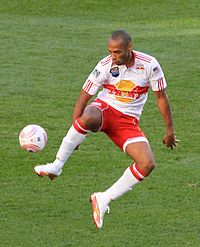
In June 2007, after eight years with Arsenal, he transferred to Barcelona for a fee of €24 million. In 2009, he was an integral part of the club’s historic treble when they won La Liga, the Copa del Rey and the UEFA Champions League. He went on to achieve an unprecedented sextuple by also winning the Supercopa de España, the UEFA Super Cup and the FIFA Club World Cup. In total, Henry has been named in the UEFA Team of the Year five times. In 2010, he joined the New York Red Bulls of Major League Soccer, winning the Eastern Conference title with the team in 2010. He returned to Arsenal on loan for two months in 2012. In 2013, Henry with the New York Red Bulls won the MLS Supporters’ Shield.
Henry enjoyed success with the French national team, winning the 1998 FIFA World Cup, UEFA Euro 2000 and 2003 FIFA Confederations Cup. In October 2007, he surpassed Michel Platini‘s record to become France’s top goalscorer. After amassing 123 appearances and 51 goals, Henry retired from international football after the 2010 FIFA World Cup. Henry was also one of the top commercially marketed footballers; he was ranked ninth in the world in 2006. In August 2016 he was appointed as the second assistant manager of Belgium’s national team, alongside head coach Roberto Martínez and fellow assistant Graeme Jones.
Henry is of Antillean heritage: his father, Antoine, is from Guadeloupe (La Désirade island), and his mother, Maryse, is from Martinique. He was born and raised in Les Ulis suburb of Paris which, despite sometimes being seen as a tough neighbourhood, provided good footballing facilities. As a seven-year-old, Henry showed great potential, prompting Claude Chezelle to recruit him to the local club CO Les Ulis. His father pressured him to attend training, although the youngster was not particularly drawn to football. He joined US Palaiseau in 1989, but after a year his father fell out with the club, so Henry moved to ES Viry-Châtillon and played there for two years. US Palaiseau coach Jean-Marie Panza, Henry’s future mentor, followed him there.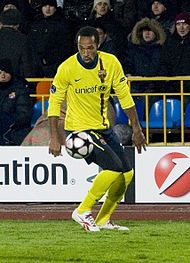
In 1990, Monaco sent scout Arnold Catalano to watch Henry, then at the age of 13 in a match. Henry scored all six goals as his side won 6–0. Catalano asked him to join Monaco without even attending a trial first. Catalano requested that Henry complete a course at the elite Clairefontaine academy, and despite the director’s reluctance to admit Henry due to his poor school results, he was allowed to complete the course and joined Arsène Wenger‘s Monaco as a youth player. Subsequently, Henry signed professional forms with Monaco, and made his professional debut on 31 August 1994, in a 2–0 loss against Nice. Although Wenger suspected that Henry should be deployed as a striker, he put Henry on the left wing because he believed that his pace, natural ball control and skill would be more effective against full-backs than centre-backs.
Henry was named the French Young Footballer of the Year in 1996, and in the 1996–97 season, his solid performances helped the club win the Ligue 1 title. During the 1997–98 season, he was instrumental in leading his club to the UEFA Champions League semi-final, setting a French record by scoring seven goals in the competition. By his third season, he had received his first cap for the national team, and was part of the winning team in the 1998 FIFA World Cup. He continued to impress at his tenure with Monaco, and in his five seasons with the French club, the young winger scored 20 league goals in 105 appearances.
Henry left Monaco in January 1999, one year before his intimate and closest teammate David Trezeguet, and moved to Italian Serie A club Juventus for £10.5 million. He played on the wing, but he was ineffective against the Serie A defensive discipline in a position uncharacteristic for him, and scored just three goals in 16 appearances.
Unsettled in Italy, Henry transferred from Juventus on 3 August 1999 to Arsenal for an estimated fee of £11 million, reuniting with his former manager Arsène Wenger. It was at Arsenal that Henry made his name as a world-class footballer, and although his transfer was not without controversy, Wenger was convinced he was worth the transfer fee. Brought in as a replacement for fellow French forward Nicolas Anelka, Henry was immediately moulded into a striker by Wenger, a move that would pay rich dividends in years to come. However, doubts were raised about his ability to adapt to the quick and physical English game when he failed to score in his first eight games. After several difficult months in England, Henry even conceded that he had to “be re-taught everything about the art of striking.” These doubts were dispelled when he ended his first season at Arsenal with an impressive goal tally of 26. Arsenal finished second in the Premier League behind Manchester United, and lost in the UEFA Cup Final against Turkish club Galatasaray.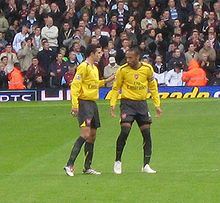
Coming off the back of a victorious UEFA Euro 2000 campaign with the national team, Henry was ready to make an impact in the 2000–01 season. Despite recording fewer goals and assists than his first season, Henry’s second season with Arsenal proved to be a breakthrough, as he became the club’s top goalscorer. Armed with one of the league’s best attacks, Arsenal finished runner-up to perennial rivals Manchester United in the Premier League. The team also reached the final of the FA Cup, losing 2–1 to Liverpool. Henry remained frustrated, however, by the fact that he had yet to help the club win honours, and frequently expressed his desire to establish Arsenal as a powerhouse.
Success finally arrived during the 2001–02 season. Arsenal finished seven points above Liverpool to win the Premier League title, and defeated Chelsea 2–0 in the FA Cup Final. Henry became the league’s top goalscorer and netted 32 goals in all competitions as he led Arsenal to a double and his first silverware with the club. There was much expectation that Henry would replicate his club form for France during the 2002 FIFA World Cup, but the defending champions suffered a shock exit at the group stage.
2002–03 proved to be another productive season for Henry, as he scored 32 goals in all competitions while contributing 23 assists—remarkable returns for a striker. In doing so, he led Arsenal to another FA Cup triumph (where he was man-of-the-match in the Final), although Arsenal failed to retain their Premier League title. Throughout the season, he competed with Manchester United’s Ruud van Nistelrooy for the league scoring title, but the Dutchman edged Henry to the Golden Boot by a single goal. Nonetheless, Henry was named both the PFA Players’ Player of the Year and FWA Footballer of the Year. His rising status as one of the world’s best footballers was affirmed when he emerged runner-up for the 2003 FIFA World Player of the Year award.
Entering the 2003–04 season, Arsenal were determined to reclaim the Premier League crown. Henry was again instrumental in Arsenal’s exceptionally successful campaign; together with the likes of Dennis Bergkamp, Patrick Vieira, Freddie Ljungberg and Robert Pirès, Henry ensured that the Gunners became the first team in more than a century to go through the entire domestic league season unbeaten, claiming the league title in the process. Apart from being named for the second year running as the PFA Players’ Player of the Year and FWA Footballer of the Year, Henry emerged once again as the runner-up for 2004 FIFA World Player of the Year award. With 39 goals scored in all competitions, the Frenchman led the league in goals scored and won the European Golden Boot. However, as was the case in 2002, Henry was unable to lead the national side to honours during UEFA Euro 2004.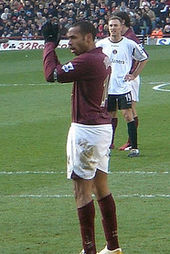
This dip in success was compounded when Arsenal failed again to secure back-to-back league titles when they lost out to Chelsea in the 2004–05 season, although Arsenal did win the FA Cup (the Final of which Henry missed through injury). Henry maintained his reputation as one of Europe’s most feared strikers as he led the league in scoring, and with 31 goals in all competitions, he was the co-recipient (with Diego Forlán) of the European Golden Boot, and is currently the only player to have officially won the award twice in a row (Ally McCoist also had two Golden Boots in a row, but both were deemed unofficial). The unexpected departure of Arsenal’s captain Patrick Vieira in the 2005 close season led to Henry being awarded club captaincy, a role which many felt was not naturally suited for him; the captaincy is more commonly given to defenders or midfielders, who are better-placed on the pitch to read the game. Along with being chief goalscorer, he was responsible for leading a very young team which had yet to gel fully.
The 2005–06 season proved to be one of remarkable personal achievements for Henry. On 17 October 2005, Henry became the club’s top goalscorer of all time; two goals against Sparta Prague in the Champions League meant he broke Ian Wright‘s record of 185 goals. On 1 February 2006, he scored a goal against West Ham United, bringing his league goal tally up to 151, breaking Arsenal legend Cliff Bastin‘s league goals record. Henry scored his 100th league goal at Highbury, a feat unparalleled in the history of the club, and a unique achievement in the Premier League. On the final day of the Premier League season, Henry scored a hat-trick against Wigan Athletic in the last ever match played at Highbury. He completed the season as the league’s top goal scorer, was voted the FWA Footballer of the Year for the third time in his career, and was selected in the FIFA World XI.
Nevertheless, Arsenal failed to win the Premier League title again, but hopes of a trophy were revived when Arsenal reached the 2006 UEFA Champions League Final. The Gunners eventually lost 2–1 to Barcelona, and Arsenal’s inability to win the league title for two consecutive seasons combined with the relative inexperience of the Arsenal squad caused much speculation that Henry would leave for another club. However, he declared his love for the club and accepted a four-year contract, and said he would stay at Arsenal for life. Arsenal vice-chairman David Dein later claimed the club had turned down two bids of £50 million from Spanish clubs for Henry before the signing of the new contract. Had the transfer materialised, it would have surpassed the then-world record £47 million paid for Zinedine Zidane.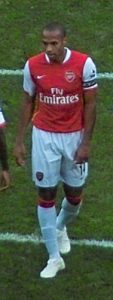
On 25 June 2007, in an unexpected turn of events, Henry was transferred to Barcelona for €24 million. He signed a four-year deal for a reported €6.8 (£4.6) million per season. It was revealed that the contract included a release clause of €125 (£84.9) million. Henry cited the departure of Dein and continued uncertainty over Wenger’s future as reasons for leaving, and maintained that “I always said that if I ever left Arsenal it would be to play for Barcelona.” Despite their captain’s departure, Arsenal got off to an impressive start for the 2007–08 campaign, and Henry admitted that his presence in the team might have been more of a hindrance than a help. He stated, “Because of my seniority, the fact that I was captain and my habit of screaming for the ball, they would sometimes give it to me even when I was not in the best position. So in that sense it was good for the team that I moved on.” Henry left Arsenal as the club’s leading all-time league goalscorer with 174 goals and leading all-time goalscorer in European competitions with 42 goals; in July 2008, Arsenal fans voted him as Arsenal’s greatest player ever in Arsenal.com’s Gunners’ Greatest 50 Players poll.
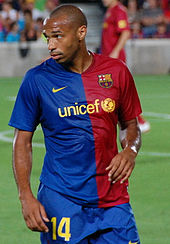
At Barcelona, Henry was given the number 14 jersey, the same as he had worn at Arsenal. He scored his first goal for his new club on 19 September 2007 in a 3–0 Champions League group stage win over Lyon, and he recorded his first hat-trick for Barça in a Primera División match against Levante ten days later. But with Henry mostly deployed on the wing throughout the season, he was unable to reproduce the goal-scoring form he achieved with Arsenal. He expressed dissatisfaction with the move to Barcelona in the initial year, amidst widespread speculation of a return to the Premier League. In an interview with Garth Crooks on BBC Football Focus, Henry described missing life “back home” and even “the English press.” However, Henry concluded his debut season as the club’s top scorer with 19 goals in addition to nine league assists, second behind Lionel Messi‘s ten.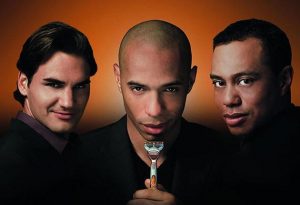
The golfer, tennis champion and former Premiership football star lined up for the Gillette Razor Commercial in 2008. Roger Federer, Tiger Woods and Thierry Henry in 2008 were three of the world’s most famous sports stars.
Henry went on to surpass this tally in a more integrated 2008–09 campaign, winning the first trophy of his Barcelona career on 13 May 2009 when Barcelona defeated Athletic Bilbao in the Copa del Rey final. Barcelona won the Primera División and UEFA Champions League soon after, completing a treble for the Frenchman, who had combined with Messi and Samuel Eto’o to score 100 goals between them that season. The trio was also the most prolific trio in Spanish league history, scoring 72 goals and surpassing the 66 goals of Real Madrid‘s Ferenc Puskás, Alfredo Di Stéfano and Luis del Sol of the 1960–61 season (this was later surpassed by Real Madrid trio Cristiano Ronaldo, Karim Benzema and Gonzalo Higuaín who scored 89 goals in 2011–12). Later in 2009, Henry helped Barcelona win an unprecedented sextuple, consisting of the aforementioned treble, the Supercopa de España, the UEFA Super Cup, and the FIFA Club World Cup.
After training with Arsenal during the MLS off-season, Henry re-signed for the club on a two-month loan deal on 6 January 2012. This was to provide cover for Gervinho and Marouane Chamakh, who were unavailable due to their participation in the 2012 Africa Cup of Nations. Henry made his second Arsenal debut as a substitute against Leeds United in the FA Cup third round and scored the only goal. In his last league game on loan, he scored the winning goal in stoppage time in a 2–1 win against Sunderland.
On 17 February 2012, Henry returned to Red Bulls to prepare for the 2012 season. His base salary of $5 million ($5.6 million guaranteed) made him the highest-paid player in the MLS—surpassing David Beckham, who had taken a salary cut for his last year with the Los Angeles Galaxy. In 2013, Henry’s base salary dropped to $3.75 million setting him behind Robbie Keane‘s $4 million base salary. With bonuses, however, Henry remained the highest-paid player with $4.35 million compared to Keane’s $4.33 million.
On 31 March 2012, Henry scored his first MLS hat-trick in a 5–2 Red Bulls win over the Montreal Impact. He was named MLS Player of the Month that same month. On 27 October 2013, Henry scored once and provided two assists in the last game of the season against the Chicago Fire at Red Bull Arena to help his team win 5–2 and become champions of the regular season. It was the club’s first major trophy in their 17-year history.
On 12 July 2014, Henry provided a goal and three assists in a 4–1 Red Bulls win over the Columbus Crew. With that effort he became the all-time assist leader for the New York Red Bulls with 37, surpassing Amado Guevara and Tab Ramos.
On 1 December 2014, it was announced that Henry had left the Red Bulls after four-and-a-half years at the club. On 16 December, he announced his retirement as a player and stated that he would begin working for Sky Sports as a pundit.
Although Henry played up front as a striker during his youth, he spent his time at Monaco and Juventus playing on the wing. When Henry joined Arsenal in 1999, Wenger immediately changed this, switching Henry to his childhood position, often pairing him with Dutch veteran Dennis Bergkamp. During the 2004–05 season, Wenger switched Arsenal’s formation to 4–5–1. This change forced Henry to adapt again to fit into the Arsenal team, and he played many games as a lone striker. Still, Henry remained Arsenal’s main offensive threat, on many occasions conjuring spectacular goals. Wenger said of his fellow Frenchman: “Thierry Henry could take the ball in the middle of the park and score a goal that no one else in the world could score”.
One of the reasons cited for Henry’s impressive play up front is his ability to calmly score from one-on-ones. According to his father Antoine, Henry picked up his precision shooting from watching his idol Marco van Basten. He was also influenced by Romário, Ronaldo and African star George Weah, a new breed of strikers in the 1990s who would also operate outside the penalty area before running with the ball towards goal. At his physical peak from the late 1990s to the mid 2000s, Henry’s ability to dribble past opponents with exceptional pace, skill and composure, meant that he could get in behind defenders regularly enough to score. In 2004, former Arsenal striker Alan Smith commented on Henry: “I have to say I haven’t seen a player like him. He’s an athlete with great technical ability and a tremendous desire to be the best.”
One of the reasons cited for Henry’s impressive play up front is his ability to calmly score from one-on-ones. According to his father Antoine, Henry picked up his precision shooting from watching his idol Marco van Basten. He was also influenced by Romário, Ronaldo and African star George Weah, a new breed of strikers in the 1990s who would also operate outside the penalty area before running with the ball towards goal. At his physical peak from the late 1990s to the mid 2000s, Henry’s ability to dribble past opponents with exceptional pace, skill and composure, meant that he could get in behind defenders regularly enough to score. In 2004, former Arsenal striker Alan Smith commented on Henry: “I have to say I haven’t seen a player like him. He’s an athlete with great technical ability and a tremendous desire to be the best.”
When up front, Henry is occasionally known to move out wide to the left wing position, something which enables him to contribute heavily in assists: between 2002–03 and 2004–05, the striker managed almost 50 assists in total and this was attributed to his unselfish play and creativity. Henry would also drift offside to fool the defence then run back onside before the ball is played and beat the offside trap, although he never provided Arsenal a distinct aerial threat. Given his versatility in being able to operate as both a winger and a striker, the Frenchman is not a prototypical “out-and-out striker“, but he has emerged consistently as one of Europe’s most prolific strikers. In set pieces, Henry was the first-choice penalty and free kick taker for Arsenal, having scored regularly from those positions.
In August 2016, Henry became second assistant manager of the Belgium national team, working alongside head coach Roberto Martínez and fellow assistant Graeme Jones.



