
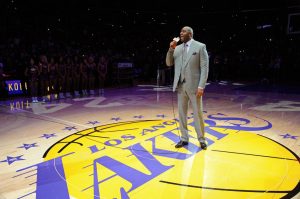
Johnson’s career achievements include three NBA MVP Awards, nine NBA Finals appearances, twelve All-Star games, and ten All-NBA First and Second Team nominations. He led the league in regular-season assists four times, and is the NBA’s all-time leader in average assists per game, at 11.2. Johnson was a member of the 1992 United States men’s Olympic basketball team (“The Dream Team”), which won the Olympic gold medal in 1992. After leaving the NBA in 1992, Johnson formed the Magic Johnson All-Stars, a barnstorming team that travelled around the world playing exhibition games. Johnson was honored as one of the 50 Greatest Players in NBA History in 1996.
In 905 NBA games, Johnson tallied 17,707 points, 6,559 rebounds, and 10,141 assists, translating to career averages of 19.5 points, 7.2 rebounds, and 11.2 assists per game, the highest assists per game average in NBA history. Johnson shares the single-game playoff record for assists (24), holds the Finals record for assists in a game (21), and has the most playoff assists (2,346). He is the only player to average 12 assists in an NBA Finals series, achieving it six times. He holds the All-Star Game single-game record for assists (22), and the All-Star Game record for career assists (127).
Johnson became a two-time inductee into the Basketball Hall of Fame—being enshrined in 2002 for his individual career, and again in 2010 as a member of the “Dream Team”. He was rated the greatest NBA point guard of all time by ESPN in 2007. His friendship and rivalry with Boston Celtics star Larry Bird, whom he faced in the 1979 NCAA finals and three NBA championship series, are well documented.
Earvin Magic Johnson has numerous business interests, and was a part-owner of the Lakers for several years and the Los Angeles Sparks in 2014. In February 2017 he became President of Basketball Operations for the Lakers.
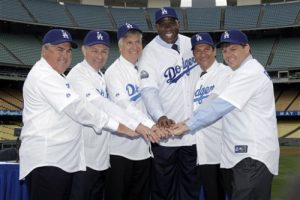
Together with Guggenheim, Johnson was also involved in the February 2014 purchase of the Los Angeles Sparks team in the WNBA. As such, in 2014 Johnson was named one of ESPNW’s Impact 25. He won the WNBA championship as the owner in 2016.
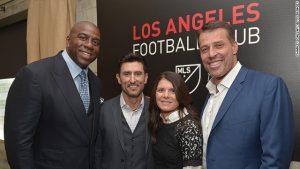

From the moment he came into the NBA as a point guard in a power forward’s body, Magic Johnson was a transformative figure. If he can build the Lakers into champions again, the way he did as a player, he will become the league’s ultimate Renaissance man.
Few athletes have re-invented themselves in as many ways as Johnson, who has treated each life moment as another no-look pass on a fast-break dunk. In the four decades since he and Larry Bird forever changed college basketball with their 1979 NCAA championship game, he has led the Lakers to five titles as a player, become a face for millions living with HIV, built a lucrative business empire and turned himself into a professional sports owner, even if he only bought a 2.3% share of the Los Angeles Dodgers.
By pushing his way into the Lakers while helping Jeanie Buss shove her brother Jim out of his role as president and firing general manager Mitch Kupchak, he has taken on the reconstruction of the NBA’s most glamorous franchise. This won’t be an easy task. The Lakers have tumbled from dynasty to disaster as Kobe Bryant’s career wound down. The current team has the league’s third worst record and a roster filled with young but flawed players.
Making the Lakers great again could be Magic’s greatest trick ever. It would create a legacy even bigger than the one LeBron James is making on and off the court as a superstar player, community builder and political activist. Johnson has a chance to be remembered not just as great player and businessman – but as the man who turned the Lakers back into the Lakers. He can write a résumé of lifetime accomplishments that no one may ever match.
But there is a risk in what Magic is attempting. Few superstar players have the patience to run sports teams. His model should be Jerry West, the Lakers’ Hall of Fame guard and silhouette of the league’s logo who built much of Johnson’s Showtime teams in the 1980s and put the pieces in place for the team’s later title runs under Phil Jackson.
West, though, built the Lakers through hard work, trading the star athlete’s cool for the grinder’s life of a basketball scout. West stumbled through the snow for February games in woebegone Midwest college towns two hours from the closest big airport. Most great players are not West. Most great players are not grinders. They rely too much on hunches gleaned from watching a workout or drawn through slipshod research. They guess on brilliance and usually miss.
Magic is clever enough to know he is too distracted to be a scout. He won’t be working the prospect circuit. On Tuesday evening the Vertical reported that Johnson hired as general manger, Rob Pelinka, the former Michigan star and agent to Kobe Bryant, James Harden and several other top NBA players. While the move raised eyebrows, remember that the Warriors have won one title and narrowly missed another with Bob Myers, also a former agent, as their general manager. Pelinka’s presence also guarantees Bryant’s return as a quasi-coach and adviser. It also means the man in charge of transactions will be someone familiar with the unique intricacies of the Lakers operation.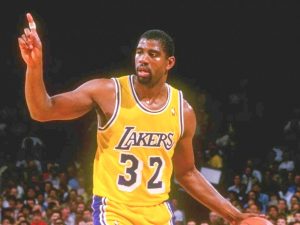
Yes, Magic is naive in thinking he can remake the Lakers by the sheer force of being Magic. His tweets over the years about the team and other NBA players are agonizing to read, both in their misjudgments of talent and overly simplistic platitudes. He will not be a master of the salary cap. He likely won’t be breaking down film. He’s never seemed interested in the less glamorous aspect of team management. As the team’s coach in 1993-94, he lasted just 16 games, growing bored of a team that wallowed their way to a 5-11 record under his management.
And yet do not dismiss Magic as a wealthy fool with a healthy ego and little sense. He has always had outstanding instincts both as a player and a businessman. Early in his career he was blasted for his role in ousting the team’s coach, Paul Westhead, though obviously he was right in championing Pat Riley for the job. Johnson brilliantly handled the announcement of his HIV infection in 1991 and taught the world to not fear a virus many did not understand. He invested in African American communities at a time when capitalists still stayed away, helping struggling neighborhoods to thrive. He even chose the right group to join in helping to buy the Dodgers.
The Lakers had grown stale under Kupchak and Jim Buss. Their frantic, last-second attempt to trade for DeMarcus Cousins over the weekend spoke to the chaos of their tenure’s final years. Buss’s obsession with center Andrew Bynum – the center who never seemed in love with the game – cost the franchise a shot at still being relevant. It was time for them to go.
Now the show is Magic’s again, as if this is 1984 once more and the Lakers are a flash of gold racing down the court with their leader flinging passes to open team-mates without even glancing their way. Back then, he didn’t need to see to be right. This won’t be like Showtime. The Lakers have long since moved from Inglewood to downtown. The Forum, the center of his power, will soon be the dot on the exclamation point of Stan Kroenke’s new football palace. It takes more than a good guess to win in the front office. He will have to know when to stop being Magic and let his basketball minds do their best work.
But like the guard in the big man’s body, Magic has always found greatness in ways others miss. He has a force of will like few humans alive. He is not afraid to take the chances others would never attempt. And if he does indeed lead the Lakers from their current darkness, he will have added another line of genius to a most remarkable body of life’s work.



