Raines is the 1986 NL batting champion, a seven-time All-Star, and four-time stolen base champion. He was elected to the Hall of Fame on January 18, 2017.
Raines was born in Sanford, Florida, to Ned and Florence Raines. He attended Seminole High School in Sanford. As a baseball player at Seminole, Raines stole home plate ten times. He also rushed for 1,000 yards in eight football games and set two school track and field records that lasted for several years.
The Montreal Expos selected Raines in the fifth round of the 1977 Major League Baseball draft. After debuting with six games as a pinch runner in 1979, he played briefly as a second baseman for the Expos in 1980 but soon switched to playing the outfield, and rapidly became a fan favorite due to his aggressiveness on the basepaths. In the strike-interrupted 1981 rookie season, he batted .304 and set a then Major League Baseball rookie record with 71 stolen bases, breaking the previous mark of 56 steals set by Gene Richards in 1977. Raines was caught stealing for the first time in 1981, after having begun his career with a major league record 27 consecutive successful stolen bases. Raines was the runner-up for the National League’s Rookie of the Year Award in 1981, which was won by Los Angeles Dodgers pitcher Fernando Valenzuela.
In 1983, Raines stole a career high of 90 bases, the second-highest total in franchise history, and scored 133 runs, a franchise record. He was named Expos Player of the Year in 1983, 1985, and 1986. In each season from 1981 to 1986, Raines stole at least 70 bases. He had a career-high .334 batting average in 1986, winning the National League Batting Championship. Raines maintained a consistently high on-base percentage during this period and a rising slugging percentage, reaching a career peak of .429 in 1987. Although he never won a Gold Glove Award, Raines was an excellent defensive player who led the National League with 21 assists in 1983 and, with 4 double plays, tied for the league lead in double plays by an outfielder in 1985.
Raines became a free agent on November 12, 1986, but in spite of his league-leading play, no team made a serious attempt to sign him. (During this period, the Major League Baseball owners acted in collusion to keep salaries down.) On May 1, 1987, hours after being permitted to negotiate again with Montreal, Raines signed a new deal with the Expos for $5,000,000 over three years, and a $900,000 signing bonus. In his first game back, on May 2, facing the Mets, although Raines had not participated in spring training or any other competitive preparation for the season, he hit the first pitch he saw off the right-field wall for a triple. Raines finished the game with four hits in five at-bats, three runs, one walk, a stolen base, and a game-winning grand slam in the 10th inning. Even without having played in April, Raines led the Expos in runs, walks, times on base, runs created, and stolen bases, in addition to batting average, on-base percentage, and slugging percentage. He also garnered MVP honors in the All-Star Game as he delivered a game-winning triple in the 13th inning. Raines would, in 1992, be one of dozens of players retroactively awarded collusion damages, receiving over $865,000.
Raines was traded to the Chicago White Sox on December 20, 1990, along with Jeff Carter and a player to be named later (Mario Brito would eventually be agreed upon), in exchange for Iván Calderón and Barry Jones.
In his first season in the American League, Raines hit for a .268 average but with a .359 on-base percentage; he was second on the team in runs scored as the White Sox finished the season in second place in the American League Western Division. His average improved in 1992 to .294 with a .380 on-base percentage. In 1993, despite missing nearly six weeks in April and May due to a torn ligament in his thumb he suffered while stealing a base, he managed to hit .306 with 16 home runs as the White Sox won the American League Western Division title.[20] In the 1993 American League Championship Series against the Toronto Blue Jays, Raines posted a .444 batting average and scored five runs in a losing cause.
On December 28, 1995, he was traded to the New York Yankees. With the Yankees, Raines received two World Series rings in 1996 and 1998. While his playing time was curtailed due to injuries, he contributed to a loose clubhouse atmosphere, and was productive when he came up to the plate.
In January 1999, Raines signed as a free agent with the Oakland Athletics. After a kidney biopsy on July 23, Raines was diagnosed with lupus and spent the rest of the year undergoing treatment and recovery.
Raines was signed by the Yankees as a free agent on February 1, 2000, but was released on March 23. On December 21, Raines was signed by the Expos, returning to the team that drafted him. At the Expos home opener in 2001, Raines received what he described as the longest and loudest standing ovation in his entire career, resulting in the pitcher walking him on four pitches. With limited playing time, Raines batted .308, with a .433 on-base percentage and a .436 slugging percentage.
Raines underwent surgery on May 31 due to a left shoulder strain, and spent time rehabilitating with the Expos Triple-A club, the Ottawa Lynx. On August 21, 2001, Raines and his son, Tim Raines, Jr., became the first father-son pair to play against each other in an official professional baseball game, when the Lynx played the Rochester Red Wings (the two had faced each other earlier in the year during spring training). Raines returned to the major league club on August 22.

On October 3, the Expos traded Raines to the Baltimore Orioles, thereby permitting Raines to play a major league game with his son. On October 4, Raines, Jr. played center field and Raines, Sr. played left field for Baltimore, becoming the second father and son team to play for the same major league team (a feat previously accomplished by Ken Griffey, Sr. and Ken Griffey, Jr.).
Raines played his last season in 2002 with the Florida Marlins. He is one of only 29 players in baseball history to date to have appeared in Major League baseball games in four decades.
In a 23-year career, Raines played in 2,502 games accumulating 2,605 hits in 8,872 at bats for a .294 career batting average along with 170 home runs, 980 runs batted in, a .385 on-base percentage and a .425 slugging percentage. He ended his career with a .988 fielding percentage. Raines stole at least 70 bases in each of his first six full seasons (1981–1986), leading the National League in stolen bases each season from 1981 to 1984, with a career high of 90 steals in 1983. Raines also led the National League in runs scored twice (1983 and 1987). Raines batted over .300 in five full seasons and over .320 from 1985 to 1987, winning the 1986 National League batting title with a .334 average. He also had six full seasons with an on-base percentage above .390.
With 808 steals in his career, Raines has the fourth-highest total in major league history, behind Rickey Henderson, Lou Brock and Ty Cobb. Until 2008, His career stolen base percentage (84.7%) was the highest in major league history for players with 300 or more attempts and he was successful on 40 consecutive steal attempts between July 1993 and August 1995, setting an American League record at the time (the record was broken by Ichiro Suzuki in May 2007, when he completed 45 consecutive steals).
Among switch hitters, Raines ranks sixth in career hits (2,605), fourth in runs (1,571), walks (1,330) and times on base (3,977), fifth in plate appearances (10,359), seventh in singles (1,892), doubles (430), total bases (3,771) and at bats (8,872), eighth in triples (113) and tenth in extra base hits (713). He holds Expos/Washington Nationals franchise records for career runs (947), steals (635), singles (1,163), triples (82) and walks (793), and was the seventh player whose career began after 1945 to retire with over 1,500 runs and 100 triples. His 1,966 games in left field ranked seventh in major league history when he retired.
From 1983 to 1987, Total Baseball rated him as one of the National League’s five best players each season. He is also listed as the 40th greatest non-pitcher in major-league history, one place ahead of Mark McGwire.
- Led the National League in batting average in 1986 (.334), the third switch hitter to win the NL batting title
- Led the National League in on-base percentage in 1986 (.413)
- Led the major leagues in stolen bases in 1981 (71) and 1984 (75)
- Led the National League in stolen bases in 1982 (78) and 1983 (90)
- Led the major leagues in runs scored in 1983 (133) and 1987 (123)
- Led the National League for times on base in 1983 (282), 1984 (281), and 1986 (274)
- Led the National League in outfield assists in 1983 (21)
- Tied for the National League lead in double plays by an outfielder in 1985 (4)
- Single-season record for plate appearances (731 in 1982)
- Single-season record for runs (133 in 1983)
- Career record for runs (947)
- Single-season record for triples (13 in 1985); shared with Rodney Scott and Mitch Webster
- Career record for singles (1,163)
- Career record for triples (82)
- Career record for walks (793)
- Career record for times on base (2,440)
- Career record for stolen bases (635)
- Career record for runs created (1,047)

- Raines was a National League All-Star in 7 consecutive seasons (1981–1987), and was named the Most Valuable Player of the 1987 All-Star Game.In 1981 the Sporting News named Raines the National League Rookie of the Year.Raines finished in the top 10 in voting for the NL Most Valuable Player Award three times (1983, 1986, 1987). He won a Silver Slugger Award as an outfielder in 1986 when he led the National League in both batting average and on-base percentage.Raines began his coaching career in 2003 as manager of the Class A-Advanced Brevard County Manatees affiliate of the Expos. He was promoted to the major league team in 2004 and was present for the Expos’ final games as a Montreal franchise.He was a coach for the White Sox from November 2004 until October 2006. During the 2005 World Series Championship season, Raines served as first base coach. During the 2006 season, he served as bench coach. He was the hitting coach for the minor-league Harrisburg Senators in 2007, but was not retained by the team for 2008. Raines signed a two-year contract to manage the Newark Bears of the Atlantic League, starting in 2009. After the 2010 season, the Bears moved to the Canadian American Association of Professional Baseball, and the team announced Raines would return to manage in 2011. In 2012, he was an assistant coach and Director of Player Development for the Bears. The Toronto Blue Jays hired Raines as a minor league baserunning and outfield coach in 2013.In 1979, Raines married Virginia Hilton, a classmate at Seminole High School. The couple gave birth to two children: Tim, Jr. (“Little Rock”), and André (“Little Hawk”). In high school he was a running back and has said he enjoyed football more than baseball at the time. On the matter between the two he reflects, “…in football I was a running back, so in the NFL my career would have probably lasted six or seven years and in baseball I ended up playing 23 years. In baseball you can play a long time so I think it’s better when you think of it in that way.”In 1985, Raines became a resident of Heathrow, Florida. In 2007, he moved to Estrella Mountain Ranch, a suburb of Phoenix, Arizona, and married Shannon Watson from Arnprior, Ontario. Raines had twin babies in 2010.
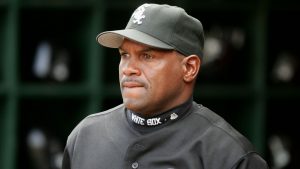
- 7× All-Star (1981–1987)
- 3× World Series champion (1996, 1998, 2005)
- Silver Slugger Award (1986)
- MLB All-Star Game MVP (1987)
- NL batting champion (1986)
- 4× NL stolen base leader (1981–1984)
- Montreal Expos #30 retired