RIO DE JANEIRO —Claressa Shields brought to Rio De Janeiro what everyone forgot about, her 1st Boxing Gold Medal, as The surprise was hidden in her pocket, something great, wonderful, and historic.
Claressa Shields stood on the podium on Sunday afternoon with the Olympic gold medal hanging around her neck that she had just won in women’s boxing. She reached into her pocket and pulled out her other gold medal, the one she won in London at the 2012 Games.
She slipped it over her head, looked down at both medals at her chest and let out a huge smile. It was historic on so many levels, something never seen before. Shields became the first U.S. boxer to win two gold medals.
“I’m the two-time Olympic champion!” Shields said, defeating the Netherland’s Nouchka Fontijn in the women’s middleweight (75-kilogram) division in a unanimous decision. “Oh my God, I feel like I’m dreaming. I don’t want to wake up right now. Please tell me I’m not dreaming.”
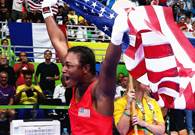
Shields talked to reporters still wearing tape on her hands, still covered in sweat. An American flag was draped around her neck. After the win, she did a cartwheel in the ring and ran around the arena with the flag. She let all her emotions show, something she didn’t do in 2012 and she has always regretted it. But not this time. She let it all out, pure unbridled joy and surprise.
“I worked so hard to be here,” she said. “Oh my god, this is crazy.”
This is a gold medal that represents survival. She escaped from poverty and a difficult childhood, bouncing between 11 homes by the time she was 12, turning all of that pain into a champion boxer.
“I want to inspire people,” she said, at a press conference where she was named the tournament’s most outstanding boxer. “I want to help people. I want to give people just a little bit of hope.”
After winning the gold in London, Shields did not get the money or fame or endorsements that she expected. She was perceived to be too strong, too tough and too fierce to be marketable and didn’t have a strong, experienced team behind her. After winning the gold medal, life didn’t get easier. When everybody thought Shields had become rich, there she was, going to a collection agency to pay her mother’s past-due water bill.
But she is older now, more mature and has control of her life. She split from her longtime coach, Jason Crutchfield, who had coached her when she started boxing at 11 and had been a father figure. She moved to the U.S. Olympic Training Center in Colorado Springs, Colo., staying in a dorm. The move was to simplify her life, trying to avoid the distractions in Flint, Mich.
“The difference is, now that I’m grown, I make a lot of decisions in my life,” Shields said, earlier this week. “I kind of protect myself. When I was 17, my coach would turn off my phone for me. He would ask me was I OK all the time. He would check on me constantly. He would see me on Twitter at 1 o’clock in the morning and he’d be like, ‘What are you doing? Go to bed.’
“Now, it’s like, I have to tell myself to do those things. Go to bed. Drink right. Eat right. Don’t stay up too late. Don’t stay in the shower for 20 minutes because it’s like a steam room. Get in there for 5 minutes and get out. I have to keep reminding myself these things. I’m telling myself to focus.”
With this win, Shields becomes the most successful U.S. Olympic boxer in history — the only one to win two gold medals. That should be applauded.
But she is not — not yet, at least — the most accomplished boxer in Olympic history. A pair of Cubans have won three golds each: Teofilo Stevenson dominated the men’s heavyweight from 1972 to 1980 and Felix Savon won three in a row from 1992 to 2000.
Shields is not the most accomplished female boxer in Olympic history, either. Here in Rio, Nicola Adams, who is called the “smiling Yorkshire assassin,” won the flyweight boxing division for Britain for the second straight Olympic Games.
Before the match, Shields came to a conclusion: there was no way Fontijn was going to win. Shields had beaten her two months ago for the world championship, and at that time, Shields had an injured hand and shoulder.
“She can’t outbox me,” Shields said. “She can’t out fight me. She can’t out think me, so how is she going to win? She will have to knock me out. But I knew she couldn’t do that.”
Late in the fight, Shields acted like she was begging Fontijn to fight. “I was like, ‘Hey, we are here to fight,’” Shields said. “‘If you think you can bet me, let’s go. I hit you with a hard shot, hit me back. I want to see if you can hit me.’”
“I’m a two-time Olympic gold medalist!” Shield said, gasping for air, trying to make it seem real. “I can’t believe I just said that.”
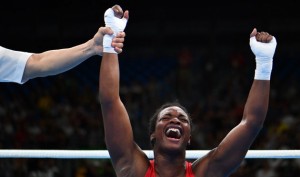
CONGRATULATIONS TO THIS GREAT 21YR OLD PHENOMENOM, CLARESSA SHIELDS.